
Shakespeare Club discusses women’s progress from 1976 to present
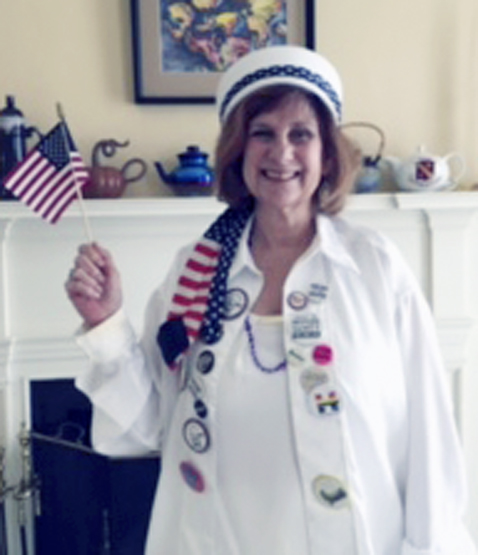
Judi Lutz Woods
The Fredonia Shakespeare Club met for its 18th regular meeting of the 2016-2017 year, hosted by Harriet “Skeeter” Tower at Lanford House. President Judi Lutz Woods presided, with 14 members present. Woods welcomed the club members to the 131st year of the club.
The topic for the year is “Women Artists, Authors, Designers & Entrepreneurs.” Woods presented her paper on “Women’s Progress from the International Year of the Woman 1976 to the present.” Her paper is summarized as follows:
“Never doubt that a small group of thoughtful committed citizens can change the world; indeed, it’s the only thing that ever has.”
Perhaps this concept is no better reflected than in the gatherings of women determined to make a difference. We saw this in the first women’s conference held in Seneca Falls, New York in 1848 that had the explicit purpose “to discuss the social, civil and religious condition of woman.” We saw it again most recently in the Women’s March in Washington, D.C. that attracted almost a million people, with an additional two million marching in cities and towns throughout the country. This march had the mission to ‘stand together in solidarity with our partners and children for the protection of our rights, our safety, our health, and our families — recognizing that our vibrant and diverse communities are the strength of our country.”
It also is reflected in an event that many might not even have heard of: The National Women’s Conference in Houston in 1977. Gloria Steinem has stated that this gathering “.. may take the prize as the most important event nobody knows about … one that transformed lives with the hope and ideas of what is possible.”
The idea for a national women’s conference grew from the United Nations declaration of International Year of the Woman in 1975. The declaration was later changed to the Decade of the Women, as much more than one year is needed to truly honor and address issues specific to half of the population. In observation of that, President Gerald Ford issued an executive order creating a National Commission on the Observation of International Year of Women. The commission was charged to make recommendations on promoting equality between the genders in the United States. Their final report is outlined in: To Form a More Perfect Union.
Inspired by her experience in Mexico at the UN conference on the Year of the Woman in 1975, Rep. Bella Abzug was determined to seize the opportunity to turn the work of the commission into a movement. She, along with fellow congresswoman Patsy Mink, introduced legislation to fund a national women’s conference. The bill had requested $10 million in funding, congress reduced it to $5 million (22.3 million in today’s dollars), but it was passed and signed into law by President Ford. The funds were to be used to have meetings in every state and U.S. territory to consider the report developed by the commission (to form a perfect union) and to elect delegates for a national conference on women scheduled for 1977. The hope of many feminists leaders was not only for the official goal, ‘to make recommendations that would remove remaining barriers to gender equality and improve women’s lives,’ but to build grassroots support for the women’s rights movement, expand and diversify its base and make women even more of a force in American politics. To this end, the acts itself “mandated that elected delegates have record of some involvement in groups which work to advance the rights of women as well as to reflect the full racial and ethnic diversity of their states.”
In addition to the 2,000 elected delegates, between 17,000 and 22,000 observers attended. In addition to the business of the conference, to develop a plan of action for Congress to address issues of concern to women, the conference also included art shows, film series, workshops, and even a child care center where 150 children ranging from eight months to 11 years were cared for while their parent attended the event.
In the weeks leading up to the convention, thousands of volunteer runners from 15 states carried a torch, the Torch of Freedom, from Seneca Falls New York, site of the first convention, all the 2,610 miles to Houston, Texas to open the second and only government-funded Women’s Conference in the USA. The torch was presented to first lady Rosalynn Carter, and former first ladies Betty Ford and Lady Bird Johnson. The conference was truly a non-partisan event.
Inside the Women’s Conference, debate and discussions were conducted on the floor addressing each of the 26 resolutions that had been developed in state and territory meetings. The 26 major topics considered by the delegates included: the arts and humanity, battered women, child abuse, child care, credit, disabled women, education, elective and appointed offices, employment, ERA, health, homemakers, insurance, international affairs, media, minority women, offenders, older women, rape, reproductive freedom, rural women, sexual preference, statistics and welfare. The only plank that failed to be approved was the call for the creation of a cabinet level position concentrating on women’s social policy issues. The only plank to pass unanimously was the one on credit.
There is much empirical evidence that supports the claim women have made progress in many economic, social and political arenas. For instance, the pay gap between men and women’s pay for similar jobs has gone from 59 cents for women to a man earning a dollar in 1977 to 80 cents compared to a men making a dollar in 2017 (still, that is 20 cents lower than men for doing similar work).
More women are in elected offices, management positions and leadership roles. We have made much progress on many of the specific issues brought forth in the convention, such as services for abused women, improved laws to combat sexual assault, sexual preference non-discrimination and non-discrimination in areas of credit, and other banking needs.
However, the most lasting impact of the convention is in the will and energy generated not only by those in attendance, but by the hundreds of thousands who watched on TV, listened on the radio, read in the paper and magazines. It was empowerment. Women have the power to unite together, even given our differences. We can be respectful, courteous, and productive in large groups and for serious purposes.
This was once again demonstrated at the Women’s March in D.C. when almost a million marched, side by side, not all with the same pressing issues, but united that we can indeed have a voice and that our voice will be heard. We have been striving for equality since before Seneca Falls convention … and that fight will continue … until every person, man, woman and child, are truly seen and treated as equals. For indeed, “Never doubt that a small group of thoughtful, committed citizens can change the world; indeed, it’s the only thing that ever has.”
The members were called to tea by Tower. Leanna McMahon assisted at the tea table.
This concludes this year’s presentations. The next meeting will be on April 27, where the club members will meet to celebrate Shakespeare’s birthday.