
Shakespeare Club hears about Norway wharf area
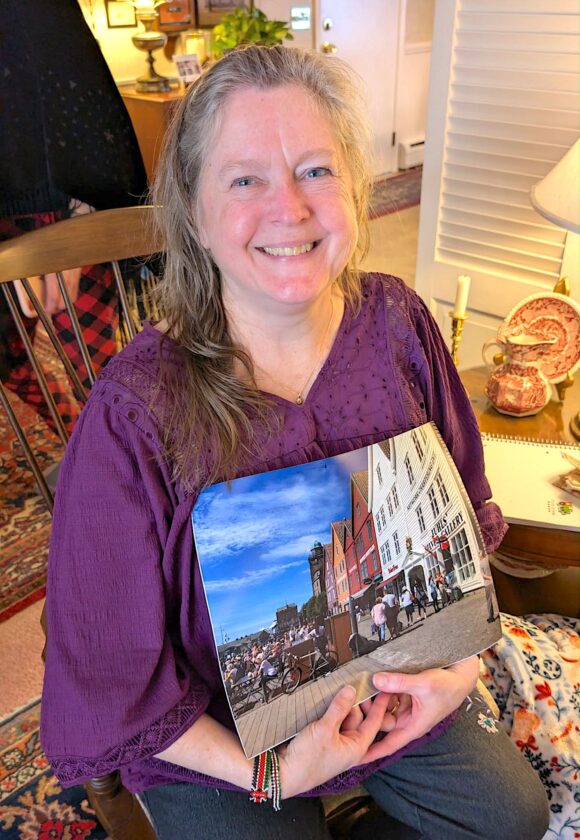
President Karin Cockram
A recent meeting of the 2025-26 season of the Fredonia Shakespeare Club was hosted at the home of Joan Larson. President Karin Cockram welcomed Club members to the meeting.
After a brief business meeting concluded, a paper by Cockram on “Bryggen” Bergen, Norway was presented. A summary of the paper follows.
Bryggen is the old wharf area of Bergen, Norway. It became an UNESCO World Heritage site in 1979 due to its “unique and exceptional testimony to a cultural tradition or civilization.”
Bryggen was originally established as a trading settlement by Norway’s King Olav Kyrre around 1070 CE. It is a beautiful city, surrounded by hills on three sides and easily accessible by water on the fourth. Bergen was the capital city for nearly two centuries and is now the second largest city in Norway.
In 1360, the economic powerhouse of the time, the Hanseatic League, decided to establish 4 overseas offices, choosing Bryggen as one of them. The League dominated the economy of Europe for more than 400 years and Bryggen was invaluable to the League, especially with its fish exports and extensive storage buildings for goods being traded between Iceland, Norway, and mainland Europe.
Bryggen has been nearly destroyed by fires multiple times, with the worst damage caused during the great fire of 1702 and again in 1955. Both times, the city was rebuilt on the original foundations and with as much historical accuracy as possible. The buildings are still constructed of wood and display a typical Medieval city structure. Sixty-two original buildings are still in use today. Bryggen is the only Hanseatic settlement still in use today.
During archeological excavations after the 1955 fire, archaeologists uncovered a huge number of Medieval artifacts, including 647 runic inscriptions which are now housed in the Bryggen museum. This historical testimony is what made Bryggen a World Heritage site.
Bryggen is now combining the respect and appreciation needed to preserve the history of the area with modernization that allowed continued growth and vibrancy for the current community. The old architecture remains. The charming passageways between buildings are lovely and colorful, and the business model continues to thrive. Nowadays, you will find more artists and craftspeople than fish and cereal markets, yet this writer imagines the small businesses and friendly merchants would be familiar to the Hanseatic and Norwegian businessmen from centuries ago.
Community News
Scholarship opportunity announced for area students
State Sen. George Borrello announced that the New York Conference of Italian American State Legislators is ...
SUNY to host ‘Douglass Day’ event honoring statesman
SUNY Fredonia will participate in a nationwide program honoring the legacy of 19th century author, orator and ...

Archie’s Airport Diner ready to open next month
Opera House to screen Oscar-nominated ‘Hamnet’
Shakespeare Club hears about Norway wharf area
Coming up …
THURSDAY, FEB. 12 Thursday Knitting Group Trinity Episcopal Church, 11 Day St., Fredonia, 9:15 to 11:30 a.m. ...