Roman Spas the topic of club meeting
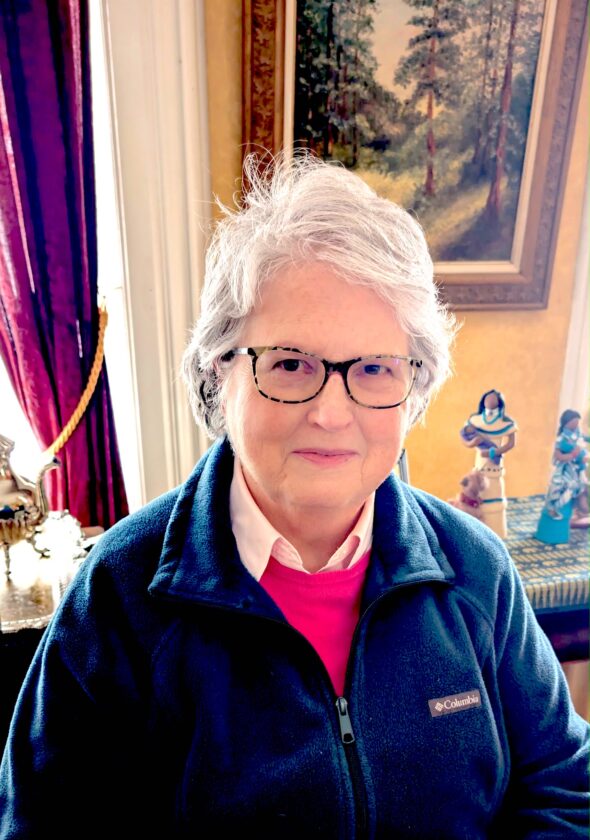
Sharon Klug
A meeting of the Fredonia Shakespeare Club’s 2025-26 season was earlier this month at the home of Judi Lutz Woods
After a brief business meeting Sharon Klug presented her paper on the Roman Spas in Bath, England. Here’s her presentation:
“In my mind, the Roman baths in the British city of Bath were a majestic feat of workmanship (true) and a remarkable historic site that flourished through time(decidedly not true). As the Romans spread across Europe they built roads, aqueducts and sewage systems, as well as spas at mineral springs in France, Germany, Austria, Hungary and Great Britain. Remnants of the European sites exist, but the baths and temple surrounding the British city now known as Bath have been beautifully reconstructed and are recognized as a UNESCO World Heritage Site. The waters were known long before the Romans arrived in the first century BCE. Legend has it that Bath was founded by Bladud, the eldest son of the legendary Celtic King Lud and mentioned as the father of King Lier, immortalized by Shakespeare. Bladud built a temple in 863 BCE by the sacred healing spring, and dedicated it to the goddess Sul. He named the place Caer Bardum.
“This was without doubt a major Celtic place of power from the Bronze Age. The Romans controlled Britain from 42 to 410 AD. They had a genius for appropriating local deities and blending them with their own gods. The Celtic goddess Sul became Sulis Minerva, goddess of wisdom, invention, and the martial arts and crafts, or Minerva Medica, guardian against disease. Messages to Sulis Minerva, scratched onto metal, known as curse tablets, have been recovered from the Sacred Spring by archaeologists. The Romans transformed the Celtic druids’ grove into one of the major therapeutic centers of the West and called it Aquis Sulis. The hot springs were said to cure gout, rheumatism and multiple other illnesses.
“Always interested in luxurious indulgence and relaxing as intently as they conquered and built, the Romans revered Spring just as the Celts had done; by the 3rd century its stunning temple and luxurious bathing complex attracted pilgrims from throughout the Roman world. The Romans devised a system of stone channels that directed the waters to their baths and funneled the overflow back to the river. Engineers drove oak piles into the mud to provide a stable foundation and surrounded the spring with an irregular stone chamber lined with lead. But then the Romans and the glory disappeared. In 410 Britain fell prey to the Picts, Saxons, Scots, Irish.
“The Romans, embroiled in the first sack of Rome, were unable and unwilling to save their westernmost outpost and their former health resort. After this, the baths fell into disrepair and were eventually lost as a result of rising water levels and silting. Over the next thousand years, the city became a center for wool trading. Commerce, not spas, became its focus during the Medieval era. In 1574 Queen Elizabeth I visited Bath, during royal progress through the western counties. She helped boost the city’s reputation as a spa town and started rebuilding the cathedral and hospitals. In the next 250 years, Bath’s population multiplied by well over ten times during the course of the 18th century. The Georgian era, 1714-1837, saw a remarkable period of renewal and growth for this resort spa city. Palladian buildings of local limestone included the Crescent, the Circus, and the great gathering places, the Pump Room and Assembly Room. Construction of the grand buildings next to the abbey led to the rediscovery of the long-buried Roman baths. Although still mostly buried under magnificent Georgian streets, the reconstructed Roman ruins in Bath are unsurpassed. In 2021 the Roman baths were added to the UNESCO Great Spa Towns of Europe.
“Today, Bath has over 6 million yearly visitors, making it one of the 10 English cities visited most by overseas tourists. Attractions include the spas, including the luxurious modern Thermae Spa, canal boat tours, the Royal Crescent, Bath Skyline and the Parade.”
Community News
Roman Spas the topic of club meeting

‘Ruthless! The Musical’ up next in Mainstage Series
Coming up …
TUESDAY, FEB. 24 Chautauqua County Board meetings BWB Building, Second floor board room, 201 W. Third St., ...

Volunteers, sponsors needed for March 20, April 4 Audubon Lights
Coming up …
MONDAY, FEB. 23 Triple P-Positive Parenting Program/support group for parents of children ages 0 to 12 Jamestown ...