
Trending
President Joan Larson opened the third meeting of the 2023-24 Shakespeare Club at Barlow's Mill hosted by Sharon Klug with 15 members in attendance. Secretary Lisa Mertz called the roll, followed by the minutes from the Oct. 26 meeting, which were approved as written. Cheryll Rogers reported no change in the treasury.
On Dec. 7, the seventh meeting of the 2023-24 Shakespeare Club was opened by President Joan Larson at the Fredonia home of Lucile Richardson with 15 members present. Mertz called the roll, then read the minutes from the Nov. 30 meeting Treasurer Cheryll Rogers reported on the club's finances.
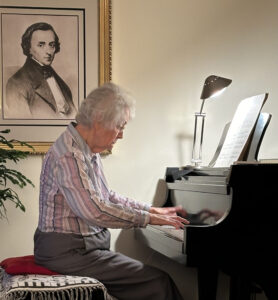
After the club's business meeting, Larson read pianist and Chopin scholar Lucile Richardson's paper, after which tea was served by Mrs. Richardson.
Frederic Chopin was a major composer amongst the stunningly many who were born during the beginning of the Romantic era: Mendelssohn (1809-1847); Chopin (1810-1849); Schumann (1810-1856); Liszt (1811-1886); Verdi (1813-1901); Wagner (1813-1883). Amongst these, Chopin however stands alone in that he was the only composer who composed almost exclusively for the piano.
His total immersion in the piano led to two historic developments in the unleashing of his creative powers. One, through his composition, it led to an unparalleled exploration and discovery of a myriad of tonal colors and expressive possibilities for this instrument, but just as consequentially, two, it initiated a new and truly radical physiological approach to "the Art of Piano Playing," to the technical development and command of the piano itself -- to major advances in pianistic technical abilities.
As a result of Chopin's innovations, a host of future composers, such as Liszt, Scriabin, Debussy, MacDowell, and Rachmaninoff were more freely enabled and inspired to express their individuality in their writing for the piano.
Chopin's creativity in writing for the piano was greatly enhanced by the extremely rapid technological improvements in his instrument -- in power, scope, expressive capabilities, and in its mechanical efficiencies (largely at the instigation or insistence of composers). They proved to be critical and indispensable factors in his every creative thought. The ultimate refinement with which he capitalized on them defined his writing style.
The sheer brilliance of his writing can be defined by: an extremely adventuresome treatment of harmony, engaging a world of extreme chromaticism (Brahms and especially Wagner bear his unmistakable influence); a consummate mastery of melodic invention, drawing inspiration from Italian opera, not only from its ultra-singing quality (the Bel Canto style) but from its highly rapid, florid, coloratura features, while avoiding virtuoso display for its own sake; a very striking emotional range and sense of drama gleaned no doubt from opera but also kindled by the traumatic emotional experiences of his youth, those associated with the suffering of his Polish brethren during their long-term domination by the tripartite powers; a natural concept of rhythm, that commonly called rubato, its inherent flexibility derived from one's emotional response to the music; and finally his meticulous search for perfection and his profound attention to detail.
A comprehensive list of Chopin's complete body of works, while not prolific, covers a wide range of genres, and features numerous formal innovations. His mazurkas and polonaises bear the stylistic stamps of their roots in the Polish national culture; his nocturnes create a mood and form significantly beyond those of their predecessors; his 24 preludes demonstrate Chopin's reverence for Bach in their sequence of key centers, and in addition to being highly varied in mood, serve as treasured materials for teaching purposes. His larger scaled works (amongst them the scherzos, ballades, sonatas, and concertos) are significant for both their innovations in form and their lyrical dramatic contexts.
Chopins 24 Etudes are in a category by themselves, putting into sharp focus his groundbreaking innovations in the cultivation and expansion of piano technique. Composed to demonstrate his pedagogic concepts, they elevated the "breed" to an unprecedented level, becoming works of both enormous pianistic imagination and esthetic substance. As "concert" Etudes, they provided the groundwork for its adaptation by many subsequent major composers. The latter's concepts were of no less significance in contributing to his rich historical legacy than his authorship of a new school of composition.
Richardson played the following selection of varied works on her piano to provide a cross-section of Chopin's contributions to the piano literature: The Etude in E major, Opus 10, No. 3; The Nocturne in D flat major, Opus 27, No 2; The Ballade in f minor, Opus 52.