Fiery Knight had many shining lessons
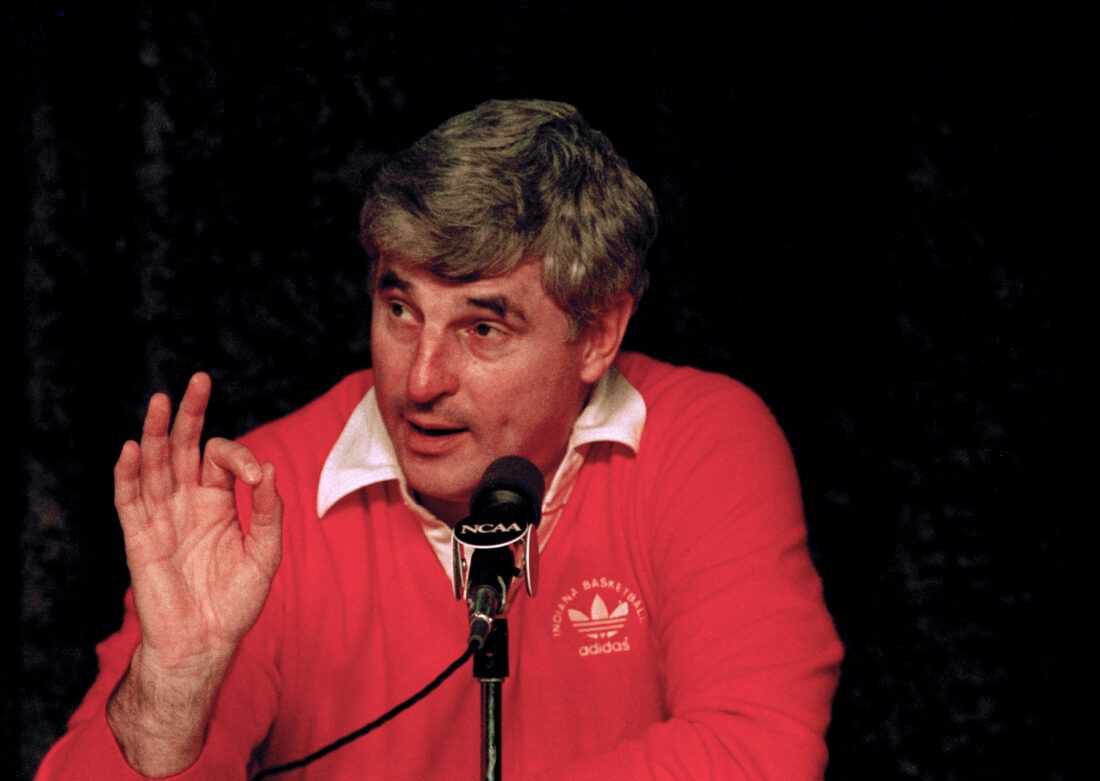
Indiana coach Bobby Knight gives the okay sign at a news conference following his team's victory over Syracuse for the NCAA Championship in New Orleans, La., Mar. 30, 1987. (AP Photo/Bob Jordan)
-
- Indiana coach Bobby Knight gives the okay sign at a news conference following his team’s victory over Syracuse for the NCAA Championship in New Orleans, La., Mar. 30, 1987. (AP Photo/Bob Jordan)
I first met Coach Knight in 1966 at a basketball clinic at Erie Community College. At that time, he was the head coach at Army and his assistant coach and current Duke Legend “Coach K,” Mike Krzyzewski, who he had also coached at Army.
About 100 coaches showed up for the clinic, which in those days cost $25. After about an hour into the clinic, we all knew we had come to the right place. His presentations on any topic, his organization and attention to detail were amazing. During the course of the clinic, he used ECC players for demonstration. Most of the ECC players were lackadaisical during the first few drills. After a tongue-lashing about a defensive drill, their improvement was 60% better. Coach Knight’s point to the group was, “if you, as a coach, keep letting your kids keep making the same mistakes over and over, and you don’t tell them, then how the hell are they supposed to improve?
On a charging drill, that included taking the charge, and giving the charge, Knight introduced the concepts of advantage and disadvantage, which he would use in all of his lectures over the next twenty years.
At the end of October, coaches like myself, Bob Uszacki, Bob Muscato, Curt Raymond, Dutch Leonard, would go to the Binghamton basketball clinic on Thursday through Saturday for a three-day clinic.
All the top college basketball coaches in the country would lecture on certain topics. Coaches like John Wooden (UCLA), Dean Smith (North Carolina), Coach Knight (Indiana), Al McGuire (Marquette), Dick Vitale (Detroit), Hubie Brown (at that time assistant at Duke).
It was at this point that I struck up friendships with Coach Knight and Al McGuire of Marquette University.
One morning I came down from my room for breakfast and Coach Knight was by himself at the breakfast table. I got my coffee and buffet breakfast and sat down with Coach. The day before he had given a lecture on the Indiana passing game. I complimented him on what he had given to the group, then spread a napkin out and stated, “now Coach, can you give me some of the real stuff on the passing game?”
He drew out on the napkin what hadn’t been presented on the podium. That clinic was going into the 1974-75 season, which Coach Knight thought with his kids, Wilkerson, Scott May, that they had a chance to win it all. Unfortunately, after a 35-0 season, Indiana was beaten by Kentucky in the semifinals. Kentucky, at that time, was a powerhouse. But in the finals they were upset by Don Haskins’ Texas Western team.
I remember when we returned to Binghamton the next year, Knight was there again and stated to the group that with all his players back, they would accept nothing but a national championship. Indiana went 36-0, won the 1976 NCAA Championship and had a 71-1 record. Without a doubt, that team was the best college “basketball team” I have ever seen to this day. Six of his players were drafted into the NBA. But more than that, if you, as a coach, wanted to learn complete team basketball, watch Indiana, especially on defense.
I didn’t see Coach Knight the next few years at Binghamton, because he started doing clinics all over the country and out of the country. Coach Bob Muscato (Cardinal Mindszenty High) went to his clinic in Toronto with Coach Joe Jusko (Cardinal Mindszenty, South Alabama, Roberts Wesleyan, Fredonia State). This was a 2 ½-day one man clinic done by Coach Knight. Coach Muscato stated it was tremendous and he worked hard at every session for the clinicians. Coach Knight’s philosophy was simple. Coaches of today should turn the volume up when presenting this. “I’m the coach, you are the players. You as a player only know what you want, not what you need. I have studied, and continue to study basketball as to what makes a successful team. You measure your success by how many points you score and I measure yours by how many defensive stops you get – how many rebounds, loose balls, and assists for your teammates. As you can see, we have a lot to agree on as we go through a season!”
If you are a basketball fan and you are into this article, it’s easy to see why we as high school coaches became better coaches in preparation for a team to compete against anyone, no matter how good they were or not.
Knight was able to take average college basketball players and get them to play above their ability against many teams that had McDonald’s All-Americans. Not only did Indiana under Coach Knight compete, but they won many Big Ten championships. Yes, his 1981 team won the NCAA again, as did his 1997 team on Keith Smart’s jump shot. What he taught us over the years did not appear in self-help coaching books.
Our paths crossed again when my best friend and basketball coach Uszacki and I went to Virginia University for a two-man, two-day coaching clinic with Coach Knight and Coach K. It was amazing that he remembered what had happened at Utah in 1979. Coach Bill Hughes and I attended the NCAA finals at Salt Lake City. I was his assistant coach at UB and that was a highlight, going to my first NCAA championship. Coach Knight was there and I introduced him to Coach Hughes. Michigan State won the game and the NCAA championship. During the day I was at the game and didn’t check my messages from home. My wife, Karen, was 7 months pregnant with our fourth child, but had urged me to go to the game because she still had 2 months until delivery. I was shocked when I read the messages which stated, ” Call home, concerns baby;” “Urgent, wife may be in delivery.”
I was supposed to go the coaches’ dinner, but now I was frantic to get home. As I was coming down the stairs, Coach Knight was coming up and he asked what the hurry was. I explained the situation and Coach said, “Then get the hell out of here quick.”
I did and she delivered Jeffrey, who spent two months at Children’s Hospital.
To make a long story short, when we met Coach Knight in Virginia, as we were having coffee, he stated, “Coach, what did your wife have?”
I stated a boy, He smiled and stated, “Maybe a future Indiana athlete.”
This is the type of Bob Knight that most people never knew. Or the guy that raised over $4 million for Landon Turner, one of his ex-players that was paralyzed from the neck down in an automobile accident; or a recruit that didn’t come to Indiana, but had no medical coverage in a severe accident. Coach Knight paid all the medical and hospital bills because of how highly he thought of him. Also, Coach Knight raised millions of dollars for the Indiana University Library and one season didn’t take a salary because he stated that he coached poorly. So, when all you remember is a chair-throwing incident, weigh this against 3 NCAA championships, over 900 wins and turning out over 60 Division 1, 2 and 3 coaches and also professional NBA coaches. Thank you, Coach, for treating us as you would want to be treated. I will always attribute much of my success to Coach Muscato, my high school and varsity coach as his assistant and your clinics and friendship. You now have the best seat in the arena.
Mike Tramuta is a Rational Emotive Behavior Therapy counselor.
Sunday Lifestyles

Healing with Horses: Getting moving always a healthy choice
Brocton school art part of regional show
BROCTON — The Brocton Central School Art Department is thrilled to announce 82 students whose artwork is ...

On the cutting edge: County junior eyes future in heavy equipment
Brocton celebrates top students

Grasslands, meadows and prairies