Geometric shapes in nature
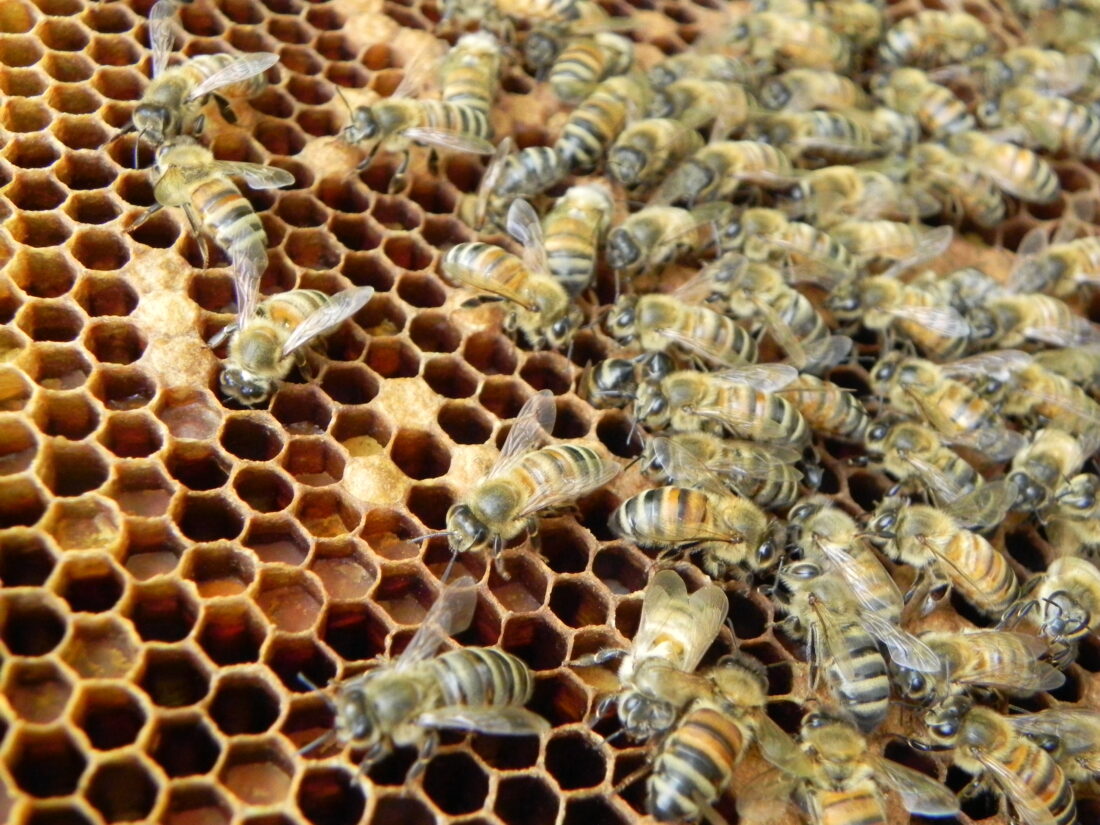
Photo by Jeff Tome Bees on hexagonal honeycomb.
-
- Photo by Jeff Tome Bees on hexagonal honeycomb.
-

- This flower has 21 petals, a Fibonacci number, and the center of the flower also curves in a Fibonacci spiral.
Hexagons are a unique but familiar shape. They can perfectly tessellate, which means that they can line up and fill a space without leaving gaps. The most natural hexagon, and the image that likely comes to mind, is honeycomb. Honeycomb is created by female worker bees who secrete wax from their abdomens and then chew it up until it is soft and malleable before shaping it. Hexagons are the perfect shape for bees because it is the shape that is able to store the most honey per section without leaving gaps between them like circles would.
Winter is home to another hexagon commonly found in nature. It might not seem obvious to the naked eye, but snowflake have six sides or points. Snowflakes are created by water droplets freezing into ice crystals. All snowflakes have a hexagonal base in one form or another; however, the temperature and humidity that a snowflake freezes at can influence the shape it takes, whether it’s flat and simple, pointy and needlelike, or lacy in appearance.
Although they melt quickly when coming into contact with a surface, it is possible to catch individual snowflakes for observation. If you go outside during a light snow while wearing a dark jacket you will be able to see them land on your sleeve, catching a glimpse before they inevitably melt away. Heavier snows might cause the snowflakes to clump together before you have a chance to observe an individual snowflake, however I encourage you to experiment and see how many different snowflakes you can find.
Another mathematical phenomenon often found in nature is fractal patterns. Fractals are patterns that repeat themselves at different scales, for example snowflakes have a fractal nature to them. If you draw a triangle then add a new, smaller triangle to the midpoint and continue repeating this pattern, after a few iterations you will end up with a familiar snowflake shape. Some tree branches are another example of fractals in action, with branches splitting in two, then those offshoots splitting again and again, changing a single trunk into many branches, and eventually tiny twigs.

This flower has 21 petals, a Fibonacci number, and the center of the flower also curves in a Fibonacci spiral.
Fractal and selfsame patterns often appear in nature because it is much easier and less resource intensive to repeat the same simple pattern on different scales than to make many unique ones over and over.
The Fibonacci sequence is a common mathematical pattern in nature found within all kinds of organisms. In mathematical terms, a sequence is a set of numbers with a rule that determines what the next number will be. For example, 1, 2, 3, 4, 5… is a sequence where the rule is to add one. The Fibonacci sequence is slightly more complicated. To create the next number, you must take the current number in the sequence and add it to the previous number. It starts as 1, 1, 2, 3, 5, 8, 13, 21, but can go on infinitely. Numbers in this sequence tend to pop up in plants a lot, whether it’s the number of petals on a flower or the arrangement of scales on a pinecone. This pattern of numbers is efficient in filling space. So, for example, arranging seeds using numbers in the Fibonacci sequence lets plants use space more effectively, increasing the number of seeds one plant can hold while simultaneously reducing energy cost. This can be seen in the curve of seeds on the head of a sunflower.
In addition, these numbers can also be arranged to form a spiral that follows the golden ratio, 1:1.618, and this Fibonacci spiral is just as commonplace in nature. For example, you can see this shape in the spiral of a snail’s shell or the curl of a fiddlehead fern.
While it may seem easy at first to separate math from nature, the truth is that in many aspects they are intertwined. Although “natural” shapes have their own appeal, finding geometric patterns and designs in nature reveals its own form of beauty.
Audubon Community Nature Center builds and nurtures connections between people and nature. ACNC is located just east of Route 62 between Warren and Jamestown. The trails are open from dawn to dusk and birds of prey can be viewed anytime the trails are open. The Nature Center is open from 10 a.m. until 4:30 p.m. daily except Sunday when it opens at 1 p.m. More information can be found online at auduboncnc.org or by calling (716) 569-2345.
Sunday Lifestyles
Discovery in Turkey part of area Shakespeare club meeting
The Fredonia Shakespeare Club recently was hosted at the home of Joyce Haines. President Karin Cockram welcomed ...
Winter scavenging come from air, ground
Driving down a winter road, the easiest bird to spot is sometimes the bird that’s in your path. It’s not ...
There’s benefits, negatives to uninformed
In a recent article I described a group of individuals objecting to the use of the Hindu Arabic Base 10 Number ...

Top School 5 students named
Common ground today still shaky
Wheel. Compass. Dam. Lynchpin. Toilet. Dynamite. Roadmap. This list represents a tiny fraction of the inventions ...