Getting a second chance: Volunteer shelters keep helping furry friends
I think it’s fair to say, without quoting Hamlet, that on any given day, humans are either noble and virtuous beings close to God, or we are wasteful, cruel, self-consumed creatures.
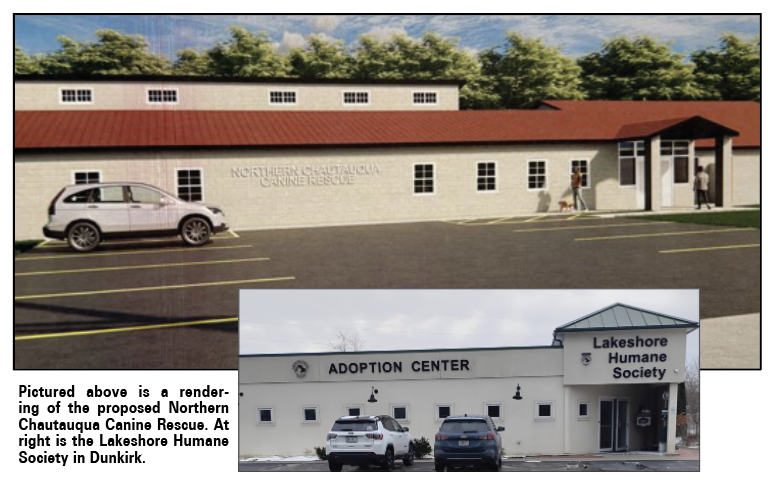
The good people who work at the local animal shelters – The Lakeshore Humane Society and Northern Chautauqua Canine Rescue – know a thing or two about both the beauty and the ugliness of human behavior. I sat down recently with Rock Vallone, president of LHS in Dunkirk, and Mark Swanson, volunteer and construction advis3r for NCCR in Westfield to learn more about these humanitarian operations.
Both organizations are entirely volunteer based. They are not for profit, and are able to exist only because of the good will of benefactors and the dedication of a team of volunteers who believe in the sentience of animals and strive to protect them from abuse.
LHS was organized in 1969 as the Dunkirk Humane Society. At the time it was largely a program to help find foster homes for stray animals. Vallone, a recent Fredonia State graduate from New York City, got on board in 1980 at the behest of volunteer Gail Clark. He began sheltering cats and dogs in his old barn on Newell Road.
A couple years later, a woman named Carol Dudley came to Vallone’s barn to adopt a cat (by this time he had accumulated more than 30, along with several dogs). Mrs. Dudley was greatly moved by what she witnessed there and pledged a large amount of money to help develop the society.
Other donors followed, including Purina, and local business owners pitched in to provide all kinds of services.
Notably, Rick Peebles provided the architectural design for the new facility, and Bill Cocose sold the property on Chestnut Street for a dollar.
More recently, Betty Jacka, a woman from Chicago summering in Van Buren, called the shelter about a stray cat. Her experience with the shelter somehow blossomed in her heart, and in her will she endowed the shelter with a large sum of money that was sorely needed.
The Westfield facility also has its roots in a barn, this one on Hard Scrabble Road. Founded and developed by Jann Balsano and Marcia Okerlund in 2000, the shelter was later moved to a vacant machine shop on Gale Street. Jordon Nichols now serves as the director of operations. After retiring as Vice President of Mayshark Builders, Mark Swanson got involved in 2012 as a dog-loving volunteer. It wasn’t long before his background in construction would come into play in order to meet the newly released New York State licensing requirements.
As anyone who has dealt with New York’s bureaucratic systems knows, application processes are cumbersome. The shelters were hit with a slew of new regulations regarding building specs and volunteer training procedures. Both facilities are in the process of compliance.
The majority of animals received by the shelter were abandoned. Typically they’re spotted by neighborhood residents who report them to animal control officers or the shelters. In some cases, owners who can no longer care for their pets come to the facility requesting they be put up for adoption. The most common case is that of stray cats, many of them feral. The situation is exacerbated because cats reproduce so rapidly.
Getting animals spayed or neutered is the main mission for both shelters. Because many low income pet owners can’t afford surgery, the shelters offer financial assistance and rely on the help of local veterinarians. Also, because the facilities implement a No Kill policy, meaning they do not euthanize, they are careful not to take in overly aggressive animals that pose a threat to people or other dogs. All new animals are vaccinated for rabies and treated for any evident health issues.
To close, I’ll relate a couple stories from the shelters. Swanson recalls a recent horrific incident in Piketon, Ohio, where someone named Wyndan Skye was arrested and convicted for severe animal cruelty. Discovered on his property were 40dead, unburied dogs and nearly 80 emaciated ones, along with an undisclosed number of farm animals. The surviving dogs were sent to shelters across state lines. Two came to Westfield. At first they were extremely withdrawn and untouchable, but with gentle care they opened up and were subsequently adopted. Says Mark, “We receive periodic reports of their success and adventures in their new world.”
Vallone shared this: In 2008, LHS took in an abused/neglected dog that was emaciated, and very ill. His neck was severely infected and swollen. It was discovered that he had been chained for so long that the skin on his neck had grown over the metal collar. He was dubbed Chance. The wonderful part of Chance’s story was that she was given a second chance. He was adopted into a loving home and lived to the ripe old age of fifteen.
For the dedicated volunteers at the animal shelters, these are the kinds of stories that make their jobs worthwhile. To learn more, and perhaps find an antidote to a bad day, visit the Lakeshore Humane Society and the Northern Chautauqua Canine Rescue online. Or better yet, make a plan to visit in person, and maybe even take the chance to help make the world a better place.