Keeping warm in the winter
-
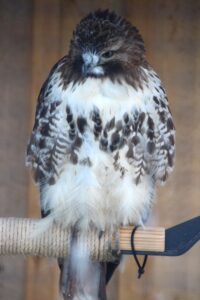
- Red-tailed Hawks and other birds fluff their feathers to trap warm air.
-
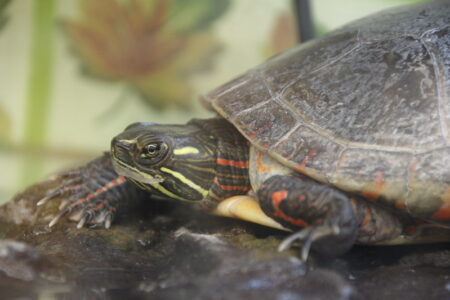
- Painted turtles can freeze as babies and then go through brumation as adults.
-
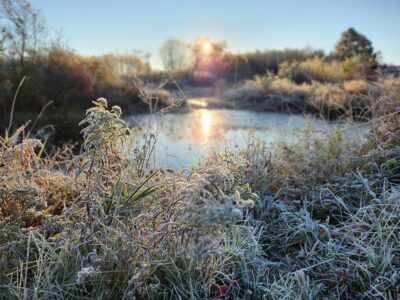
- Frost over a pond in the morning.
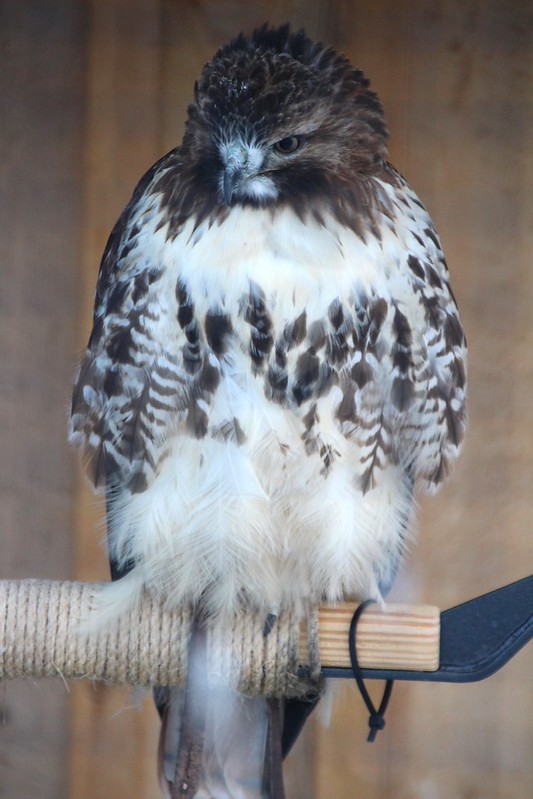
Red-tailed Hawks and other birds fluff their feathers to trap warm air.
The sunlight reflecting off the frost that covered the trees was a beautiful and welcome sight last week. The glittering hillsides made for a stunning commute and walk into work. The only downside is that my face was freezing.
Winter weather in most of the northern U.S. has a reputation for being pretty brutal. Cold, ice, and snow line up to either make a winter wonderland or a slog through the elements depending on who you talk to and how much snow they had to shovel that morning. This scenery has the potential to be anything from a serene and hushed, crisp white forest to a slushy mess. Either way, the temperatures still have to be cold enough to cause this collection of frozen water in all of its forms.
When these below freezing temperatures hit, we can bundle up or head inside a heated building to warm up, but the living things outside must adapt in other ways.
Some animals do just say goodbye to the colder temperatures and migrate south to warmer weather. Often these animals are ones who eat either insects and invertebrates or nectar from flowers, and they can’t store up enough fat to take them through the winter. Since their food sources start disappearing once fall sets in, these animals must travel somewhere that will have invertebrates and flowers out in abundance even in January.
Not every animal has the ability or the need to travel, and those that stick around employ multiple strategies to keep themselves alive through the oscillating winter temperatures. Many of these methods often mirror our own ways of staying warm.
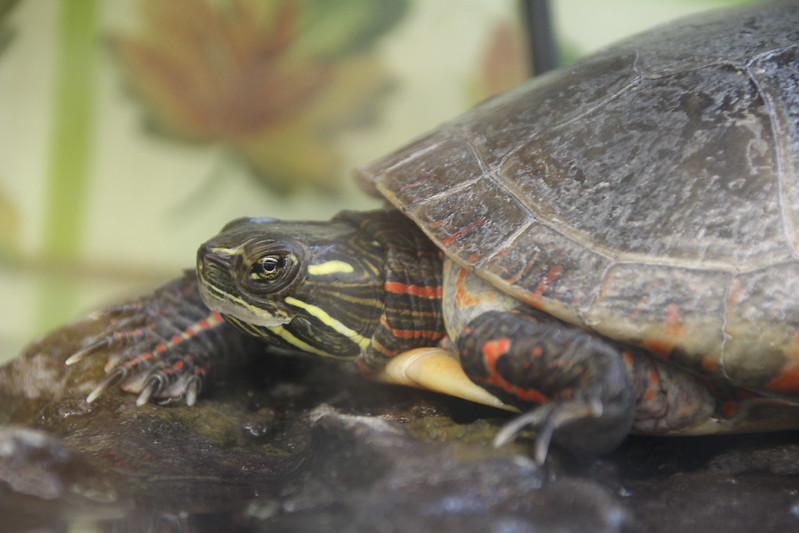
Painted turtles can freeze as babies and then go through brumation as adults.
There are three non-releasable birds of prey currently residing at Audubon Community Nature Center. Each time I put my winter coat on to walk outside so I can feed them, I pass by the Red-tailed Hawks in their aviaries. These birds live in their aviaries year round, and just like many hawks and other birds in the wild, they remain outside throughout the winter. It’s not to say that western NY’s winter birds are immune to the cold. They just have other methods or built-in ways to keep warm.
Every time I pass by them, I see some of these strategies. They may not have coats and hats, but similar to my insulating winter jacket, they have insulating feathers. You might notice some birds look particularly round when it is cold outside. Birds can puff up their feathers to trap warm air inside their soft, downy feathers, while their outer contour feathers overlap to protect them from the outside air sneaking in.
Animals will also use what they find in nature to keep warm. In the morning, you can often see the Red-tailed Hawks, both in our aviary and in the wild, sitting in the spots exactly where the sun is shining down. In opposition to the summer, when they can head into the covered spots to stay cool and out of the sun.
Right now, there are also masses of geese flocking on Chautauqua Lake despite the ice. Geese, ducks, gulls, and other birds employ something called countercurrent heat exchange to keep their unfeathered feet from freezing to the point of damage. Basically, the artery carrying warm blood from the body into the foot is directly next to the vein carrying colder blood from the foot into the body. The proximity allows the warm arterial blood to transfer heat into the cooler veins, keeping everything at a more even-keeled temperature and making sure the main part of the body doesn’t have to expend the energy to warm up cold blood.
Birds are not the only animals that have ways to keep warm. The plethora of deer and rabbit tracks out in the snow show us that plenty of mammals are still active out there. Mammals can grow a thicker undercoat to keep them insulated and warm in the snow and cold. Longer guard hairs on top keep the snow sitting on the fur so they stay dry, rather than melting into their undercoat.
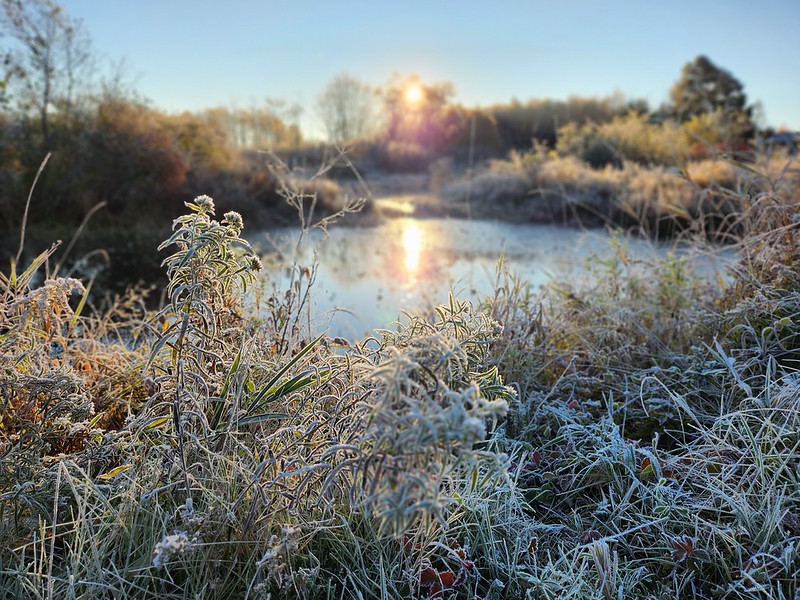
Frost over a pond in the morning.
Mammals will also find warmer areas to hang out. Grey squirrels crawl inside of tree cavities. Deer bed down under evergreens. Some mammals, like groundhogs and chipmunks build underground tunnels under the snow and topsoil, insulating them from the cold above.
One of Audubon’s bird nest boxes is currently full of Deer Mice, huddling together in the nest they built. And of course, sometimes this insulated space is in a barn or your home, which is great for the animals, but less desirable for the humans already occupying those spaces.
I feel like the reptiles and amphibians are often forgotten about in the winter because they are out of sight and thus out of mind. They are cold-blooded, so they cannot regulate their body temperatures the way we can. In order to survive these cold temperatures, many of them enter a state called brumation, which is basically their version of hibernation. They burrow under logs, the topsoil, or the mud on a pond bottom, and they slow their metabolic processes way down. Painted Turtles slow their breathing rate down so much that they can spend the winter entirely submerged and get all of their oxygen through their skin, so long as oxygen remains available in the water.
Mudpuppies are an oddball. They are actually active throughout the winter. On the other end of the spectrum, Wood Frogs can freeze almost completely through, but their liver and heart will remain in a supercooled state. Then, the next spring, they can unfreeze from the inside out.
The ways animals survive changing temperatures is as wide and varied as they are. They may not be as comfortable as I am in this heated room with my warm drink, but they are doing everything they can to survive and make it to next spring, and they are doing it in some really fascinating ways.
Audubon Community Nature Center builds and nurtures connections between people and nature. ACNC is located just east of Route 62 between Warren and Jamestown. The trails are open from dawn to dusk and birds of prey can be viewed anytime the trails are open. The Nature Center is open from 10 a.m. until 4:30 p.m. daily except Sunday when it opens at 1 p.m. More information can be found online at auduboncnc.org or by calling (716) 569-2345.
Sunday Lifestyles
Keeping warm in the winter

Rocco finally starting to feel at home

Gowanda star students
A secret longing of the heart
PVCS announces first quarter honor, merit students
SOUTH DAYTON — Pine Valley Central School has announced its honor and merit rolls for the first quarter of the ...