
Barn Cats
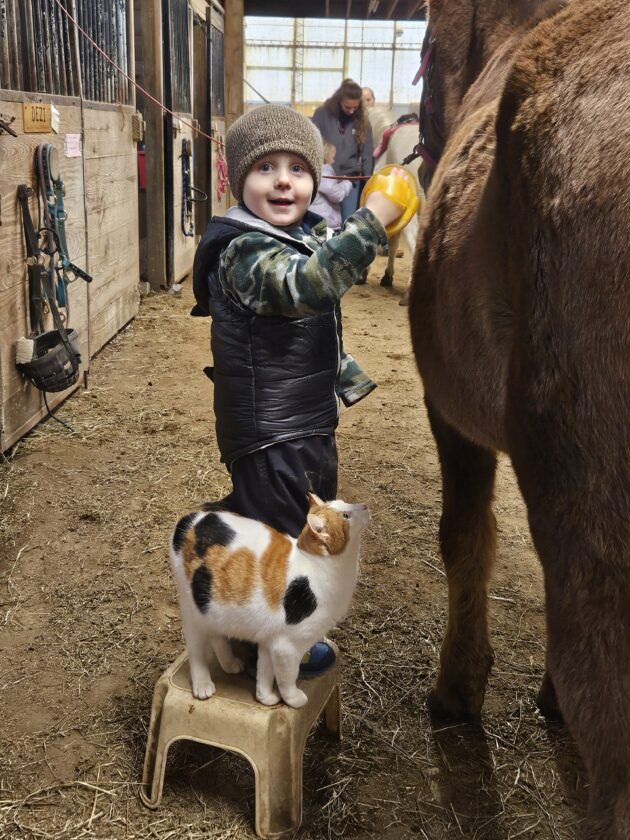
Braelin the cat assisting Griffin Chicora getting his horse ready to ride.
You can’t have a horse barn without barn cats. They simply appear, and then they stay! They seem to bond easily with the horses. It takes more time to trust humans.
First priority is to catch them, so they can be spayed or neutered and vaccinated. Then they’re released back to the barn to do what barn cats do best — keep the mice population in check. It doesn’t take them long to become “domesticated”, every single one of them showing up promptly at feeding time (before the food is gone).
One semi-feral cat appeared to be pregnant. She was fast, darting in to eat and then vanish, not letting anyone close to her. After four weeks being very skittish, she appeared at the barn with four kittens, already about five weeks old. She must have decided it was a good place for her kittens, now ready to be weaned. From that day on, she didn’t run.
The kittens were already feral and ran to hide whenever anyone came near. Eventually we could pet them while they were eating and get them used to touch. Once handled, they were easy to tame — and so was their mother. We could then take them for their shots. Kittens are like a magnet. The riders were drawn to the kittens and quickly rearranged their priorities.
They ran to the grain room first to check on the kittens before even saying hello to their horses. Sometimes lessons were only completed after solemn promises that there would be more kitten time afterward.
All the cats thrived on the attention. So did the people who came to our barn. One of the group homes brought a woman in a wheelchair to watch her housemate ride. When she arrived, one or two cats would hop right onto the tray of her wheelchair and curl up, purring contentedly. She had cerebral palsy and limited arm movement, but she loved their presence, and her smile brought pure joy. They stayed with her the whole time she was there.
On trail rides, the cats often tagged along, following the horses. Sometimes they’d disappear into the brush along the trails, only to pop out dramatically just as the horses approached. The riders squealed with delight, often with deep belly laughs. The horses never flinched. They knew the cats and I’m sure they were aware of their presence before we were.
The most memorable was Bob, the cat, named after the movie with Bill Murray.
Bob was always the center of attention. If given the chance, he’d jump right onto a horse and ride along with a student — unless we shooed him off for being a distraction. Occasionally, though, we let him stay, because Bob was a powerful motivator for the rider. If he wasn’t riding the horse, he’d climb the instructor and perch on her shoulder during the lesson. watching everything. More than once, he was found asleep in a stall, stretched comfortably across a horse’s back as if it were the most natural bed in the world.
One day I noticed scat in the grain room. It was odd, since the cats usually went outside. If inside, they were all litter trained. I cleaned it up. The next day, there was more. This went on for two weeks. I thought we had another feral cat. Then I caught a faint whiff of skunk–nothing overpowering, just enough to make me wonder if one of the cats had been sprayed.
The mystery solved itself one afternoon when, as riders groomed horses in the aisle, a large, beautiful skunk came prancing down the barn aisle like he owned the place. He was not even bothered by people, and the horses didn’t even react. He simply strolled through. Everyone froze. The horses were clearly already acquainted with him.
After ushering riders and observers safely out of the way, the skunk settled under the Pepsi machine. We called a wildlife officer, who connected us with a trapper. He arrived quickly, carrying a three-foot piece of PVC pipe baited with apple and peanut butter. He explained that once inside the pipe, the skunk wouldn’t be able to lift his tail–and therefore couldn’t spray. He warned it might take days.
After riders left and before chores were even finished that evening, the skunk wandered back into the grain room and right into the trap following the scent of the apple and peanut butter. The trapper was stunned that the skunk was already in the pipe. I told him I suspected the skunk had already made this his home and knew exactly when feeding time was. He promised to release him far away so he wouldn’t find his way back.
The barn cats remain a treasured part of our therapy programs. If someone isn’t engaged with a horse, they’re usually petting or playing with a cat, who greet everyone who comes to the barn.
Because in the end, our barn cats do more than catch mice. They bring laughter, companionship, and healing touch, as they rub their heads against us with a purr that vibrates more naturally than a tuning fork.
Volunteer orientation is Saturday, Jan 31 from 12-2. Call the barn to register at 716 326-4318. Soup Supper Fundraiser is Saturday, Feb 7 from 5-7 at the Westfield United Methodist Church.
Sunday Lifestyles
New Horizons Band to begin spring session
Lake Shore Bank awards Small Business Recovery grant to WMH
Barn Cats
Ten Commandments of math always equates
I received excellent math instruction growing up in Fredonia. After three years of middle school math with Roger ...
Top Brocton students highlighted
Brocton Elementary School recognized students who were chosen as Students of the Month representing grades K-5. ...
Nothing is ever as simple as 1+1
I am enjoying filling in for my good friend and former colleague Pete Howard as he takes a little break from ...