Solid as a rock: A boulder’s journey by bridge to cemetery
As WRITTEN By EBER L. RUSSELL, 1950
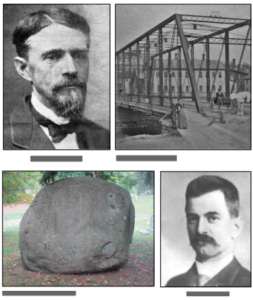
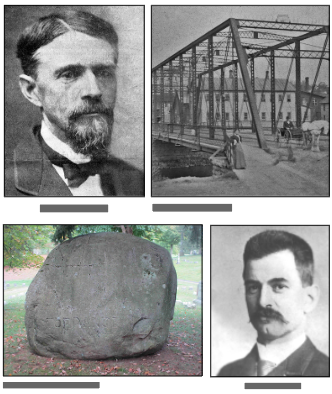
We must also tell the saga of the removal of the wooden covered bridge, the building of the present one in 1889, and the test of its strength in 1890. The upper works of the old bridge were easily removed and when that was done there lay six sixteen-inch square, 158 foot long pine timbers, weighing 8,400 lbs. each or a little over four tons each. Ansel Conger, with one not too heavy ox team dragged them off through the dirt and left them so that both doors of the old engine house were blocked all summer. Fortunately there was no fire.
The contractor on the new bridge, Groton Bridge Co, had made a bet with someone in town that he could finish the bridge on a certain day. The bridge was done on the day but the last pin was missing, presumably stolen so he would lose the bet. He was not to be beaten though, for he went to the foundry and found a piece of steel exactly the right size and finished his job on time.
The test of the bridge came about in this way. Cyrenius Torrance, one of the leading citizens of Gowanda, had made a request of his two sons, (Jared) Sidney and Lewis, that a certain granite boulder be placed on the family lot of Pine Hill Cemetery as a monument.
Cyrenius was a great uncle of Robert Torrance. He died in 1888, but it was not until 1890 that Sidney was able to organize matters so that the wish could be fulfilled.
The stone lay where there is now a small grove of hemlocks on the last curve before getting to the four corners on the way to Perrysburg — west of the S-curve on Route 39, before the intersection of Route 39, Jolls and Stafford Hill roads. On being dug out so that the boulder could be measured it was found to weigh 18 tons. It would be no chore at all today to move such a weight with present day equipment, but back in 1890, it was pretty much a hand proposition.
As best as we can tell now from our own and the memories of some older people, Sidney Torrance secured the services of William Smith with his capstan or windlass, stout cables, and rollers, Uri Clark and one horse and the young strength of Fred and Burt Hawkins. A cradle was built under the stone, then by laying down heavy hardwood planks (elm, we believe) and putting the rollers between, passing the hand line of a heavy set of rope blocks around the drum of the capstan, hitching the team to the sweep of the windlass, and driving them “round and round,” the stone was moved at a not much faster rate than a good healthy snail could walk.
They could not go the short way [east on Route 39] for there was a very frail wooden bridge over the gulf where there is now a fill [on the S-curve above Metcalf Creek, next to Ada Gabel’s], so they went up to the four corners [Route 39, Jolls and Stafford Hill] and down onto Jamestown Street [turning left onto Stafford Hill Road, then down the hill, across Maltbie Road, and down West Hill Street to Jamestown Street].
By the time they reached the new bridge, popular fear was aroused to such a point that the Road Commissioners of both counties had forbidden Sidney from putting the stone across. At that time the bridge was supposed to have a capacity of only 9 tons, and the boulder weighed 18. Torrance knew the highway law however, and in addition had a telegram from the Groton Bridge Co. which read, “Put the stone across, we will guarantee the bridge.” They planned to get to work the next morning before daylight so as to cross over without interference, but the whole town “smelled a rat” and was on hand to see the fun. By the time the Commissioners arrived, the stone was well on its way to Pine Hill Cemetery, where it rests today, a fitting monument to a great man, a great family and the men who put it there. Scarcely a day passes now but that a twenty ton or heavier load goes over the bridge and nobody bats an eye. The poor old lady is sixty-one years old, too. There used to be a sign, “$25 fine for crossing this bridge faster than a walk.” Not even heavy loads slacken speed noticeably.
… and an addition to Eber Russell’s account:
Thurmont, Md.
March 27, [19]50
Hello Eber –
Would like to make a little change in your history of the moving of the Torrance boulder.
A[lfred]. H. (Doc) Fess dug out the boulder, jacked it up, put 2 hewed beams under it, and made a cradle like an overtruss bridge. Timbers were beech or oak, 12 inches square and about 36 ft. long, bolted and braced with ¾ in. rods. Fess, after loading boulder onto the frame work, hooked on the frame, after putting large rollers under it, and started up the hill towards the four corners, something gave away and the outfit rolled back below where it started from, and nearly tipped over.
After some time, Mr. [Jared] Sidney Torrance hired Mr. William Smith, Uri (Ti) Clark and his horse (Dutch) and my Brother Burt and I, and we and no one else moved the boulder. Three different men have tried to tell me that they moved the stone, but after I told them what kind of a liar they was, they admitted they were liars.
The capstan on which the rope was wound belonged to Wm. Smith, also rollers, etc.
After we moved the stone to the four corners and turned east toward Gowanda, we were afraid that the stone might run down the hill past Dana Stafford’s farm and make us trouble. We went to the G. A. [Gowanda Agricultural] Works wood shop and cut out some wheels of maple, 2 in. plank, by putting enough plank together we had solid wood wheels, 18 in. in diameter with a 12 face. We borrowed a 6 in. steel shaft of Mr. Keyes, placed it in front end of our timbers, with the wheels on the end like wagon wheels. We let down the rear end and let it drag.
My Brother and I with fence posts on our shoulders with end on ground, acted as brakes to regulate movement down hill, it worked real good. One little thing I remember was the name of the man who was foreman on the erection of the Catt. Creek bridge, Fred Foote. Frank Kammerer thought it a great joke to introduce John Schoos, Mr. Foote, and May Stockings. (Ti) Clark sat under the capstan and tended the rope as it wound around, the horse went around on the sweep, horse was kept barefooted, so calks [or cleats] on horseshoes would not cut rope. Burt and I carried plank, rollers, etc. Wm. Smith was boss and he made a real good one.
While we were moving down Dana Stafford’s hill, Mr. and Mrs. Torrance came up to see how we were moving. Mrs. Torrance found a real nice large bunch of grass to sit on. She moved quick, it was an ant nest.
When we got where the boulder rests now and was letting it down to the ground, the jack screws slipped and caught Smith’s and my feet under the timber. We couldn’t get away as our feet were pushed so deep into the ground we couldn’t pull them out. We had no relief until Burt and Clark raised the timber again.
This is a true picture of the whole affair and don’t let anyone tell you they were on the job.
— Fred E. Hawkins