
Author’s work on novel only part of the story
I spent the last two months writing a novel for young adults (and all adults). It was an intense process in which I put in eight hours a day either sitting in front of the computer or walking around, pacing the house, or outside in the neighborhood or at the college or the lake. The process involves a whole lot of talking out loud to myself (and my dog).
Sometimes I’m speaking in the voice of my story’s narrator, which I’m trying to keep consistent in terms of point of view, tone and style. Sometimes in a character’s voice. But a lot of the time it’s just me talking to myself, either cursing because an idea flops, or celebrating a stroke of genius.
If you ever get serious about writing a novel, one of the first decisions you’ll have to make is about how much of the ending to your story should you know before you start writing it. There are two main schools of thought regarding this. Edgar Alan Poe was of the opinion that the story will be best executed if the writer has predetermined the outcome, and that the form and structure of the writing should lead to that end. Other more modern writers like Virginia Woolf, Ken Kesey, and Jack Kerouac have created from a more pliable, stream-of-consciousness mindset, allowing for a more natural, uninhibited flow of ideas that may determine an outcome-in-the-making.
I try to follow the more structured mode. The interconnections among character, setting, and a theme rooted in compassion are essential for me to become invested emotionally within a story, whether it’s my own or someone else’s.
Although I don’t follow a prescribed story map, and I do allow for deviations and spontaneous changes as the story grows, I feel obliged to take on a grand theme of some sort. A story shouldn’t end just because the action stops, or because a big question has been answered. There should be a sense that there is more to come, and that a bigger question has now been asked.
“Rosebud Dreamworld” is a coming of age story about a troubled teenage boy trying to overcome the loss of his father. I took on the two big ideas here. One is the process of finding the pieces and the glue to put a broken life back together. The other is a deep probe into the linear and cyclical nature of time. To frame the novel, I chose a junkyard setting, with metaphors and motifs arising from the old obsolete machines. Here is the prologue to “Rosebud Dreamworld.”
The seasons are stubborn. They do not change willingly. The green heart of summer does not welcome autumn, knowing her brief, blazing glory cannot replace the sun’s warmth. Autumn clings to the last single quaking leaf until impetuous winter tears it from her bony grasp. Heedless of storms above, winter slumbers beneath its white blanket among roots and rocks only to be awakened by noisy birds and a rekindled sun. And the wild burgeoning of spring must succumb to the laze of summer.
Such is the nature of Time. The cycle repeats endlessly, always moving forward, never back. Yet each season has its own life – its unique color and mood. It has been shaped by the ones that came before. Within the cusp that joins two seasons lies a seed of creation.
Likewise, each generation does not pass on without a fight. The time to leave is always too soon, and never right. The old do not go gently into the dark and unknown night. Sons and daughters know they must follow their own light, for memories are all that remain, and what was, can never be again.
Yet in the wake of something gone are things to come. New people, new places, new experiences, new tools begin to fill empty spaces. They become the elements of our story, the pieces of machinery we weld, solder and screw together to fashion the vehicle that takes us on our journey into the future.
This is the story of Raif Williams, who in the early summer of his life stands to inherit a junkyard filled with much more than old junk. For Raif, Rosebud Dreamworld is a place that whispers of a near and distant past, a haunted present, and a future that is in grave danger.
Pete Howard is a Dunkirk resident who teaches English Language Arts at Northern Chautauqua Catholic School and is a musician. Send comments to editorial@observertoday.com
Sunday Lifestyles
‘Game of REAL Life’ fair planned for April 8
MAYVILLE — Local organizations are teaming up to help teens and young adults prepare for independent living ...
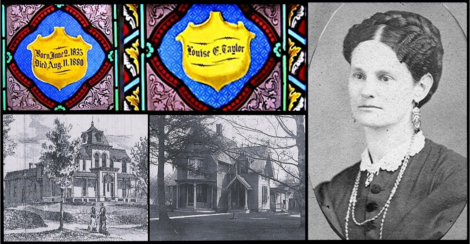
Window profile offers glimpse of 19th century high life
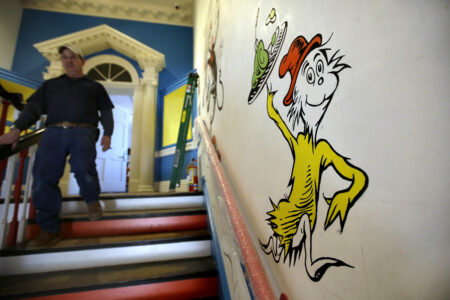
Don’t cancel Dr. Seuss
Spotlighting the women of nature
Clerk of the year named
Just between us
… Koty Leeper of Dunkirk was named to the Dean's List for the fall 2025 term at University of Maryland Global ...