Clear picture of two tied to scandals
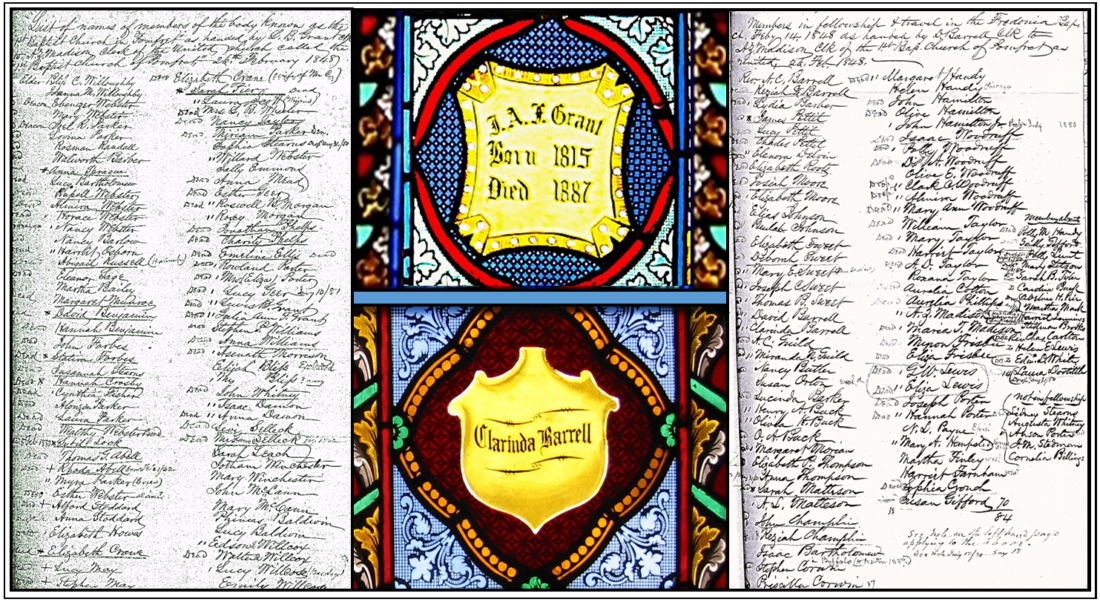
From left: L.B. Grant’s Baptists of the West, details from Julia’s and Clarinda’s windows, David Barrell’s Baptists of the East.
This is the second of a three-part series. Images are courtesy of Jack Woodbury and the early Fredonia Baptist records, SUNY Fredonia Archives and Special Collections. Those records are also transcribed and posted with Chautauqua GenWeb.
Like their predecessors in Part 1 of this series, Julia Ann Forbes Grant (1816-1875) and Clarinda Yale Barrell (1803-1881) are honored to this day in the exquisite stained-glass of the historic building which formerly housed the Fredonia Baptist Church.
Julia’s and Clarinda’s windows were each donated by their husbands, the merchant Lewis Beach “L.B.” Grant (1809-1884) and the merchant David Barrell (1803-1888). The memorials were two of four announced on 6 July 1881 in the Fredonia Censor newspaper.
Julia and Clarinda were inadvertently caught up in two scandals. Both events involved their husbands’ relationships to the church, and both resulted in a longtime, east-west split in the congregation.
It is probably no accident that Julia’s window is on the westerly wall of the sanctuary, and Clarinda’s is on the east. Julia’s husband was the clerk for those who worshipped in the 1822 wood-frame church on the west side of Temple Street. Clarinda’s husband was the clerk for those on the east.
The first scandal, from 1839 through 1841, involved a few years of controversy over the retention of the church’s pastor, who had been accused of frequenting a local brothel. Half of the congregation, including L.B. Grant, believed the minister’s claim of innocence.
David and the other half of the Baptists did not. After his excommunication in 1841 for disbelieving the pastor, David and his group worshiped in the former Fredonia Academy building, which was later replaced by today’s Village Hall.
That second scandal, lasting through 1847, had repercussions beyond Fredonia. The split in Fredonia interfered with the organization of the Erie Baptist Association, an anti-slavery group of several churches on the easterly side of Chautauqua Lake and in westerly Cattaraugus County.
Those churches could not decide which Fredonia Baptists should be invited to join, because Fredonia’s Underground Railroad stationmaster Dr. James Pettit (177-1849) and his family had sided, quite literally, with David.
Pettit was also the leader of the county anti-slavery society, and as the controversy among his Fredonia church brethren wore on, Pettit’s own health deteriorated.
Finally, through the tireless efforts of the abolitionist Rev. Bliss C. Willoughby (1807-1906) of nearby Conewango, the two Fredonia factions reunited. As shown here, each clerk dutifully listed the members on his respective side of the street.
They all agreed in writing to speak of the split never again. Following the merger, the Erie Baptist Association quickly consolidated, and adopted its first, public, anti-slavery resolution.
Throughout the scandals, Julia and Clarinda were obligated to side with their husbands. Ladies had no formal say in the controversy. Only men could vote on church matters. In fact, L.B. and David also included their own names in windows they donated to honor their wives.
The two windows were among a total of eight, 2-story, stained-glass installations for the sanctuary of the 1852 brick structure at 19 Church Street. The brick building had replaced the 1822 wood-frame church, and is now owned and restored by a non-denominational organization known as Family Church.
Sunday Lifestyles
Healing with horses — ‘Truly special’: Centaur Stride cultivates smiles, togetherness
The best way to support the troops
Take A Look At The Night Sky
Top School 4 students
A life in a collection of mugs
I don’t know about you, but I have a collection of assorted mugs that, in their own quiet way, mark the moments ...