
Club hears presentation on headstones
Trending
On a brisk, sunny day in September, members of the Bud 'n Bloom Garden Club assembled at the home of co-president Nancy Kohler on Parkview Lane in Fredonia on the lake.
Bright red-orange, tall canna lilies at the roadside mailbox greeted the club ladies and their guest, Vicki Clark. A cheerful bed of golden marigolds welcomed them into the home where member Sharon Przybyciel greeted the guests in the sun-drenched sunroom of the home, housing large houseplants.
Nancy Kohler and her son, Doug, welcomed the ladies into the living room overlooking serene Lake Erie. Doug is the Erie County Historian, retired professor and an expert on cemetery markings, their meaning and the history of the area.
Using a slide presentation entitled "History In the Headstones – WNY Cemeteries and the Eternal Meanings," Doug gave a very interesting presentation. The slides depicted what he was referring to. Proper terms were explained. The lunette is the top part of the stone. The finals are the two sides of the stone where hints of the person are given. The inscription is the center part depicting the name and dates of the loved one.
After the 1800s – trees, a dove and shaking hands were very popular to decorate the headstones. Urns, wreaths, wheat, grapes, open books and roses were also popular.
In the Victorian age, the settings were chosen for their serenity and restfulness, often by water or in park-like settings.
As the years passed, more modern headstones included actual photos of the deceased, hobbies and more religious signs.
Jewish cemeteries often have an arch. The Irish cross with a circle denotes the four counties of Ireland.
Mausoleums became popular – denoting wealth.
Putting a stone or a penny on the gravestone signifies that the person is remembered and missed.
During the discussion period, co-president Judy Wilcox assisted Kohler in serving her delicious homemade apple cake with cream cheese frosting. Kohler's homemade fudge was also enjoyed. They were served from a table covered with a tablecloth with pumpkins, gourds and grapes pictured on it, and it matched the wreath on the table.
The group enjoyed their treats on the patio in the rear of the home, overlooking the deep blue waters of Lake Erie. A pleasure boat sailed in the distance, and sea gulls were gliding across the clear skies, making for a lovely nautical scene.
The red mandevilla plants in the three planters were still blooming heavily and the huge wisteria plant hugged one side of the patio – the large purple hanging blossoms just a distant memory.
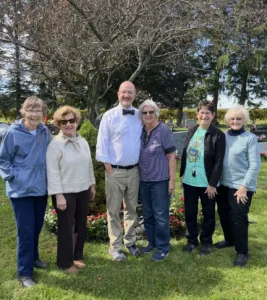
Then Doug and Nancy led the club members and their guests to the nearby Historic Portland Evergreen Cemetery.
Starting at the sedate oldest section, Doug pointed out examples of the grave markings that he had referred to earlier.
Many tall obelisks marked family plots. Just as Kohler had explained, the markings changed considerably as they proceeded to the newer section.
At one point, they stood in reverence at the gravesite of former member and dearly missed friend, Barbara Krauth. Her gravestone was a perfect example of changing markings. It was designed with a photo etched in the surface of the stone with a man and woman sitting on a bench looking at a sunset over the lake.
After the tour, the ladies had a much better understanding of gravestone markings through the years.
The next meeting was making a canvas beach glass picture at the home of Sharon Przybyciel.