
Electrovaya, Cummins find different ways into data center market
Trending
Two companies with local ties want to be part of data centers' power supply solutions – one with battery storage technology and the other with generators that can power data centers when needed.
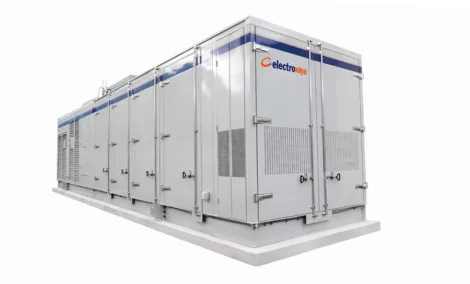
Electrovaya recently announced its ElvaPulse battery energy storage system that will be made at its Ellicott Gigafactory. The ElvaPulse 1500 is built around a modular 20-foot container and a 1,500-volt DC architecture. It provides up to 2.88 megawatt hours of nominal energy and can be configured to deliver up to 9 megawatts of power. Dr. Raj DasGupta, Electrovaya CEO, said the ElvaPulse's power-to-energy ratio allows it to discharge its full rated capacity in under 30 minutes compared with roughly 2- to 4-hour duration profiles offered with most utility-scale lithium-ion storage systems on the market.
Why does that make Electrovaya a player in the data center market?
"We believe this makes the ElvaPulse one of the highest power density containerized stationary battery systems commercially available," DasGupta said. "That power density can translate to a smaller site footprint and potentially lower balance of system cost for the customer. The reason we designed the system this way is very specific. AI data centers can experience large and rapidly changing power demands, creating a growing requirement for storage systems capable of responding quickly and repeatedly. Much of the storage available today was optimized primarily for energy duration. The ElvaPulse 1500 was purpose-built for high-power applications. It also incorporates the same ceramic separator technology that underpins our Infinity platform, which has now been validated across more than 35,000 battery systems, operating in demanding industrial environments."
Along with gas projects, tech giants like Google are investing billions into their own zero-emissions projects like solar, wind, geothermal, nuclear or battery storage. Tech giants often find themselves confronted with utilities that can't promptly supply the kind of power they need. So they -- along with environmental groups, energy entrepreneurs and business associations -- are trying to persuade regulators to expand access to the grid, including in states where legislators are averse to clean energy mandates. Another option is a product like ElvaPulse, which can store power and then deploy it when needed.
DasGupta said it is in active discussions with hyperscale and energy developers on ElvaPulse deployments, and is accepting production reservations now. The systems will be made in Jamestown when Electrovaya's new manufacturing plant in Ellicott is ready for production.
"In a data center environment, safety, reliability and rapid power response are not simply desirable attributes, they are fundamental requirements," Das Gupta said. "The commercial interest we are seeing has been very encouraging. We are already in active discussions with hyperscale customers, data center developers and major power and energy developers regarding a range of potential projects. Based on the scale of the opportunities currently under discussion, successful conversion of even a portion of this pipeline could require substantial utilization of the planned production capacity at Jamestown. Importantly, this energy storage pipeline is broad-based across multiple hyperscalers and developers and end markets, and it is not dependent on any single customer relationship. Together with defense, robotics and high-voltage demand, it gives us confidence that the Jamestown capacity will be drawn from several sources as it comes online rather than from any one customer.
The process for UL 1973 and UL 9540 certifications has begun and could be completed early in 2027. Manufacturing of the ElvaPulse is also designed to qualify for Section 48E, a technology-neutral federal Clean Electricity Investment Credit for facilities generating zero-greenhouse-gas electricity and energy storage systems.
DasGupta said the move into battery energy storage systems could be a growth platform for Electrovaya by taking battery technology developed for material handling, largely forklift batteries, and using the technology in a new market.
CUMMINS: MORE DEMAND THAN SUPPLY
While Cummins won't be making power generation systems for data centers in its Jamestown Engine Plant in Busti, the company is looking to fill a niche in the power generation market for smaller generating systems that will bolster the company's bottom line. Cummins projects data center revenue to rise from $5 billion in 2026 to over $9 billion by 2030.
As demand for artificial intelligence and other power-intensive digital infrastructure accelerates, data center developers are increasingly evaluating on-site power generation as part of their energy strategy. When integrated with microgrid controls and utility interconnection planning, natural gas solutions can provide a flexible pathway to support phased energization, redundancy, cost-competitive power delivery, and long-term grid integration.
The company also recently announced it had expanded its high-horsepower generator portfolio with solutions powered by the QSK78 engine platform for 50Hz markets. The generator is designed to meet the growing power demands across data centers, healthcare, wastewater treatment, and other mission critical applications for customers operating in regions where 50Hz power is standard, including Europe, the Middle East, Africa, Asia Pacific, and Latin America. The QSK78 platform, a 78-liter V18 engine, delivers up to 3500kVA and 3300kVA standby power at 50Hz, offering both Tier 2 and Low Nox scalable solutions for standby and data center continuous power applications.
"Really, it continues to be a capacity-constrained, strong demand market," said Jennifer Rumsey, Cummins CEO. "You heard the strength in the U.S., China, Southeast Asia. It continues. I’d just say we had a summit recently with customers and leaders from across the Americas for power generation, and the message from them really remains consistent, which is continue to expand capacity, demand for backup power is ahead of industry supply availability, and how much more can we deliver them? The backlog is very strong. We feel very confident in the capacity investments that we’re in the midst of making and under pressure to go faster if we can."