Mayville Diner arsonist sentenced to weekends behind bars
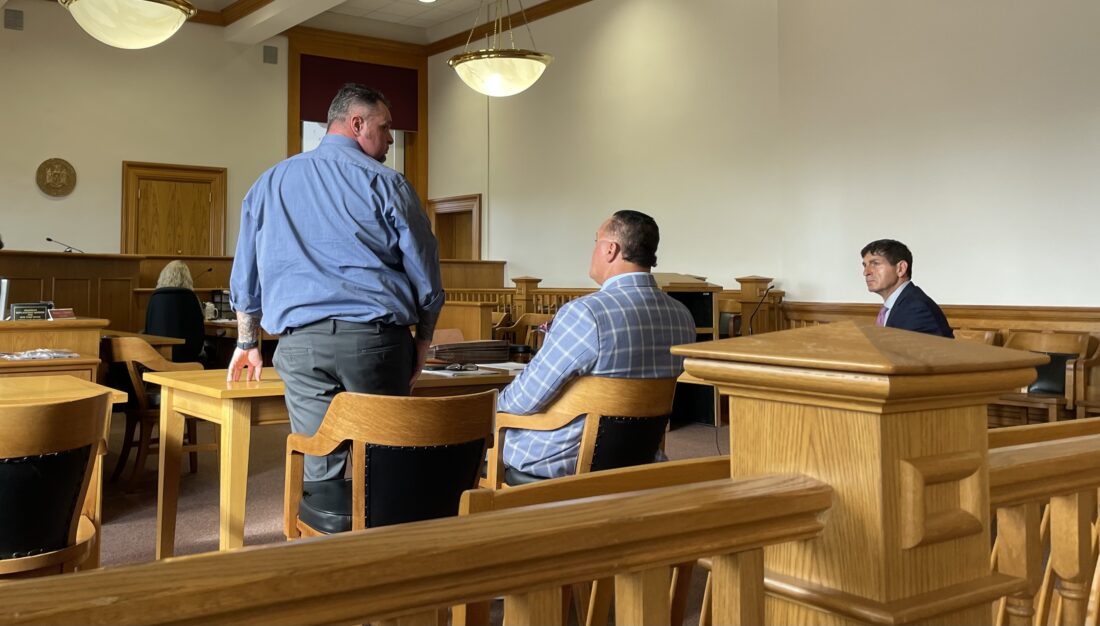
OBSERVER Photo by Gregory Bacon Michael Ellis, left, turns and apologizes to Bob Bonar, not pictured, for destroying the Mayville Diner, before Judge Grace Hanlon issued the sentencing for the guilty plea to fourth-degree arson. Also pictured is Ellis' attorney Anthony Lana (center) and District Attorney Jason Schmidt.
MAYVILLE – The individual responsible for burning down the Mayville Diner nearly three years ago has been sentenced to seven weekends in jail, must pay more than $40,000 in costs and will be on probation.
On Thursday, state Supreme Court Justice Grace Hanlon sentenced Michael Ellis, 43, to weekends in the Chautauqua County Jail beginning Friday evening, Sept. 16, through Oct. 30 and be on probation for the next five years. Additionally, Hanlon ordered Ellis to pay Bob Bonar $22,576, the village of Mayville $14,985 and the Sweet Spot $1,000.
Bonar held the land mortgage of the restaurant and the $22,576 was the land value of the property that was taken by the county due to back taxes. Mayville’s $14,985 is what the cost was for the village to clean up the property. The $1,000 to the Sweet Spot is because that establishment was damaged in the restaurant fire. There were also additional fees in Hanlon’s order.
Ellis pleaded guilty on May 24 to fourth-degree arson.
The Mayville Diner was destroyed in a nighttime blaze Dec. 9, 2019. Ellis was initially charged with third-degree arson, when former District Attorney Patrick Swanson was in office.
Current District Attorney Jason Schmidt said Hanlon reduced the charge to fourth-degree after she reviewed the grand jury transcript. “That (grand jury) predated me,” Schmidt said.
Schmidt said the difference between the degrees is third degree is for “intentional” and fourth degree is for “reckless.”
“She (Hanlon) felt there wasn’t enough evidence put into the grand jury that would say he (Ellis) acted intentionally. She felt that it was reckless,” Schmidt said after the sentencing. “The worst you can do in life is an intentional act. Beyond that is recklessness, that you’re so reckless that you can cause an injury and she’s saying, ‘I’ll call it reckless.'”
During the court appearance, Schmidt lobbied the judge for a harsher sentence. “It’s a societal issue, so that the community knows that an adequate punishment is obtained here for a criminal act,” he said.
See Friday’s edition for complete coverage.
Latest news

Pets die, family displaced in early morning city fire

City man facing federal charges for drugs, weapons
Westfield’s Renold announces expansion, $3M investment

Man charged after threats with rifle in city
Jamestown Man Faces New Federal Child Pornography Charges
John Peterson, 42, of Jamestown was arrested and charged by criminal complaint with distribution and possession of ...