
Science graduate helps to conquer a global problem
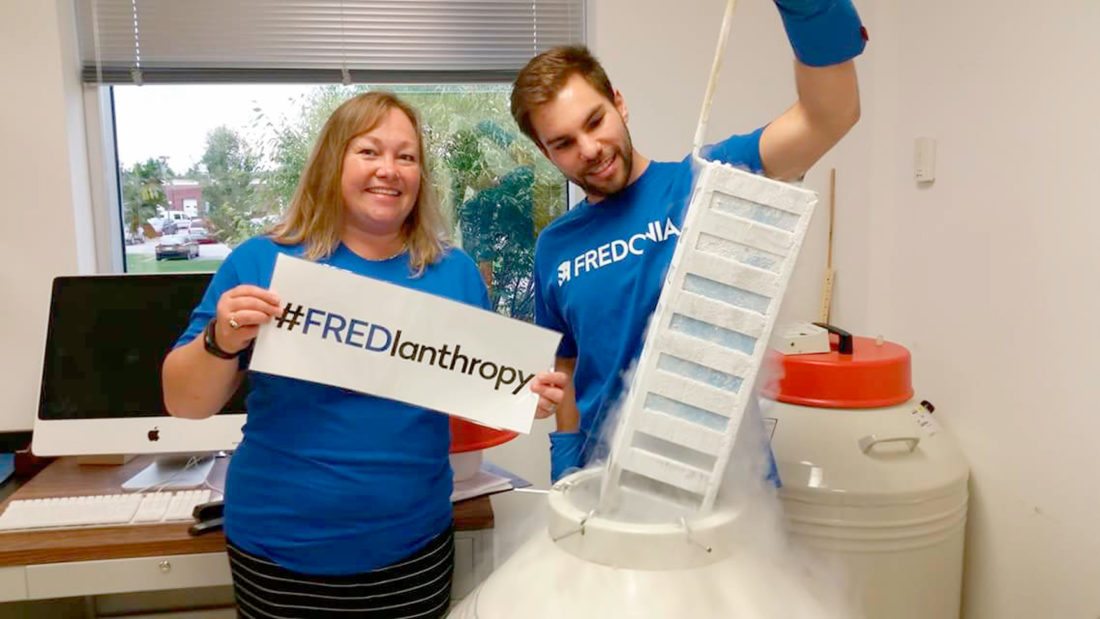
Fredonia alumni Nick Catanzaro, ‘13, with Dr. Deborah Good, ‘87, at Virginia Tech, having fun celebrating last fall’s #FREDlanthropy Day.
A Fredonia alumnus, now a graduate student at Virginia Tech, has been awarded a fellowship to investigate a virus responsible for significant economic losses in the swine industry.
Nicholas Catanzaro, of Lewiston, N.Y., completed a bachelor’s degree in Molecular Genetics at Fredonia in 2013. He first visited Virginia Tech during the summer of 2012 to participate in Research Experiences for Undergraduates, a 10-week summer program that introduced him to microbiology research at the university.
Mr. Catanzaro credited his undergraduate professors at Fredonia with preparing him for the next step in his studies. “Through integrative and engaging experiences in both the classroom and lab, I learned valuable skills and techniques that allowed me to hit the ground running upon starting my dissertation research,” Catanzaro said. “However, it was the environment and culture at Fredonia, especially within the Biology department, that prepared me the most. The people around me, both my peers and professors, made science exciting and motivated me to learn.”
Catanzaro, a Ph.D. student in the Virginia Tech Department of Biomedical Sciences and Pathobiology, hopes his research on porcine reproductive and respiratory syndrome virus (PRRSV) will eventually help scientists develop safer, better vaccines. He was recently awarded a two-year, $95,000 fellowship from the U.S. Department of Agriculture’s National Institute of Food and Agriculture for his research.
“This is one of the most economically devastating global swine pathogens and causes more than $600 million in economic losses in the United States alone each year,” Catanzaro said. “My fellowship looks at how the virus causes disease in pigs. That’s important because scientists are trying to make safer, more-effective vaccines for pigs against the virus.”
First discovered in 1987, PRRSV causes reproductive failures in pregnant sows and respiratory disease in young piglets. Although it has similarities to the Coronaviridae family of viruses, which include the deadly severe acute respiratory syndrome (SARS), it cannot spread from animals to humans and poses no food safety threat.
Catanzaro’s interest in research peaked during his time at Fredonia, he said. “During my junior and senior years at Fredonia, I worked on an undergraduate research project with Dr. Theodore Lee,” Cantanzaro said. “We were interested in microbial communities involved in a unique geological process along the banks of Canadaway Creek. This research experience allowed me to apply the skills and techniques discussed in the classroom to a real world problem. In working with Dr. Lee, I realized research was something I enjoyed and would like to pursue as a career.”
Thanks to his Fredonia undergraduate degree, Catanzaro is able to do just that.
Reprinted in part with permission from Virginia Tech University.
Local/Region
Local lawmakers back Rural Suicide Prevention Council
City parking changes start this weekend
With the following changes, spring and summer parking regulations will take effect for alternate and overnight ...
UPMC Chautauqua hosts training sessions for rare birth emergencies

UPDATE: City fire blamed on malfunctioning electric cable
Thomas Erlandson honored by Chautauqua County leaders
Brush pickup another thorn in city’s side
Unhappiness about Dunkirk’s brush pickup situation was a notable topic at the most recent Common Council ...