
Concord grapes topic of Westfield-Mayville Rotary Rural Urban Day
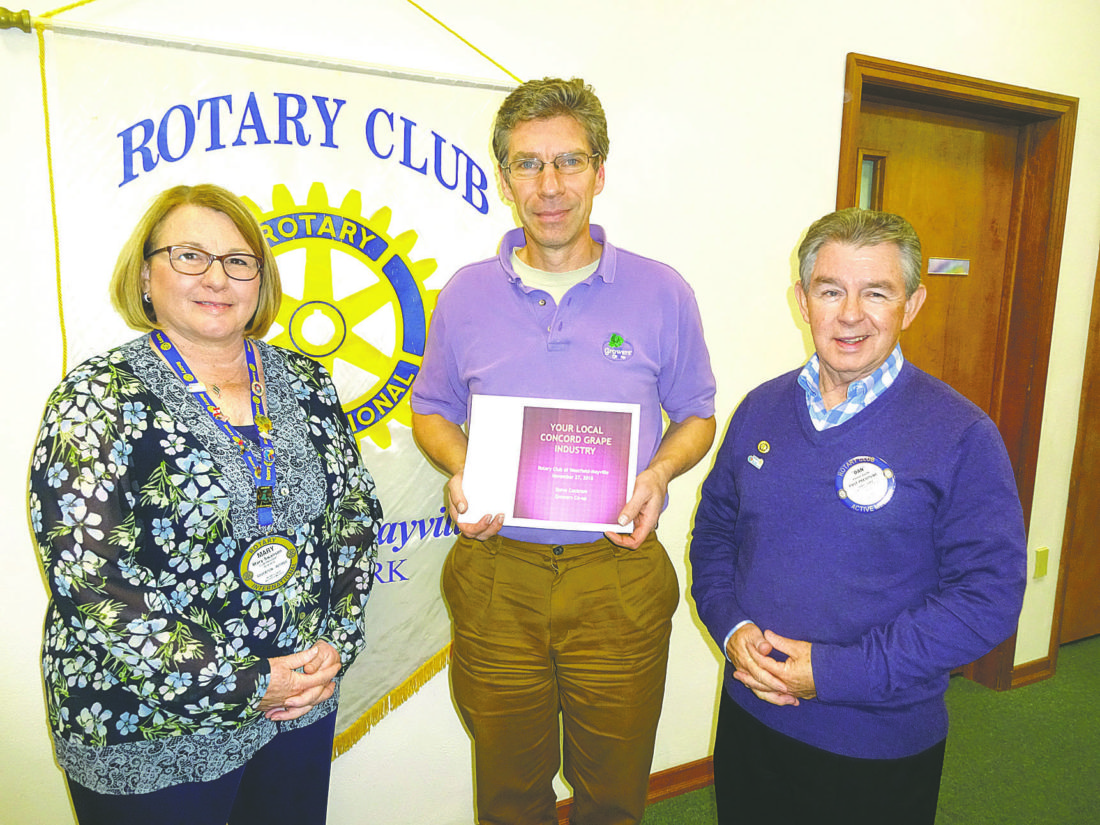
Submitted Photo Steve Cockram, center, general manager of the Growers Co-op in Westfield, was welcomed to the Westfield-Mayville Rotary Club’s Nov. 27 “Rural Urban Day” meeting at the Lakeshore Assembly of God Church in Westfield by Club President Mary Swanson, left, and Rotary District 7090 Vocational Training Team Chair Dan Smith, right. Cockram, who was the special guest presenter, gave an interesting program titled “Your Local Concord Grape Industry.”
WESTFIELD — Local Concord grape growing origins, our microclimate, production and market trends were a few of the topics reviewed by Steve Cockram, general manager of the Westfield Growers Co-op Grape Juice Company, during his presentation entitled “Your Local Concord Grape Industry” at the Nov. 27 meeting of the Rotary Club of Westfield-Mayville. This special program for Rotarians and guests, which was held at the Lakeshore Assembly of God Church in Westfield, was the highlight of this Rotary Club’s annual “Rural Urban Day.”
Local high school students, farmers and agribusiness individuals were invited to attend this luncheon and special session. Sherman Central School Future Farmers of America students and Chautauqua Lake Central School Environmental Science students, as well as other guests, were in attendance. Westfield-Mayville Rotary Club President Mary Swanson welcomed all. Past Club President Helen Baran gave a brief history of this Rotary Club’s unique, annual Rural Urban Day event. Dan Smith, Rotary District 7090 Vocational Training Team Chair and this Rotary Club’s Youth Services Chair, introduced Cockram, the special guest presenter.
Helen Baran said, “The best recollection of the beginning of the Westfield-Mayville Rotary Club’s Rural Urban Day was in the early 1970’s. Steve Baran, Past Club President, held a meeting of the club in the backyard of his home, Baran Vineyards, with a picnic lunch and a visit of Ballantrae Angus cattle from the Nixon Farm. Most of the Rotarians who were present had never been up close to these cattle or any other farm animals. From then on, a day was set aside each year to invite agribusiness people, farmers, processors and anyone associated with agriculture to attend a meeting to learn more about agriculture and its economic impact in our county.”
She continued, “Some of the speakers in the past have included USDA officials from Washington, professors from Cornell University and Ohio State University, medical specialists, Cornell Cooperative Extension specialists and food processors. Over the years, many of the area schools have sent to this event FFA members and students in biology, chemistry and environmental science classes.”
Special presenter Steve Cockram has had diversified roles for over 30 years in the fruit juice industry. After earning his Bachelor of Science Degree in Chemical Engineering from Cornell University, he began at Seneca Foods in the 1980s working with apples, grapes, and many other fruits and vegetables. He spent much of his time “in the analytical world, taking apart all kinds of fruits and vegetables. He also was a corporate troubleshooter and trialed new equipment from all over the world.”
Cockram then moved to Wisconsin “to be a cranberry guy, doing many of the same things for Northland Cranberries.” In 2005, he moved to Westfield and has been at Growers Co-op for 13 years, first as Technical Director and for the past three years as General Manager. Cockram noted that “the Growers Co-op has just completed its 90th grape harvest.” He has served on the Westfield Academy and Central School District Board for the past nine years, and he enjoys biking and skiing.
During his interesting presentation, Cockram noted that “The Concord grape is one of only three economically significant native North American fruits,” with the other two being the cranberry and the blueberry. He said, “Most people around the world do not know that Concord is what makes grape juice taste like grape juice.”
He offered a brief history of the Concord grape, which was developed by Ephraim Bull in Concord, MA, in the 1840s. Cockram stated, “After 22,000-plus hand crosses, there was immediate recognition for its flavor. Every grapevine in Europe is based on our U.S. root stock. As a native, it is resistant to weather and disease pressures.”
“Our region was settled in the late 1700s. Elijah Fey planted grapes in Portland in about 1818 and the first Concords in 1851. He planted his first commercial vineyard of one-quarter of an acre in 1857.” Cockram said, “Our Grape Belt is the oldest and largest Concord grape growing region in the world.”
Initially all of the Concord grapes were for the fresh market. In 1869 Dr. Thomas Welch, an abolitionist and dentist in New Jersey, did not want wine served for communion in his church. He used Louis Pasteur’s germ theory and Concords from his back yard to “hot fill his homemade juice and make his first bottle of grape juice, which he called ‘Unfermented Sacramental Wine.'” His son Charles E. Welch recognized the economic potential and moved to Westfield in 1897. His first production plant was outgrown in its first year of operation, and Concord grape juice production exploded.
Cockram noted, “Processors go where the raw material is, and there were nine different processors. Starting in World War I, when there was a need to feed the troops, Welch’s made a new spreadable product called Grapelade, which was like jam. The U.S. Army made a ground peanut spread for the troops. Fast forward 10 years later, when sliced bread was invented, and the peanut butter and jelly sandwich was born.”
During WWI, original Welch patents had equal vale to juice, tartrates and grape seeds, for the oil. During the decade of the 1980s, researchers noted the paradox of the French diet, which was high in fat and saturated fat. The French people seemed to be protected from cardiovascular disease, and researchers found that red wine consumption was the reason.
Cockram said, “Concord grapes and juice have the same protective compounds as red wine, and at more consistent levels. Once the study was published and the public knew about the French Paradox, retail grape sales soared in one week, while annual sales doubled a year later. Now, with all of the consumer concern about sugars, grape and other juice sales have declined. Bottled water is the number one selling beverage in the world.”
Though there are now wineries in all 50 states, most do not have vineyards. Cockram said, “There are only four regions worldwide where the Concord grape grow, and they are the NY/PA/OH, which is the largest with 20,000 acres of Concords, WA (16,000), MI (7,000 and getting smaller) and Brazil. The Lake Erie Grape Belt, which is 60 miles wide and at most 6 miles deep, is bordered by Lake Erie and the Niagara Escarpment, which makes this area an ideal grape growing microclimate.”
“We live in a bath tub! The local soils, terrain and bodies of water all affect how plants grow, which is what the French call terroir,” Cockram said. “Consider Lake Erie to be the bottom of the tub, and the escarpment to be the top. Along Lake Erie our grapes usually stay in hibernation about two weeks longer than in other places.” Cockram added that Concord grapes grown in Washington State have less disease pressure than here in the East, but they do not develop the color, flavor or acid that the eastern Concords do. This is due to Washington grape farmers needing to use irrigation from the Snake River in this state’s desert climate.
Cockram discussed financial returns to grape farmers with the break-even rate for Eastern farmers being about $235 per ton. He stated, “The long-term trend on Concord is that farmers are doing other things with their land. In general, if a crop is not profitable, the farmer will not grow it for the long term. Given the reduced acreage, we are probably heading towards a less than 400,000-ton industry.” Speaking about current crop utilization, Cockram said that almost all of the Concord grapes are made into juice, with smaller amounts being turned into jam, jelly and wine. He noted that Concord grapes are big in the Asian market.
As far as the future of Concords in the Grape Belt, Cockram said that though people are consuming less juice, they are drinking more wine. “Our area is now the source of much juice for many types of wines. Longer term, our area will be driven by wine-based agri-tourism. What will our next new product be? The Concord grape industry needs to continue to adapt to the needs of the consumers. We cannot rest on our laurels.”
The Rotary Club of Westfield-Mayville thanks Steve Cockram for providing a very interesting and thorough special program about our area’s Concord grape industry, and it recognizes the many efforts of all of the local grape farmers, processors and agribusiness individuals who contribute so much to our local economy.
Local/Region
Local lawmakers back Rural Suicide Prevention Council
City parking changes start this weekend
With the following changes, spring and summer parking regulations will take effect for alternate and overnight ...
UPMC Chautauqua hosts training sessions for rare birth emergencies

Pets parish in city fire
Thomas Erlandson honored by Chautauqua County leaders
Brush pickup another thorn in city’s side
Unhappiness about Dunkirk’s brush pickup situation was a notable topic at the most recent Common Council ...