
Langworthy backs Seneca law enforcement in legislation
U.S. Rep. Nick Langworthy announced the introduction of the Seneca Nation Law Enforcement Efficiency Act, legislation designed to address long-standing jurisdictional confusion that has undermined effective law enforcement coordination on and around Seneca Nation lands in Western New York.
In 1948, Congress enacted a federal statute granting New York State criminal and civil jurisdiction over offenses occurring on the reservations of the Seneca Nation of Indians. While the federal government retained certain criminal authority, the law established a framework in which the State became the primary law enforcement authority on Seneca lands. Over time, that structure has resulted in overlapping responsibilities between federal, state, and tribal authorities, with no single entity clearly responsible for coordinated enforcement.
“This outdated jurisdictional framework has created real-world public safety problems,” Langworthy said Friday. “Our men and women in law enforcement are doing the best they can under challenging circumstances, but when authority is fragmented and accountability is unclear, resourceful criminals exploit the gaps and that’s exactly what we’ve seen happen. This legislation provides a targeted solution that respects tribal sovereignty, preserves federal oversight, and ensures that any change occurs only with mutual agreement. Most importantly, it will make our communities safer, and that is a goal we all share.”
Seneca Nation President J. Conrad Seneca said, “During the Indian Termination Era 80 years ago, Congress gave New York State criminal jurisdiction to prosecute and incarcerate the Seneca people. The Termination Era is over, but this law remains on the books. We are thankful to Congressman Langworthy for introducing this legislation and working with us to improve the Seneca Nation’s public safety priorities. Our goal with this legislation is to restore the federal government’s treaty responsibility to work with the Seneca Nation to provide law enforcement services. Through cooperative law enforcement agreements, we can maximize our working relationship with outside governments to address the drug trafficking on our lands and other threats to the Seneca people, and create a pathway for the development of our own Seneca Nation law enforcement capabilities.”
Law enforcement officials and Seneca Nation leadership have raised serious concerns that this patchwork system has complicated investigations, limited coordination, and allowed non-Indian criminal actors to exploit jurisdictional uncertainty to engage in drug trafficking on and around Seneca territories, including nearby communities such as the City of Salamanca. Divided authority has often led to inconsistent enforcement and reduced risk for traffickers operating across jurisdictional lines.
The bill removes New York State’s automatic criminal and civil jurisdiction over Seneca Nation lands established under the 1948 law, but only if both the Seneca Nation and the U.S. Attorney General agree in writing to such a change. The legislation does not mandate any immediate action; instead, it creates a clear legal mechanism to resolve jurisdictional confusion when all parties determine it is appropriate. By clarifying jurisdiction and enabling a more coordinated law enforcement framework, the legislation strengthens accountability, improves cooperation among authorities, and reduces opportunities for drug trafficking and other criminal activity to flourish due to legal uncertainty.
Local/Region
Langworthy backs Seneca law enforcement in legislation
U.S. Rep. Nick Langworthy announced the introduction of the Seneca Nation Law Enforcement Efficiency Act, ...
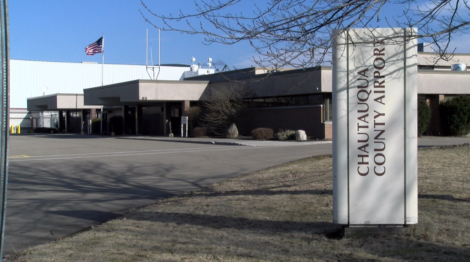
County waiting on feds for commercial air service
County receives $1.9M for emergency communications
Chautauqua County will be receiving $1.9 as part of $38 million in state funding has been awarded to 17 counties ...
Gillibrand announces bipartisan bill to ban Congressional stock trading
U.S. Sens. Ashley Moody (R-Fla.) and Kirsten Gillibrand (D-N.Y.) introduced the bipartisan Restore Trust in ...
Carroll Police identify vehicle in cemetery accident
FREWSBURG – Social media helped the Carroll Police Department find the person responsible for an accident that ...
Catholic Charities Appeal has $8 million goal
Officials and volunteers gathered this week to launch Appeal 2026 in support of Catholic Charities of Buffalo and ...