Shakespeare Club hears history on State of Palestine
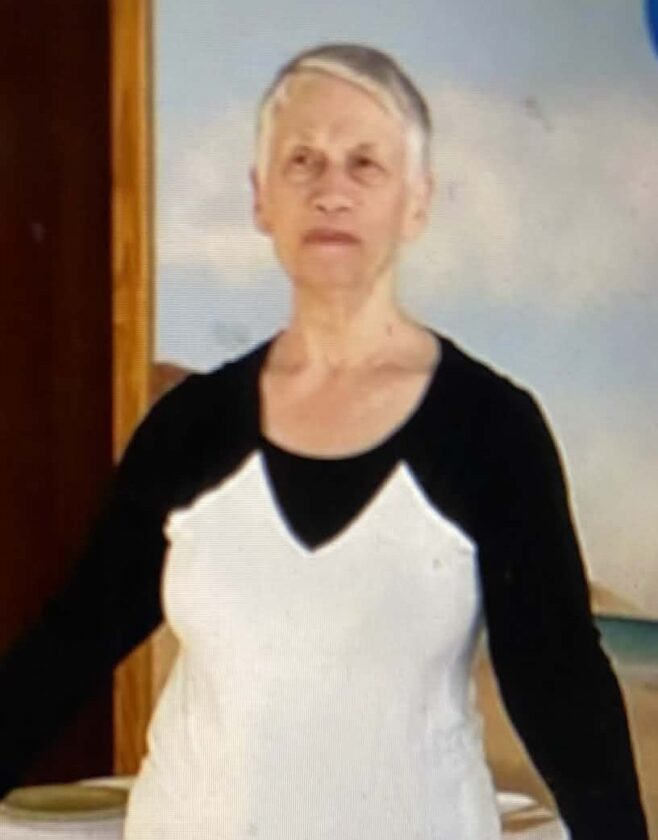
Linda Dunn
A March meeting of the Fredonia Shakespeare Club was hosted at the home of Judi Lutz Woods. President Karin Cockram welcomed Club members to the meeting.
After a brief business meeting concluded, a paper by Linda Dunn on the State of Palestine was presented. A summary follows:
In 2011 United Nations Educational, Scientific and Cultural Organization accepted Palestine as a member state despite the objection from Israel, and even though Palestine has never existed as an autonomous entity. In 2019 Israel quit UNESCO accusing it of being biased against it, and of diminishing its connection to the Holy Land. Israel, however, remains a party to the World Heritage Convention.
The Jewish kingdom of Judea was conquered by the Romans in 70 C.E., and in 135 C.E. when the Jews were expelled, the Romans changed the name from Judea to Palaestinia, a reminder of the Philistines, the Aegean people who had settled along the southern coast of Israel in 12th century B.C.E. and warred with the Jews. It was the southern portion of today’s West Bank and was ruled alternately by Rome, by Islamic and Christian crusaders, (the first Muslim invasion was in the 7th century), by the Ottoman Empire from the late 14th century to the early 20th century, and by the British after WWI. “Over the last two thousand years between invasions, crusades, the plague and other man made or natural disasters, entire populations have been replaced many times over.”
As late as 1882 the Arab population of Ottoman Palestine had barely reached 260,000. In 1919 the following resolution passed at the First Congress of the Muslim-Christian Association in Jerusalem to choose representatives to the Paris Peace conference. ” We consider Palestine as part of Arab Syria, as it has never been separated from it at any time. We are connected with it by national, religious, linguistic, natural, economic, and geographical bonds.”
In 1937 the Jerusalem Mufti Haj Amin Husseini, the leader of the Palestinian Arabs from the early 1920s to 1940s said in his testimony to the British Peel Commission established in January 1937 to find a way forward for cooperation between Arabs and Jews in British Palestine. “Most residents of Jewish lands will not be awarded citizenship in our future country. He rejected the idea of a Jewish state and promised that the Jews be expelled from a Palestinian Arab state.”
In 1947 the United Nations General Assembly voted to partition Palestine into an Arab and Jewish state. The Jews accepted the terms of the partition plan, even though the size of land was greatly reduced from that proposed by the Balfour Declaration and the Palestine Mandate with about 60% being in the Negev desert.
The demographic of the plan also ensured that a sizable Arab population would live in the Jewish state. The Arabs rejected the plan and on May 14, 1948, the British left Palestine and the Jews declared independence and the state of Israel was born. The Oslo Accords I and II were signed in Ohio in 1993 and 1995. Waves of suicide bombers were sent by the Palestinians, a “clear statement of their rejection of the idea of peace with Israel.”
President Clinton oversaw the Camp David summit in July 2000. He offered Yasser Arafat, chairman of the PLO, far reaching concessions as part of a comprehensive peace arrangement.
The Israeli proposals were rejected and a massive wave of violence, the so-called al-Aqsa Intifada unleashed an unparalleled wave of violence on Israeli civilians, murdering 1,184.
In August 2005, the government of Israel headed by prime minister Ariel Sharon, carried out the unilateral evacuation of all Israeli villages from the Gaza strip and the Northern West Bank. In response, the Palestinians have been launching missiles and rockets on Israeli towns and villages from the Gaza Strip for years, some of which reaching as far as Tel Aviv.
Instead of using the enormous Israeli concession as an opportunity to achieve peace and work towards a state, the Palestinians used it to empower Iranian backed terrorist organizations. In June 2007 Hamas took control of the Gaza Strip in a violent coup. Ever since the Hamas takeover, the villages of southern Israel have been subjected to a more-or-less nonstop downpour of rockets and missiles fired from Gaza. The number of rockets/missiles and mortar shells fired into Israel from Gaza since 2007 is in the tens of thousands.
In 2008, Israeli PM Ehud Olmert offered Mahmoud Abbas a sweeping peace proposal. Abbas rejected it outright. According to Saeb Erekat, chief negotiator for the Palestinians, “I came here to determine the boundaries of Palestine from 1967 without budging an inch.”
They insisted on the right to manage the holy sites in Jerusalem in place of the Jordanians. The Palestinian leadership rejected the current U.S. proposal, Trump’s “Deal of the Century,” before they had seen it.
They also refused to participate in the economic conference held in Bahrain at the end of June 2019 and prevented other Palestinians from participating. A Muslim cleric famously preached from a mosque in Jerusalem, “There is no Palestine. It is all Islam.”
The sites selected for inclusion in the State of Palestine by UNESCO are:
— Ancient Jericho/Tel es-Sultan where the “walls came tumbling down” on the seventh day after they were encircled by Joshua and the Children of Israel. Archaeology confirms that settlements here date to 8,000 B.C. when the early population of hunters and gatherers became the earliest practitioners of agriculture and animal husbandry.
— Hebron/Al-Khalil Old Town, the center of interest which is the Al-Ibrahimi Mosque/the
— Tomb of the Patriarchs (Machpelech), a site of pilgrimage for all three monotheistic religions, Judaism, Christianity and Islam.
— The Church of the Nativity, a Byzantine Basilica, located in Bethlehem, was built over a cave where according to a second century tradition is documented as the birthplace of Jesus.
— The Saint Hilarion Monastery/Tell Umm Amer, one of the earliest monastic sites in the Middle East dating back to the 4th century. Battir, Cultural Landscape of Southern Jerusalem known for its terrace farming.
Local/Region
Sheridan site wins Empire State Development funding
A Chautauqua County location has been selected for funding by Empire State Development under the Focused Attraction ...
Shakespeare Club hears history on State of Palestine

Speaker to discuss ‘New Neighbors’ effort
United Arts Appeal accepting grant applications

Woman faces 17 child welfare endangerment charges