
Wrapping Up
Engineer discusses I-86 bridge rehab on DOT podcast
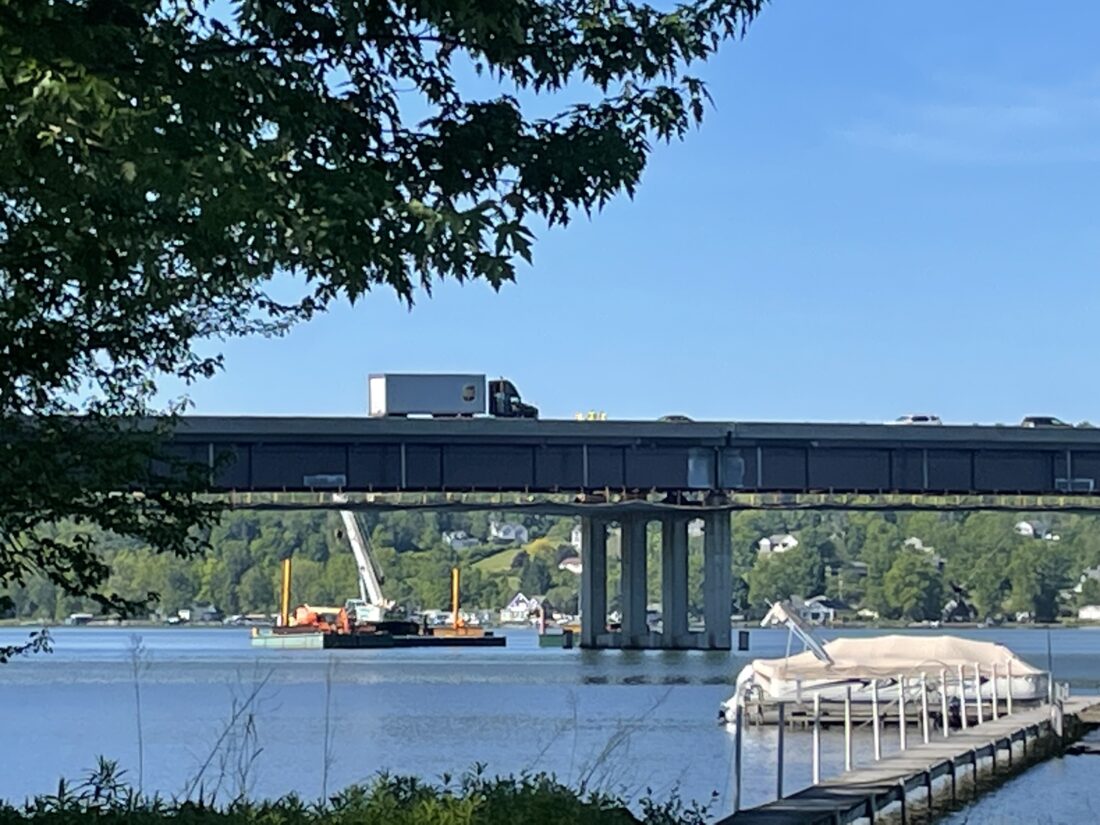
P-J photo by John Whittaker A barge with a crane is pictured near the Veterans Memorial Bridge that carries I-86 over Chautauqua Lake. One of the challenges of the bridge rehabilitation project is accessing parts of the bridge in the middle of the lake.
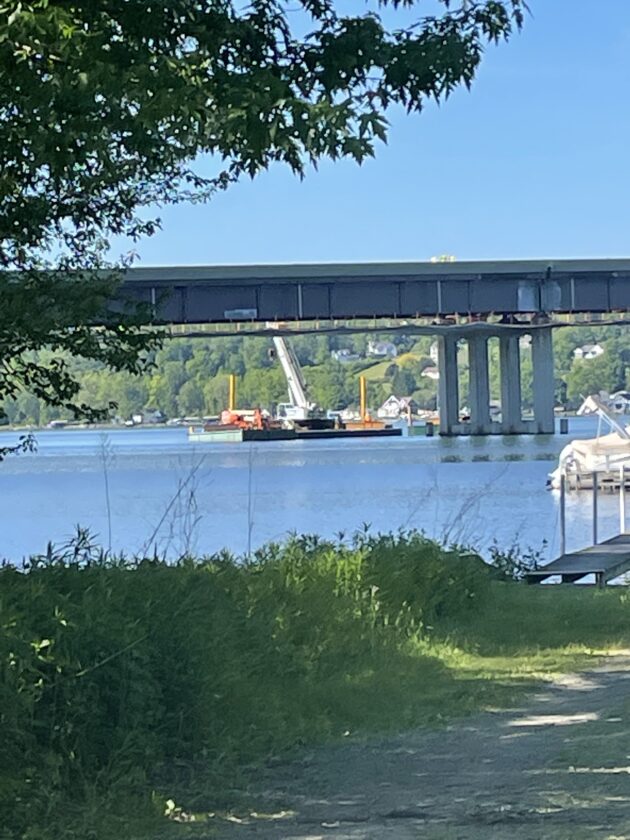
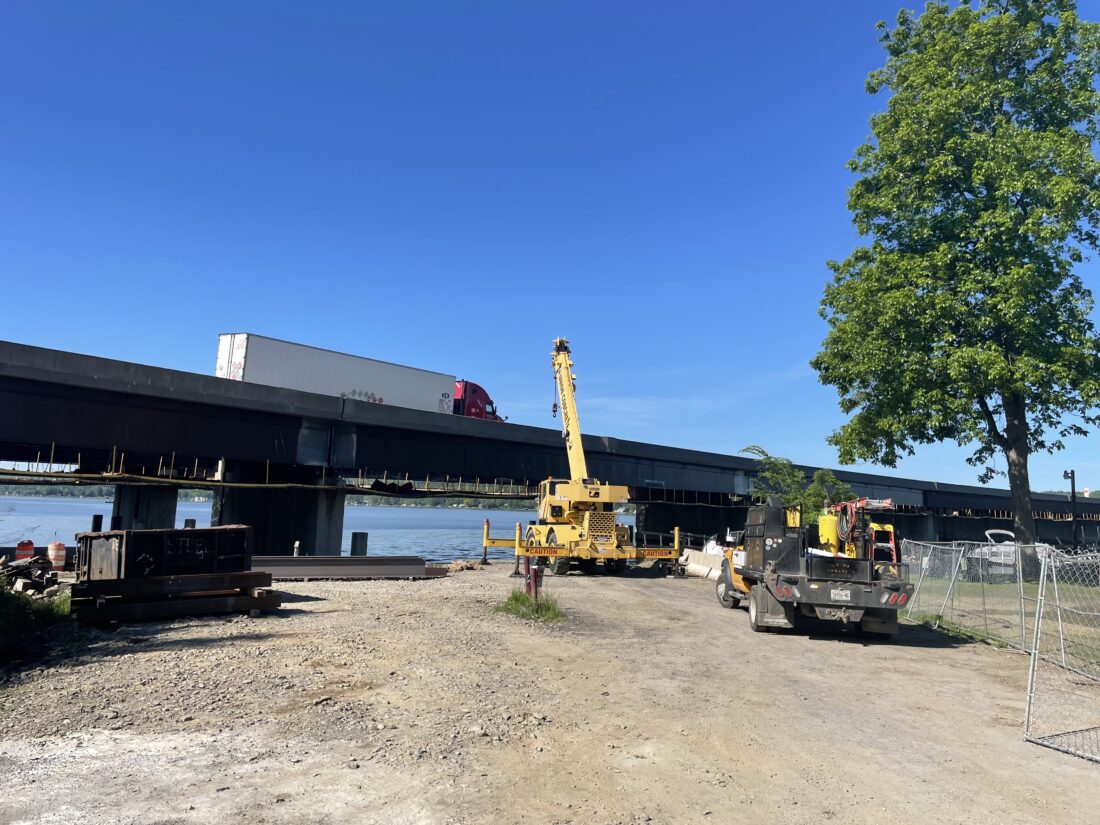
P-J photo by John Whittaker A construction vehicle is pictured near the shores of Chautauqua Lake in Bemus Point.
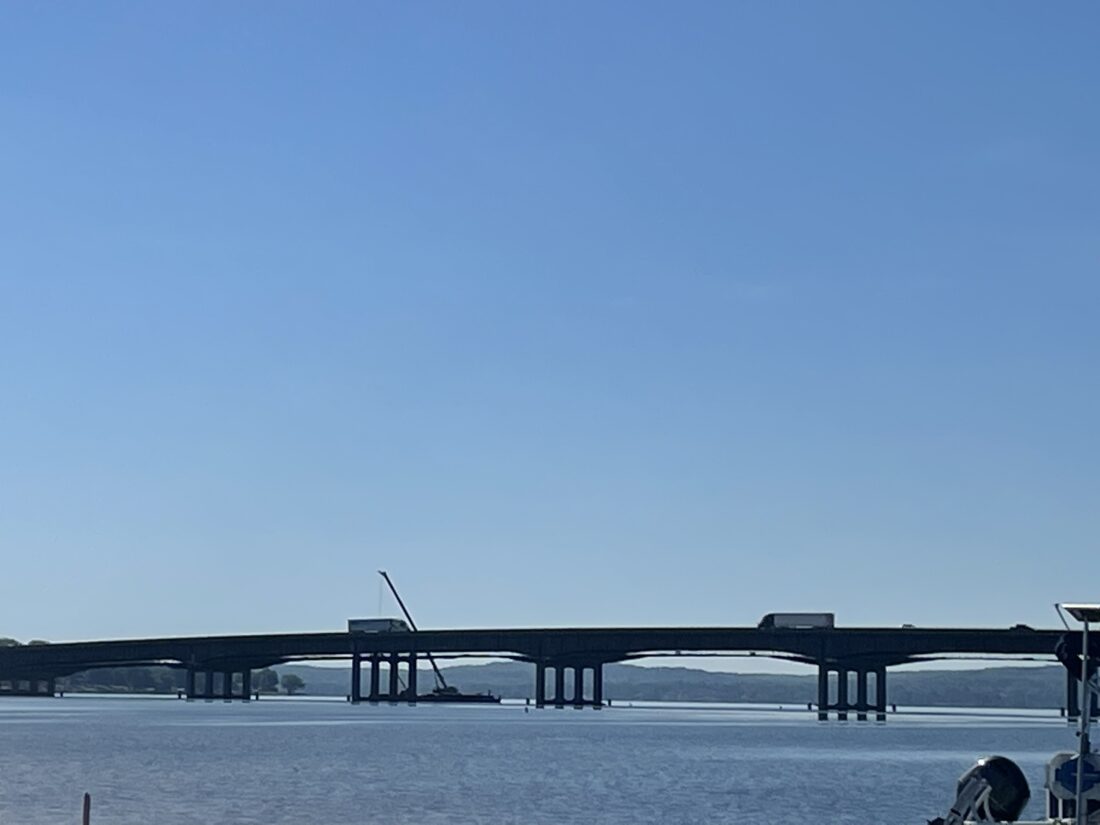
P-J photo by John Whittaker Truck traffic makes its way over the Veterans Memorial Bridge that carries I-86 over Chautauqua Lake on Wednesday as a barge with a crane is pictured in the background. Engineers for the bridge project remarked during a recent interview with DOT officials how much truck traffic the bridge sees each day.
P-J photo by John Whittaker A barge with a crane is pictured near the Veterans Memorial Bridge that carries I-86 over Chautauqua Lake. One of the challenges of the bridge rehabilitation project is accessing parts of the bridge in the middle of the lake.
P-J photo by John Whittaker A construction vehicle is pictured near the shores of Chautauqua Lake in Bemus Point.
P-J photo by John Whittaker Truck traffic makes its way over the Veterans Memorial Bridge that carries I-86 over Chautauqua Lake on Wednesday as a barge with a crane is pictured in the background. Engineers for the bridge project remarked during a recent interview with DOT officials how much truck traffic the bridge sees each day.
Trending
It hardly seems possible, but the reconstruction project of the Veterans Memorial Bridge over Chautauqua Lake is scheduled to be completed this fall.
The 3,790-foot-long main bridge crossing Chautauqua Lake and two, 500-foot-long bridge structures that split off the eastern end of the main bridge, and carry the eastbound and westbound lanes of traffic, are getting new concrete bridge decks, bridge barriers, bearings and steel repairs. The three structures total 24 spans. A fourth bridge structure that carries westbound I-86 ramps to Route 430 will also receive new bridge joints and will be resurfaced.
Jen Freaney, the state Transportation Department's lead engineer on the project, recently discussed the reconstruction of the I-86 bridge on a state Transportation Department podcast in mid-May.
"So, we’re doing what they call a rehab," Freaney said. "So, we're going through and doing concrete repairs on peers, replacing the pedestals. We’re upgrading the bearings that were installed back in the 1970s and 1980s. Now, they’re getting a whole new bearing style. It’s all very high-tech. And then where we are seeing, you know, your standard deterioration on bridges at the girder ends, those things, we’re replacing large portions of the steel girders. And then we’ll cap it all off with a brand new lightweight deck and lightweight barrier. I’m hoping for another 25 years, at least, or more. You know the products we’re seeing nowadays are so much better than they were back in the 70s and ‘ 80s. The oversight’s better. So , I look at this project like it should last well past my tenure here. I'm hoping not to see it again before I retire. And I’m hoping when they finally do get back to it, they can do another rehab."
DIFFICULT DECISIONS TO CLOSE
The history of the Chautauqua Lake bridge dates back decades, though it seems the '50s were key to its eventuality. Construction on the bridge didn't formally begin until summer 1973, though any momentum that had be gained quickly faded. That November, the Committee to Stop the Bridge Across Chautauqua Lake filed suit in U.S. District Court to stop construction, claiming the state Department of Transportation failed to complete environmental impact statements and hold public hearings. While the suit was in the courts, construction of the bridge's substructure was halted on April 8, 1974, by picket lines manned by striking workers from Local 17 in Buffalo.
Work would not resume for more than four years.
Three days after the contract dispute arose, a recommendation was made to a federal judge that a temporary injunction be granted to officially halt construction. It was based on allegations that the state failed to comply with federal laws in preparing the environmental impact study. An appeals court later affirmed the injunction.
Daylight for the project finally came in 1976 when a draft environmental impact statement was released. Soon after, lawmakers spoke in support of the project inside a jammed auditorium at Southwestern Central School.
After initial objections, the federal Department of Transportation in February 1978 gave its seal of approval to the impact statement. Three months later, a judge lifted the injunction against the building of the bridge.
Work resumed in July 1978, though not before another problem arose when the U.S. Fish and Wildlife Service and the Army Corps of Engineers began battling over the realignment of 500 feet of Bemus Creek. That dispute remained unsettled until November.
On April 27, 1979, the first test pilings were replaced for work on the substructure. From there, work went smoothly.
Freaney made note of the controversy over the bridge before its construction, contrasting it with the community's reaction when the bridge is closed now for reconstruction or when traffic was diverted.
Tammy Shack, owner of the Bridgeview One-Stop in Bemus Point, was outspoken in her attempts to get the state Transportation Department to create an exit after Exit 9, which sends traffic near her store, was closed for construction. That happened new exit was opened last summer.
Scheduled closures have been increasing in recent weeks, including overnight closures this week that began Tuesday night and ended this morning. The bridge will be closed in both directions from 11 p.m. Friday through 9 a.m. Saturday. Detours are posted on Route 394 and Route 430.
"A lot of people, I mean, they can’t even imagine a day now not having it," Freaney said. "When we close, I get phone calls, I mean, from everybody. I have phone calls from people asking me if they can make their doctor’s appointments on time to whether or not they’ll, you know, we’ll have it open for the buses for kids to (get to school). So, it’s really big the way this particular structure has just meshed itself in day-to-day life."
DEALING WITH THE LAKE
Environmental concerns raised more than 70 years ago reverberate as Freaney leads the bridge reconstruction project. One challenge has been being able to get an accurate scope of work that needed to be done, Freaney said, because there was such limited access for inspection teams to see the bridge's girders. That limited access made designing the project difficult.
"Some of the girders are 15-feet high, you know, so they can’t use the over the side equipment to see them," Freaney said. "They would have to get up underneath it and they just don't have access like that. I mean, not very many firms around here have a massive boat with a lift on it that you can just hike up in there and look at it. So that limited the scope of how much we could actually tell and see what was wrong with the bridge. But then now over the water I look at Chautauqua Lake, it has a massive water tourism economy. A lot of their businesses are affected by this bridge. I know sailboats, we’ve had an issue with sailboats being able to clear the scaffolding underneath it. And Chautauqua also has got a large portion of wetland that we cannot touch. And it also has quite a few endangered species in it. So getting in the water and working was never an option. We could not disturb the bottom. We couldn’t get in there and you know affect the environment very much at all. So we’ve had to move in a lot of large barges and we’re placing cranes on barges just to get equipment and things and materials out to the bridge. You're half a mile into the lake. You’re not just going to walk it out."
Those challenges were a challenge to the project's budget, as well. Barges and cranes are expensive, and there is a limit to the amount of work that could be done at one time. Access limitations are also a reason for overnight closures for work that has to be done from the "live" side of the bridge because it is the only way to access the side of the bridge that is being worked on.
The lack of ground access has been noted since early on in the project when passersby noted netting and boats under the bridge to keep debris and contaminants out of the lake.
"So, it has affected the project pretty much from day one," Freaney said. " And as we’ve gained access with scaffolding, as we’ve got in there and kind of dealt with some of these challenges, we’ve managed to actually do it very well. And I’m really impressed with how we’ve kind of approached things. But it is probably one of the largest cogs in this system that we’ve had to deal with."
ECONOMIC DRIVER
The 4,300-foot-long bridge spanning the narrowest point on Chautauqua Lake opened in October 1982 at a cost of tens of millions of dollars. However, calls for a connection -- long thought to be economically vital -- first cropped up in the early 1920s, but only seriously took hold toward the end of the 1950s. Advocates said construction of the bridge was vital for the regional economy.
While the bridge can sometimes be taken for granted, Freaney provided a reminder of the Veterans Memorial Bridge's importance both to Chautauqua County, as noted earlier, but to commerce throughout the eastern United States. She mentioned the way delays from the bridge project can affect infrastructure projects around the state as well.
"Right now, I mean, when you look at it, it is the gateway to the Southern Tier," Freaney said. "It really promotes the transfer of a ton of economy. Everything that comes from there, like from the West Coast, has to travel I-86 to get to Western New York down to New York City. It’s huge. I get phone calls from trucking companies in Washington state when we close the bridge. It’s massive the impact this job has had. I don’t think anyone really thought of that scope when they were going through the design. But all of the major trucking comes through I-86 into New York. ... So, when we close, it’s a big deal."
While Freaney doesn't anticipate being the lead project engineer on a Chautauqua Lake bridge rehabilitation again during her career, she said there are lessons she will take with her through the rest of her career.
"It's actually been quite a ride," she said. " I know we talked a lot about a lot of responsibility and it being humbling and stuff, but it’s made it to the point where everyone on this project has been able to learn from it. And I think it’s like that’s one of the most important parts of it. It’s been fun, interesting, and a massive amount of information has come in. Everyone on the team has been able to actually learn something and take that forward with them."