
Club hears history of Eleanor Roosevelt
Trending
The first regular meeting of the Fredonia Shakespeare Club's 2026-27 season was Oct. 15 at the home of Joan Larson. President Gail Crowe called the meeting to order, and the business meeting was conducted.
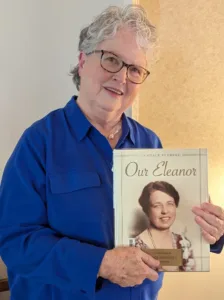
Sharon Klug then presented her paper on Eleanor Roosevelt, a notable New Yorker, in keeping with the topic theme for this year, as summarized:
"Eleanor Roosevelt remains one of the 20th century's most influential figures. From 1948 to 1961, Americans consistently named her the most admired living woman in Gallup's annual poll. Celebrated as the longest serving First Lady, the first female U.S. Delegate to the United Nations General Assembly, and the “First Lady of the World,” she was a tireless champion for social justice, working women, and underprivileged youth.
"Born into New York elite on October 11, 1884, Eleanor's early life was marred by tragedy. She lost her mother and brother at age eight, and her beloved father a year later. Raised by her grandmother, Eleanor grew up plagued by self-doubt, depression, and fear. Yet, she persevered, later writing: “You gain strength, courage, and confidence by every experience in which you really stop to look fear in the face.”
"At 15, she attended a boarding school in England, where she discovered personal confidence. Returning home in 1902 for her conventional society debut -- an event she recalled as “utter agony” -- Eleanor bypassed expected elite pastimes. Guided by an early sense of civic duty, she joined reform organizations to personally fight child labor and improve tenement living conditions.
"In 1905, Eleanor married her fifth cousin, Franklin Delano Roosevelt (FDR). While Franklin was charming and outgoing, Eleanor was serious and shy. Over the next decade, she bore six children and navigated her domineering mother-in-law’s rigid control.
"When Franklin entered politics, Eleanor mastered the role of a political wife. By his 1920 vice presidential campaign, her organizational gifts and sharp judgment became true assets.
"Their lives upended in August 1921 when Franklin contracted polio, leaving his legs permanently paralyzed. Eleanor became his round-the-clock nurse and urged him to persist.
"As he returned to public life and became Governor of New York, Eleanor served as his political surrogate -- touring hospitals, prisons, and venues. By this time, she was often more widely recognized than her husband.
"When Franklin became president in 1933, Eleanor completely revolutionized the role of First Lady. She launched weekly press conferences exclusively for female reporters, toured war zones, and openly fought against racial injustice.
"To connect directly with the public, she wrote a daily syndicated column, “My Day,” and hosted commercial radio broadcasts, earning the nickname “First Lady of Radio.” Between 1927 and 1937, she also made eight impactful visits to the Chautauqua Institute to speak on family bonds and shared civic goals.
"Eleanor's work only expanded after FDR’s death in 1945. She was appointed the first female U.S. delegate to the UN, where she chaired the Commission on Human Rights and led the
drafting of the Universal Declaration of Human Rights -- an achievement she considered her proudest moment.
"Eleanor Roosevelt passed away on November 7, 1962, at age 78, leaving a monumental legacy as an architect of global human rights.