
City resident shares 30th anniversary of motorcycle accident
Remember to share the road
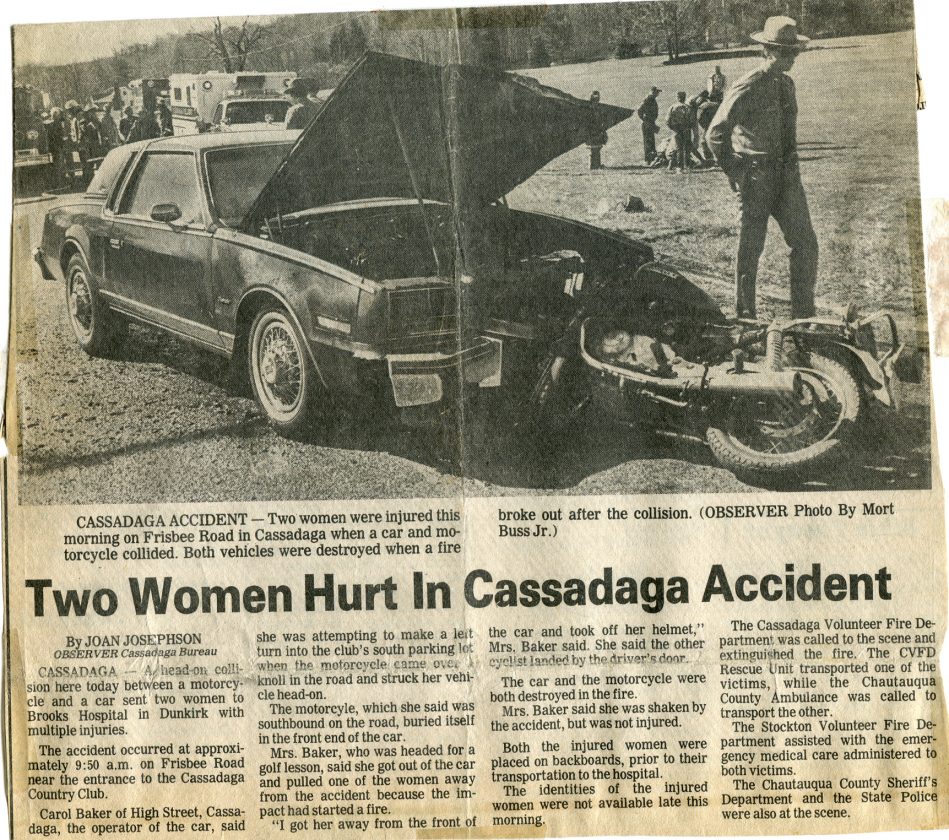
Submitted Photo On April 24, 1989, Sandy Lombardo and her passenger Fredericka Don were involved in a head-on collision with a vehicle on Frisbee Road in Cassadaga (shown here in an OBSERVER article from that date).
It was a beautiful spring morning on April 24, 1989 when 22-year-old Dunkirk resident Sandy Lombardo decided to ride her motorcycle along the back roads to Jamestown Community College for her morning class. An experienced rider, Lombardo grew up around motorcycles and felt comfortable taking the scenic route via County Road 48, otherwise known as Frisbee Road.
At that same time, a car was traveling north on Frisbee Road, heading for Cassadaga Country Club. Unfortunately, the driver did not see Lombardo and her passenger coming over a knoll as she made the left-hand turn into the country club parking lot.
The car and the motorcycle collided head on, and Lombardo flew several feet in the air, making a complete somersault before crashing down on the pavement; her head was the last part of her body to hit the ground.
Meanwhile, Lombardo’s passenger, 24-year-old Fredericka Don, was thrown from the bike and landed on the ground near the car. Both the car and the motorcycle burst into flames from the impact, and Lombardo and Don tried to crawl away from the blaze as quickly as possible.
“If I didn’t have that helmet on, I would be dead,” Lombardo recalled in an interview with the OBSERVER on Wednesday, the 30th anniversary of her accident. “It’s amazing that I’m sitting here today — a miracle.”
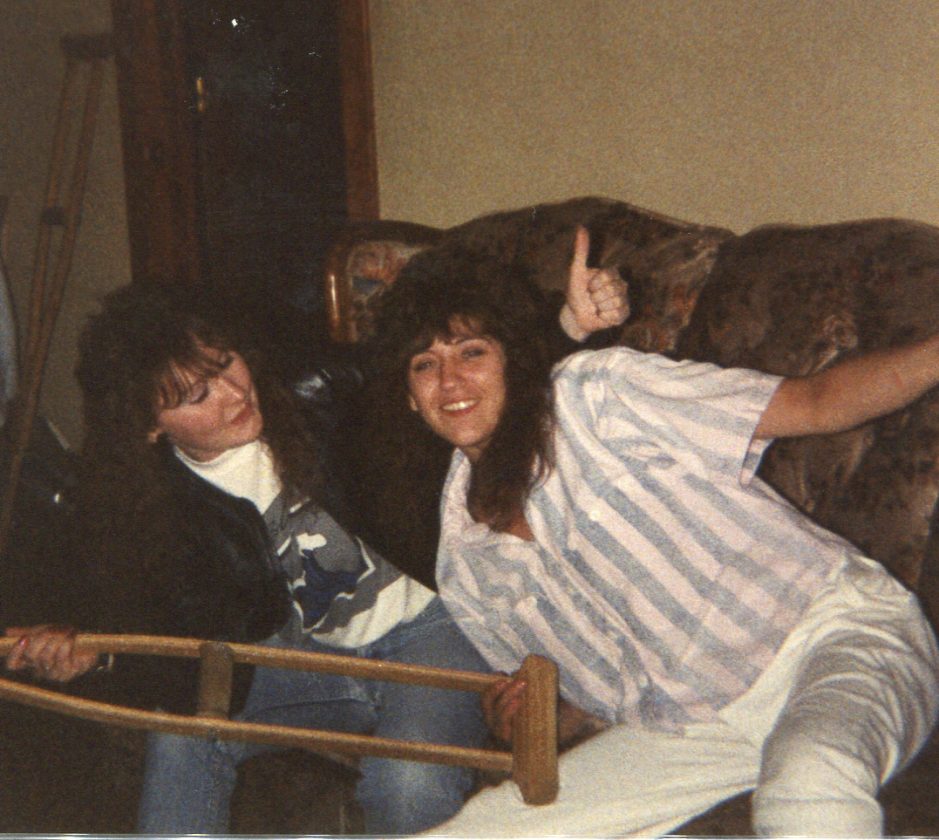
Submitted Photo Fredericka (Ricky) Don and Sandy Lombardo are pictured here after surviving a 1989 motorcycle accident, which left Lombardo on crutches for two years.
Miracle, indeed.
While the driver did not sustain any injuries, Lombardo and Don were taken by ambulance to Brooks Memorial Hospital.
“It seemed like forever for the ambulance to get there,” said Lombardo. “They took us on backboards to the hospital, but when we got there, they didn’t know what to do with us — our injuries were that bad. We were sent by Mercy Flight to Erie County Medical Center.”
Over the course of the day, Lombardo couldn’t bring herself to look down at her legs, where her bones had broken through her skin. “I was sure I was paralyzed,” she recalled. “I just didn’t want to look.”
Lombardo, though not paralyzed, broke both arms and suffered multiple compound fractures in both legs; Don, whose injuries were significant, but less severe, suffered a fractured pelvis. “My mom was just a wreck,” Lombardo recalled. “But I said, ‘Look at the bright side! We’re still alive.'”
Lombardo underwent multiple surgeries that involved metal rods in both legs, along with a metal plate and three screws in one of her arms. “I also had to have a bone graft from both sides of my hips into my leg in order for me to ever walk again,” she remembered.
The road to recovery was a long and painful one for the 22-year-old student, who had been interested in pursuing a career in law at the time. Lombardo spent the next six months in a wheelchair and was on crutches for approximately two years after that.
“You take so many things for granted when you’re strong and healthy,” Lombardo pointed out. “For awhile, my mom had to feed me. I couldn’t do anything for myself. I remember the first time I was finally able to use the bathroom by myself. It’s funny the things you take for granted.” Don also made a full recovery, said Lombardo.
Even though 30 years have passed since that frightening day, Lombardo still deals with pain from the accident. In 2011, she underwent surgery to insert a metal rod in her leg, as one leg had been longer than the other since the accident. “When it’s damp or the barometric pressure changes, I still feel quite a bit of pain and intense pressure. I always know when it’s going to rain,” Lombardo chuckled.
Today, Lombardo calls Dunkirk home and is proud to be the mother of two children, ages 16 and 20. “I haven’t been on a motorcycle since that day,” she stated. “It took me over a year to not relive the accident in my mind. It was so tragic, but I know it could have been worse. For a long time, I just kept thinking about how things would have been different if I’d left earlier, later or had chosen a different route or taken the car.”
While Lombardo can’t change the events of that day, she can — and does — use the experience to teach others about the importance of motorcycle safety. Now that spring is here and motorcycles are out, her advice is a timely reminder to share the road.
“You have to have 10 sets of eyes when you’re riding,” Lombardo said of motorcyclists. “You’ve got to watch out for animals in the road, cars pulling out or even a bee in your helmet. There’s so much you need to be aware of.”
During the early weeks of spring, Lombardo advises extra caution to all, as drivers are not used to sharing the road with motorcyclists after a long winter. “Make sure to look, especially as you’re making a turn. It’s so easy not to see motorcycles in traffic, so just be aware.” Lombardo advises drivers and motorcyclists to be aware of everyone with whom they share the road during the warm weather months: pedestrians, cyclists, young children, dog walkers and more. “A kid or a ball can suddenly be in the road any time,” she added. “Always keep that in the back of your mind.”
Lombardo advises motorcyclists to wear appropriate clothing when they are riding. “I see some people wearing shorts, and my first thought is, ‘No!’ It’s just so dangerous,” she remarked. Lombardo, who was wearing a leather jacket and full-length denim jeans during her accident, recalled how even her sturdy clothing was mostly destroyed in the accident. “The only thing holding my pants together were the belt loops — my jeans were shredded up to my waist.”
What is Lombardo’s most important piece of advice to motorcyclists? “Wear your helmet! Always, every time. Even if it’s not required in the state where you’re riding.”
Interestingly, fewer than half of all states require helmets for all motorcyclists. New York continues to hold fast to the universal motorcycle law enacted in 1967 by the federal government, which requires a helmet for all riders. In 1976, Congress revoked federal authority to penalize states for noncompliance, and many states repealed their laws or modified them to apply only to young or novice riders.
Nineteen states and D.C. still have a universal helmet law, but 28 states only require helmets for specific riders. For example, Ohio only requires helmets for riders under 18 or those who have been licensed for less than one year. Pennsylvania requires helmets for all riders under 21 or who have been licensed for less than two years, except those who complete a state-approved motorcycle safety course. Three states — Illinois, Iowa and New Hampshire — do not have any motorcycle helmet laws.
According to the most recent findings of the National Highway Traffic Safety Administration, there were 5,286 motorcyclists killed in 2016, a 5.1 percent increase from the 5,029 motorcyclists killed in 2015. NHTSA estimates that helmets saved 1,859 motorcyclists’ lives in 2016, and that 802 more lives could have been saved if all motorcyclists had worn helmets.
“It doesn’t matter where you’re riding or what time of day,” Lombardo added. “Accidents can happen anywhere. I never thought it would happen to me.”
The data appears to support Lombardo’s experience. While some may assume accidents are most likely to happen at night or in poor weather, the 2016 NHTSA shows that 59% of motorcyclist fatalities occurred during daylight and 97% occurred in cloudy or clear conditions, compared to rain or other conditions.
According to data from insurance company Geico, two thirds of all motorcycle accidents are caused by a driver violating the motorcyclist’s right of way; being aware of turning vehicles is imperative. In 41% of two-vehicle fatal crashes in 2016, the other vehicles were turning left while the motorcycles were going straight, passing or overtaking other vehicles, according to NHTSA data.
Other important road-sharing tips include the following:
¯ Leave distance between your vehicle and a motorcycle. If you rear-end a car, the driver is well-protected, but a motorcyclist is completely exposed.
¯ Motorcyclists rarely “weave” or swerve for no reason. Many are avoiding potholes, road debris or avoiding drivers’ blindspots. Leave motorcyclists as much space as possible, especially in windy weather.
¯ Their smaller size may make motorcycles look farther away than they actually are, and may make it difficult to judge their speed.
¯ Motorcyclists may slow down without visual warning, as downshifting or rolling off the throttle does not activate brake lights.
In 30 years, Lombardo has yet to meet another motorcyclist who has survived a head-on crash. She said every day she is thankful to be alive, which she has expressed both privately and publicly over the years. In 1996, Lombardo published a “Cards of thanks” notice in the OBSERVER on the anniversary of her accident. In it, she reminds drivers and motorcyclists to be cautious as they share the road and to wear the appropriate safety gear and clothing. “I also wish to thank the Cassadaga Volunteer Fire Department & Rescue Unit, the Chautauqua County Ambulance, the Sheriff’s Department and State Police whose excellent response made it possible for me to be here today!” she concluded.
On Wednesday, the 30th anniversary of her accident, Lombardo continued to thank everyone who responded to the accident and worked to save her and her friend’s lives. “I’m so grateful to be alive, and I hope I can prevent someone else from the same situation,” she told the OBSERVER. “Or one that is much worse.”
-
- Submitted Photo On April 24, 1989, Sandy Lombardo and her passenger Fredericka Don were involved in a head-on collision with a vehicle on Frisbee Road in Cassadaga (shown here in an OBSERVER article from that date).
-
- Submitted Photo Fredericka (Ricky) Don and Sandy Lombardo are pictured here after surviving a 1989 motorcycle accident, which left Lombardo on crutches for two years.
TOP STORIES
Healing with horses — ‘Connection’ and triumph: Centaur Stride worker heading to Alfred Equestrian Center
Real estate transactions include Westfield ice cream shop
2026 VanderLaan Prize awarded to SUNY senior
New Horizons Band spring concert is Thursday
Man tied to Fredonia shelter in place facing numerous weapons charges
Dairy market pushes forward despite challenges
In the wake of Refresco canceling its local contracts with grape growers, other agricultural markets such as dairy ...