
Busing ‘juggle’: Gowanda sees driver shortage, route issues
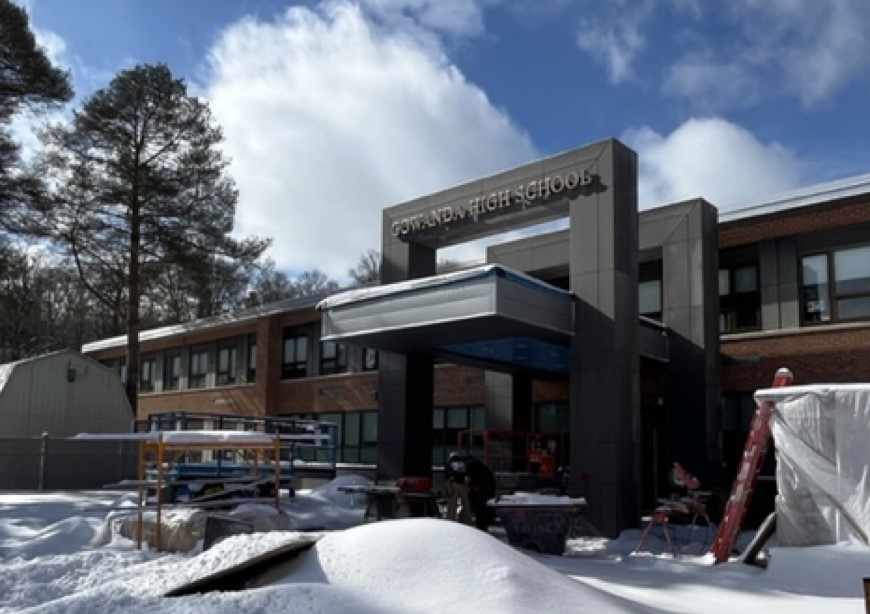
Submitted photo The entrance to the Gowanda High School has been updated as part of the Gowanda capital project.
GOWANDA — At last week’s budget workshop, the topic of bus seating capacity and bus efficiency at Gowanda Central School became a topic of discussion. Previously, Gowanda Superintendent Dr. Robert Anderson said that there was a push from the School Board to maximize efficient transportation, with the old policy being that busses should be filled to 90 percent capacity.
That desired capacity is no longer the school policy, and the discussion about what the school board wants is open. “If you look at efficiency, you may be collapsing routes,” Anderson said. “But the con of that, or the cost, is maybe students have a longer time on the bus.”
According to Gowanda’s transportation Supervisor, Annette Nelson, most students spend approximately 45 to 50 minutes on the bus as of now. There are other factors that increase that timespan, including accommodations for a student currently out of the district. Nelson said she’s doing her best to make it so students aren’t on the bus that long, but currently, that’s being held back by another issue Gowanda has been struggling with for a while: The lack of bus drivers.
“We do have a shortage of drivers,” said Nelson. “We have 15 runs and 12 regular bus drivers. That puts me behind the wheel and the mechanics behind the wheel. And if somebody gets sick, that makes it even harder to accommodate a sports run or something like that, unless they’re after hours. … It is quite a challenge to juggle all that and make it all work.”
Nelson said she’s been told since she started to focus on efficiency and condensing routes, and has worked hard every year to move things around to maximize that efficiency. Nelson said between COVID and driver shortage, the change around this year was due to lack of staff.
Nelson said that, for middle school and high school age students, buses can accommodate 44 students, which is what the state wants them to do. For younger kids, 66 kids can fit on the bus. Nelson, however, does not pack the buses to that capacity.
“Especially with COVID, I try to keep things so I don’t have more than say one or two,” said Nelson. “The way the drivers are loading the kids, we’re trying to keep them as separated as we can and the last ones to fill in, so they’re not stuck with somebody that isn’t family for longer than is necessary.”
While Nelson has always focused on efficiency, she said she would take whatever direction the school administrators need her to take, all she asked for was the staff to be able to do it. But the process for getting that staff is becoming more difficult. The federal government recently decided that any school bus driver has to go to school, like tractor trailer drivers do, so Nelson can’t bring drivers in and train them until she gets federally approved, meaning she knows her desire for more staff will take more time.
“I’m hoping a bunch of people decide this is the career they want, then they’ll be out looking for jobs and I’ll have a whole bunch,” said Nelson. “I don’t know if it’s going to happen but that’s what I’m hoping for.”
While the likelihood of anything changing this year is minimal, school board Vice President Max Graham pondered the idea of adding a couple more routes and what that would do to help reduce the time students are on the bus.
“If adding two or three runs reduced the average time from 45 minutes to 25 minutes, then that might be something we strongly consider,” said Graham. “Then the cost of three more regular bus drivers and three more runs is worth getting our kids off the bus an extra 40 minutes per day.”
One thing that could encourage drivers to want to drive in the district is the six-hour flat rate, which is of benefit to both drivers and the district.
“If the run is only two and a half hours in the morning and two and a half in the afternoon, that’s five, they’re basically giving them an hour,” said Nelson. “It’s like a salary. They’re salaried for six hours but they’re only working five.”
Ultimately, the Board and Dr. Anderson seemed to be open to considering other options, but for now, they are continuing to operate on the basis of efficiency of routes until more staff potentially come available for hire.
TOP STORIES
Fire closes Fredonia bakery until further notice
A Fredonia bakery and cafe has announced it is closed until further notice after a Thursday afternoon oven ...
Area leaders call for action on homeless issue

Fredonia’s proposed tax hike up to 4%
Deputies involved in Mina shooting back on duty
The two Chautauqua County Sheriff deputies who have been essentially cleared in an officer-involved shooting in ...
No easy way out for struggling entities
