Leaked Roe opinion prompts NY response
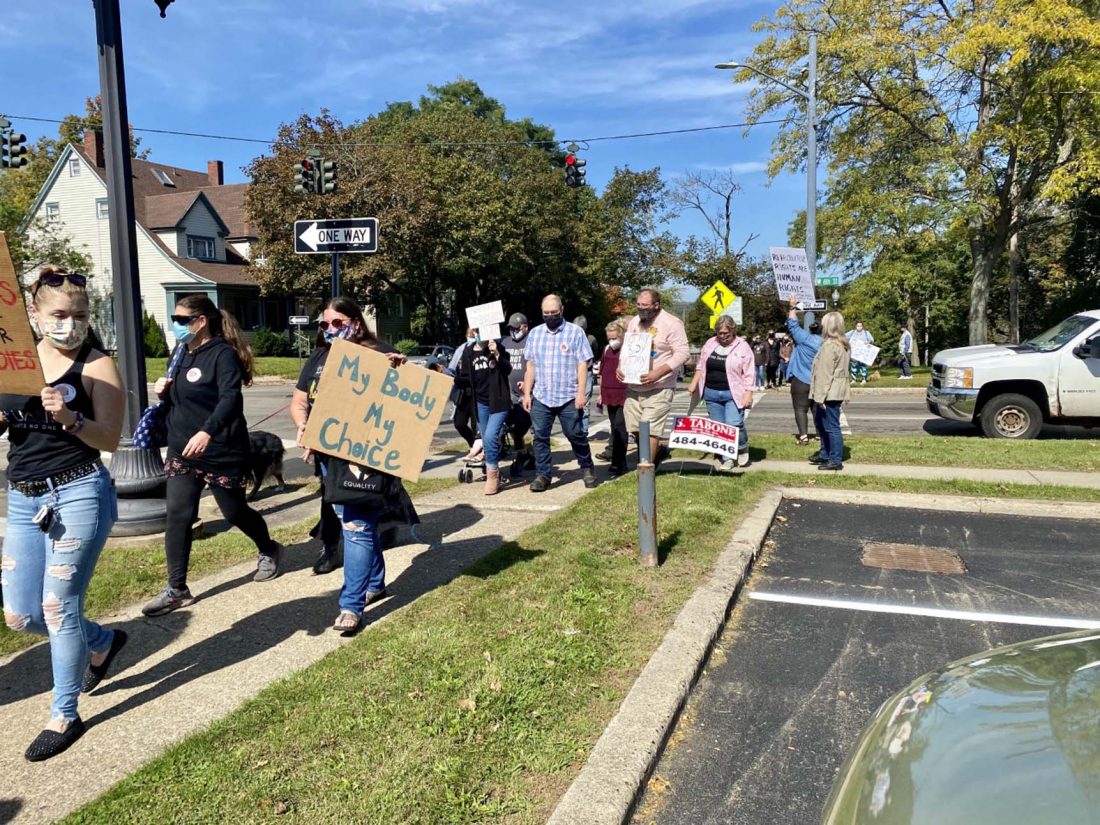
JM Rally file.jpg OBSERVER File Photo Pictured are participants in a Jamestown Women’s March held in October 2021. Two bills introduced this week would strengthen New York’s official stance as a supporter of abortion rights.
The possible end of Roe v. Wade as the law of the land is prompting a response from New York lawmakers.
The Supreme Court heard arguments in December in Mississippi’s bid to have the landmark Roe v. Wade decision guaranteeing a woman’s right to an abortion overturned. In Dobbs v. Jackson Women’s Health Organization, Mississippi is asking the high court to uphold its ban on most abortions after the 15th week of pregnancy approved in 2018 but blocked after a federal court challenge. The state has told the court it should overrule Roe and the 1992 decision in Planned Parenthood v. Casey that prevent states from banning abortion before viability, the point at which a fetus can survive outside the womb, around 24 weeks of pregnancy.
A decision in the Mississippi case has not been formally announced, but a leaked draft opinion indicated the court is likely to overturn Roe v. Wade unless one of the Supreme Court justices has a change of heart.
Last year, the Supreme Court allowed a Texas law to take effect that bans abortions after cardiac activity can be detected, around 6 weeks of pregnancy, before some women even know they are pregnant. The law is unusual in that it allows private citizens to sue people who may have facilitated a prohibited abortion. The court, split 5-4, did not rule on the constitutionality of the law, but rather declined to block enforcement while a challenge to the law plays out in the courts.
Two new bills introduced this week would strengthen New York’s official stance as a supporter of abortion rights. A.10148, sponsored by Jessica Gonzalez-Rojas, D-East Elmhurst, would establish the Reproductive Freedom and Equity Program to provide funding to New York abortion providers and nonprofit organizations to increase access to abortion care.
No funding amount is included in the bill text, with funding to be debated in annual state budget discussions. Gonzalez-Rojas proposes strict privacy protections for organizations accepting the state money. Groups would not be allowed to give the name, address, photograph, driver’s license number, email address, phone number or any other personal identifying information of patients.
“With the Supreme Court poised to overturn or dramatically weaken federal protections around the right to abortion care, New York must be prepared to respond to the dramatically shifting national landscape of abortion access,” Gonzalez-Rojas wrote in her legislative justification. “The Reproductive Freedom Equity Fund would create a mechanism to drive grant funds to improve abortion access in New York. The Reproductive Freedom Equity Fund would create a mechanism to drive grant funds to improve abortion access in New York. … Specifically, this funding would support provider capacity building in the event Roe v. Wade is overturned, fund uncompensated care for those who lack coverage or for those whose coverage is not usable and support the practical support needs for individuals facing barriers to abortion care.”
Sen. Alessandra Biaggi, D-Bronx, is proposing the Freedom From Interference With Reproductive Health Advocacy and Travel Exercise Act (S.9039). Assemblyman Chris Burdick, D-Mount Kisco, has introduced a companion bill (A.10094) in the state Assembly.
Biaggi’s proposal would amend the state Civil Rights Law to create a section titled Unlawful Interference With Protected Rights. A right would be established to obtain an abortion, and interfering with an abortion could result in a criminal charges or civil claims against a person in any federal or state court. The bill states rights protected under the proposed new section of law to include the right to obtain reproductive health care, including abortion, and the right to obtain medical care, including hormone therapy or other gender-related therapy.
Actions would have a six-year statute of limitations and would have to be brought in state Supreme Court. The bill also spells out defenses that someone could not make, including ignorance or mistake of law, a person’s belief that the Fire Hate Act is unconstitutional, reliance on a court decision that has been overturned on appeal, reliance on any state or federal court decision that is not binding on the court where the action is brought or a claim that the enforcement of the Fire Hate Act against a person would violate the constitutional rights of third parties.
“In light of the SCOTUS draft majority opinion leak overturning Roe v. Wade, New York must hold strong as a safe haven for people seeking to exercise their rights,” Biaggi said. “This bill will help protect anyone who receives an abortion in New York from unlawful interference in their rights. We must move immediately to provide every protection possible to those seeking care, including the passage of this bill.”
Both bills are in addition to other legislation pending in the state Legislature. Assemblyman Tom Abinanti, D-Tarrytown, wants the state Constitution to include a new section that states an individual’s right to personal reproductive autonomy is central to the liberty and dignity to determine one’s own life course and shall not be denied or infringed.
“Amending the state Constitution to provide for an individual’s right to personal reproductive liberty will help ensure reproductive freedoms for our citizens and further support the fundamental importance of reproductive liberty in our state,” Abinanti wrote in his legislative justification.
In 2019, the state enacted the Reproductive Health Act, which codified abortion rights established in Roe v. Wade. The legislation made abortion a “fundamental right” under the state Constitution. The law also added a “health” exception to New York law making abortions legal in the final three months of a pregnancy to protect a patient’s “life or health.” Previously the law had allowed late-term abortions only to protect a patient’s “life.” The act also legalized abortion after 24 weeks in the absence of fetal viability.