‘Diverse ideas’ rely on partisanship
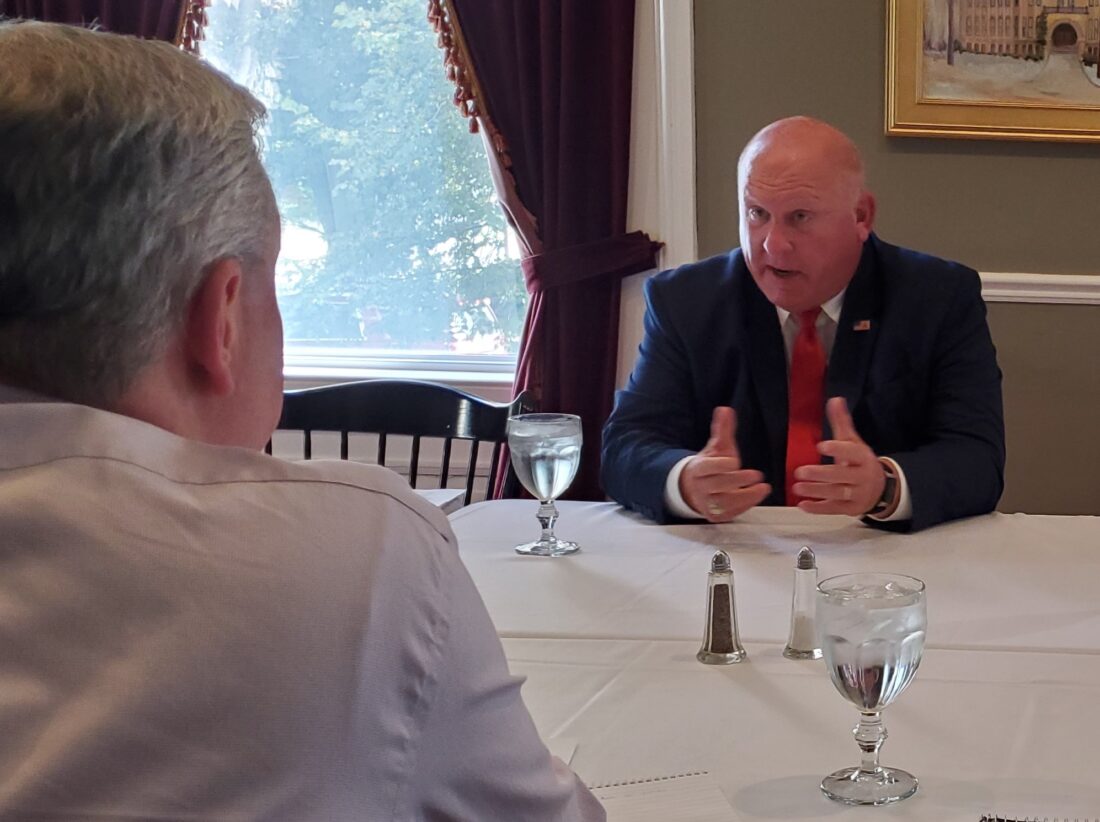
Photo by Brian Ferry U.S. Rep. Glenn “GT” Thompson, left, represents 14 counties that are heavily Republican in Pennsylvania
WARREN, Pa. — U.S. Rep. Glenn “GT” Thompson made no apologies this week for being a loyal Republican. “There’s nothing wrong with partisanship, which surprises some people to hear that,” he said during a Monday meeting at the Conewango Club in downtown. “You want diverse ideas. We’re a diverse nation. There’s 435 Congressional districts. I mean, I may like to visit Nancy Pelosi’s district in San Francisco, but I sure as heck could not get elected there.Thompson, in those statements alone, comes across as a straight shooter. What you see — and hear — is what you get from the lifelong Howard resident.
Serving the 15th Congressional district, however, can become a long haul. In its current configuration, Thompson represents 14 counties in western and central Pennsylvania. That number will grow to 18 starting in 2023, but will continue a trend of serving predominantly red voters.
A case could be made that the region he covers is just as large as the current 23rd District in New York state.
Short-term U.S. Rep. Joe Sempolinski is in the midst of holding a three-month seat that will be taken over by either Nick Langworthy or Max Della Pia in January that will extend north into Erie County.
While the Langworthy-Della Pia contest has featured few fireworks, it is no different across the border. The dominant Thompson is facing opposition from Mike Molesevich of Union County. Molesevich’s agenda, according to his web site, focuses on accessible health care, women’s reproductive rights, affordable housing and agriculture.
“If Republicans take over the U.S. House and the U.S. Senate, they will seek a nationwide ban on abortion,” Molesevich said. “The right to reproductive privacy is definitely on the ballot this November 2022.”
There is no middle ground for either party on this sensitive issue. Whatever one believes regarding a woman’s right to choose often brings little room for debate.
This is exactly where Congress — and America — can become highly divisive. Both sides, especially the radical segment of both the Democrats and Republicans, are often stubborn in their views while insulting the other side for theirs.
To his credit, Thompson this week talked about coming together on issues where there can be consensus. “These two extremes,” Thompson said, “really do impact the partisan divide. It does drive us apart. Those who want to bring (bipartisan ideas) to the table have to work all the harder to make that happen. …. I think the best legislation is legislation that is passed in a bipartisan fashion. Legislation passed by one party… it doesn’t last. It will be repealed when the pendulum swings and the other party is in control.”
Thompson pointed to an effort introduced as the Plugging Orphan Wells and Environmental Restoration Act. The act, which reauthorizes the federal orphan well remediation program under the Energy Policy Act of 2005 for five years at $50 million per year, was co-sponsored by Rep. Salud Carbajal, a Democrat from California.
“Just be willing to come to the table,” he said. “We don’t have to spend a lot of time on what we disagree on, I can just turn on cable news and figure out what that is, but be willing to come to the table and let’s talk about what we can agree upon and use that as the basis to find cost-effective solutions.”
As Republican leader of the Agriculture Committee, Thompson also spoke of some of the major challenges that many rural communities in his district and across the Northeast are facing. He’s worried solar panels are overtaking significant land in his district that is vital to farming. He also spoke of concerns regarding small businesses and manufacturers needing more individuals qualified to fill positions in the workforce.
Those struggles voiced by Thompson are very similar to the talking points heard in Chautauqua County. Both New York’s District 23 and Pennsylvania’s District 15 are filled with natural gems that include forests, rivers and lakes, but population continues to decline — especially for those who fit the 25 and under demographic.
“We’ve got great jobs in almost every industry and the challenge is finding people who are qualified and trained and willing to work,” Thompson said, noting family households that more than 50 years ago were as high as five to seven members, has decreased to just three or four in recent decades.
“That just decimates your workforce as nation,” he said.
John D’Agostino is editor of the OBSERVER, The Post-Journal and Times Observer in Warren, Pa. Send comments to jdagostino@observertoday.com or call 716-366-3000, ext. 253.