
Chamber warns against annual minimum wage increase
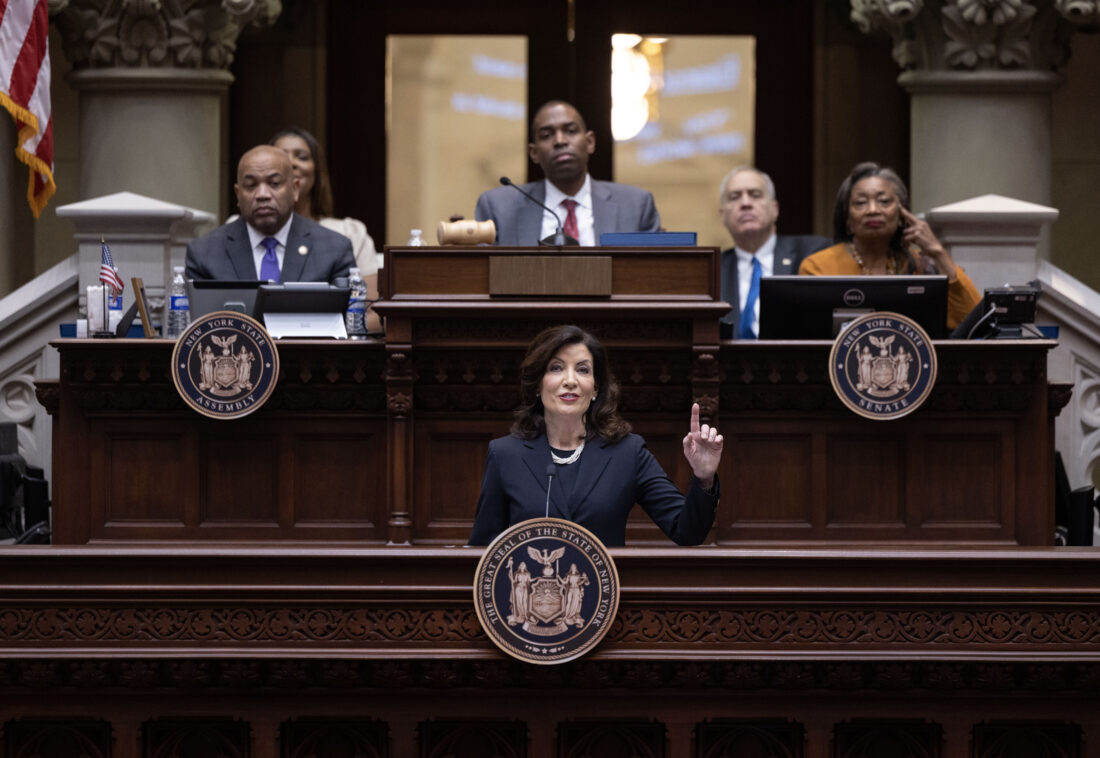
Submitted Photo Gov. Kathy Hochul is pictured giving her State of the State address last week in Albany.
The Chautauqua County Chamber of Commerce argues that the governor’s push for minimum wage to be tied to inflation could have negative impacts for local small businesses.
In her recent State of the State address, Gov. Kathy Hochul, pushed for additional increases to the state’s minimum wage in order to address inflation concerns for low-income workers throughout the state.
“As a matter of fairness and social justice, I am proposing a plan to peg the minimum wage to inflation,” she said.
Dan Heitzenrater, president and CEO of the Chautauqua County Chamber of Commerce, explained that the Chamber has typically advocated for the minimum wage to be determined from a federal level, rather than by individuals states. He explained that Chautauqua County is in a difficult position regarding minimum wage due to its close proximity to Pennsylvania and Ohio, which both have “significantly lower” minimum wage requirements for businesses.
“That’s obviously a challenge for businesses when they are looking at how to be competitive with our neighbors,” he said. “That certainly should be a consideration as the state looks at those policies.”
Now that New York has established guidelines that are gradually raising the minimum wage to $15 per hour throughout the state, Heitzenrater believes local labor markets across the state should determine further wage increases. Heitzenrater believes the state government should refrain from legislating additional minimum wage increases.
“Sometimes things don’t need to be regulated, and the local business climates and market can determine things from there,” he said. “I think we see it already locally, given the current labor climate and a lot of folks searching for employees, is that you see a lot of signs out in front of businesses that are already offering more than minimum wage.”
Tying minimum wage to inflation and the consumer price index is something Heitzenrater believes would be a dangerous precedent. According to Heitzenrater, not only would an annual review and adjustment of the minimum wage create a “real challenge” to local businesses in competition with businesses in Pennsylvania and Ohio, but that there would be a potential for wage compression.
Heitzenrater explained that for businesses that currently pay employees more than the minimum wage, the affect of the increase in minimum wage might not impact them at first; however, if the minimum wage continues to increase, those wages would start to “compress” as the gap slowly closed between wages. Heitzenrater said the affect would “trickle up” as businesses would be forced to adjust to offer competitive positions that would pay more than the minimum wage.
“I don’t think those numbers are ever going to go down,” he said. “It’s going to be something that would obviously set our businesses here in New York State on a course where those costs are going to go up every year based on that rising minimum wage, rather than maybe going up based on the business’s ability to give annual increases or tie them to performance metrics.”
With the state’s current plan to increase minimum wage to $15 per hour, Heitzenrater said businesses are already having to take a proactive approach and “pay attention” to the gradual increases. Heitzenrater encourages local businesses to remain updated on minimum wage increases and comply with the standards of the Department of Labor; however, he believes businesses will have to pay even closer attention if the governor’s proposal moves forward.
“I think, if something like the proposal that was made moves forward, certainly they will want to make sure that they are always watching that news every year and making sure that they’re reviewing where their employees are at and making sure that they’re paying what the new minimum wage is,” he said. “I think folks can look at their administrative side of things to be prepared. Whether they do payroll themselves or use a company, it’s something you want to be diligent about to make sure you’re never in violation.”
Despite the governor’s belief that additional increases to minimum wage will help low-income workers better manage the challenge of rising inflation, Heitzenrater argues that state and local regulations should enact policies that help small businesses remain competitive, rather than enact policies that discourage business owners from operating businesses across the state.
Heitzenrater explained that the current nationwide and worldwide inflation is part of “big picture economics.”
“I think if you want to take it in the context of the challenge that inflation is posing to local businesses, and small businesses in our communities, that I think further highlights the importance of states and localities being more friendly to businesses and making it easier for them to do business and be competitive rather than harder,” he said.
TOP STORIES

Ox Roast benefits St. Jude’s on Sunday
Chautauqua keeps moratoriums on energy projects
Rising city ‘data’

Barnes resigns as Silver Creek trustee

Two from Hamburg charged in Dunkirk robberies
Chautauqua woman dies after vehicle strikes bike
CHAUTAUQUA --- A bicyclist has died after an accident last week on Chautauqua-Stedman Road, law enforcement ...