Hamlin scare highlights need for trainers
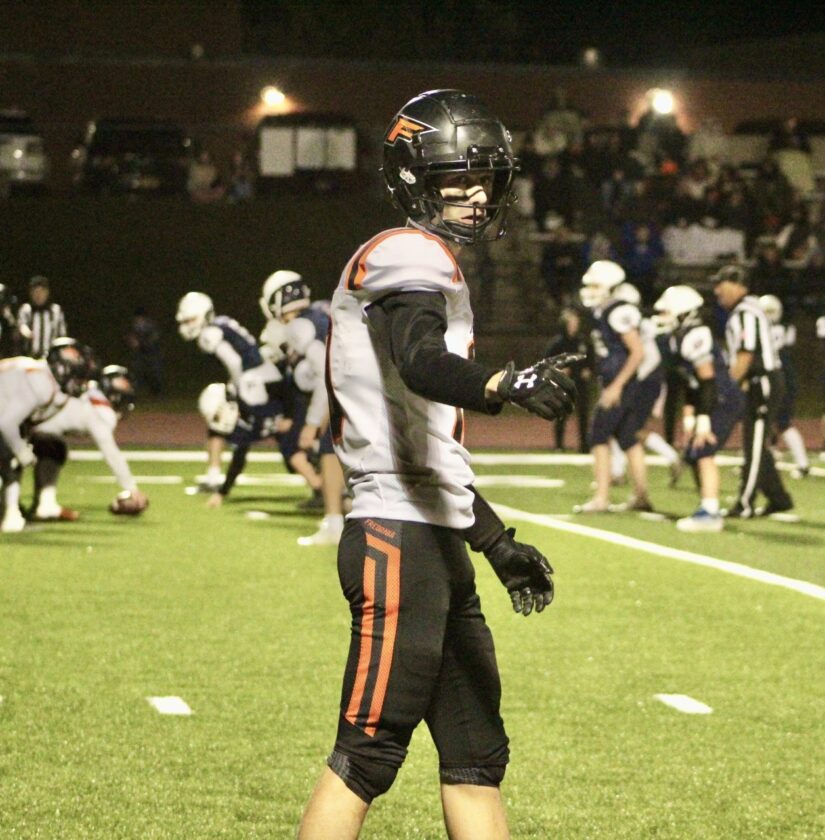
OBSERVER Photo by Braden Carmen Fredonia wide receiver Jay Hawk is shown lining up before a play during a football game at Chautauqua Lake this past fall.
When Buffalo Bills safety Damar Hamlin suffered cardiac arrest on the field during a game in Cincinnati on Monday, Jan. 2, the Bills training staff sprung into action.
Once doctors shared that Hamlin is on the road to recovery, it became apparent that the quick response of the trainers likely saved Hamlin’s life.
“We can’t say enough about the quick actions of the Bills training staff and the physicians who were on the field,” said University of Cincinnati Health Dr. Timothy Pritts, MD.
Bills assistant athletic trainer Denny Kellington was credited as being the one to administer CPR to Hamlin on the field before he was transported via ambulance to UC Health. Bills coach Sean McDermott called Kellington “a real leader, a real hero, in saving Damar’s life” during a press conference last week.
A scary part of the entire situation is what could have happened if the Bills training staff did not act so swiftly.
In many cases in high school athletics all across Western New York, schools do not have an athletic trainer employed at all.
Locally, Dunkirk and Silver Creek share an athletic trainer, Cleon Clayton, through BOCES. Because much of the cost through BOCES is reimbursed by the state, the cost shared by each district is minimal.
“It was a no brainer for us,” said Silver Creek Athletic Director Sean Helmer.
But many other schools do not have an athletic trainer, notably the Fredonia Central School District.
Fredonia Athletic Director Greg Lauer said he and Fredonia Superintendent Dr. Brad Zilliox have spoken about their desire to add an athletic trainer to the district. If a trainer is hired, the position would likely be filled through the personnel budget for a full-time employee.
“Dr. Zilliox and I are exploring every option out there. There are a lot of different ways you can get an athletic trainer, and we’re going to try to work with the (Board of Education) to see what we can do to make that happen in the future,” said Lauer.
Lauer said the district has looked into sharing a trainer in the past, especially when Fredonia was merged with other schools for football. Lauer cited the difficulty of finding qualified trainers through a partner, like Dunkirk and Silver Creek have with BOCES.
The Jamestown Public School District has been a strong supporter of athletic trainers for many years. But for a period of about a year, the district struggled to find a trainer to use, even with the expressed desire to have one on staff.
Jamestown Athletic Director Ben Drake said that BOCES was looking to have an agreement between multiple schools in the area to share trainers for athletic events throughout the year, but without enough interest from qualified applicants, Jamestown was “left scrambling” to find a solution.
“We realized that wasn’t going to be an option. The only way to have a trainer present for us was to hire one full time,” said Drake.
Finally after a year of struggling to find trainers to work at a per diem rate, the district was recently able to hire Keiona Nance as a full-time athletic trainer to work for the district. Nance works at both home and away games for all sports, prioritizing the sport deemed the biggest risk of serious injury at the time if contests overlap.
Drake said Nance has “a very diverse background” including her work with the University at Buffalo basketball programs and work in a surgeon’s office. Nance, who worked at a per diem rate while the school was searching for a full-time trainer, is currently on a pathway to receive her doctorate degree.
“We’re all very grateful that our district and the board allowed us to have someone full-time. We are very fortunate,” said Drake. “Trainers play such an important role in preventing, diagnosing, and treating injuries. In emergencies, we saw with Damar Hamlin how that can happen and how important they are. Knowing we have a trainer gives our coaches peace of mind.”
“Having a trainer is really important for a variety of reasons. Everything from a player being seriously injured comes to mind, but also the treatment of players with getting them back to health. Also being proactive to prevent injuries, to provide nutrition and education,” said Jamestown Red Raiders football coach Tom Langworthy. “Coaches do some of that too, but trainers are important to reinforce it and to provide expertise.”
For all schools, New York State requires an automated external defibrillator (AED) to be nearby for any athletic activity. Head coaches are also required to be certified in cardiopulmonary resuscitation (CPR) and first aid including the use of an AED.
All coaches across Western New York are also expected to have an emergency action plan in the event of a serious incident, but many schools take that preparation further than others. In the past, Silver Creek has brought EMTs in to practice what would happen in the event of a serious injury. “That was great experience for them and for us to know that we’re all ready in case something happens,” Helmer said.
In addition to the state mandate for head coaches to be trained in CPR and first aid including the use of an AED, Fredonia requires the certifications for all of its coaches and volunteers. Students in the district are also offered instruction on hands-only CPR, as well, in the event that the coach is the one who needs assistance.
“We have things in place that make this a safe place, but we know there are things we can do to make it even safer,” Lauer said.
Overall, the recent traumatic events surrounding Hamlin and the Bills have caused many to evaluate the state of athletics, especially in the case of minors.
“I think it brought a lot of awareness,” said Lauer of Hamlin’s injury and the importance of having an athletic trainer. “A lot of people are asking questions about not only an athletic trainer, but also about AEDs and things we already have in place that are there, but people don’t think about those things until something serious like this happens.”
“The first goal of every school is student safety. When you talk about athletics, it’s important we put our students in a position where they will be safe,” Langworthy said.