County discusses jail operations, few details on deaths
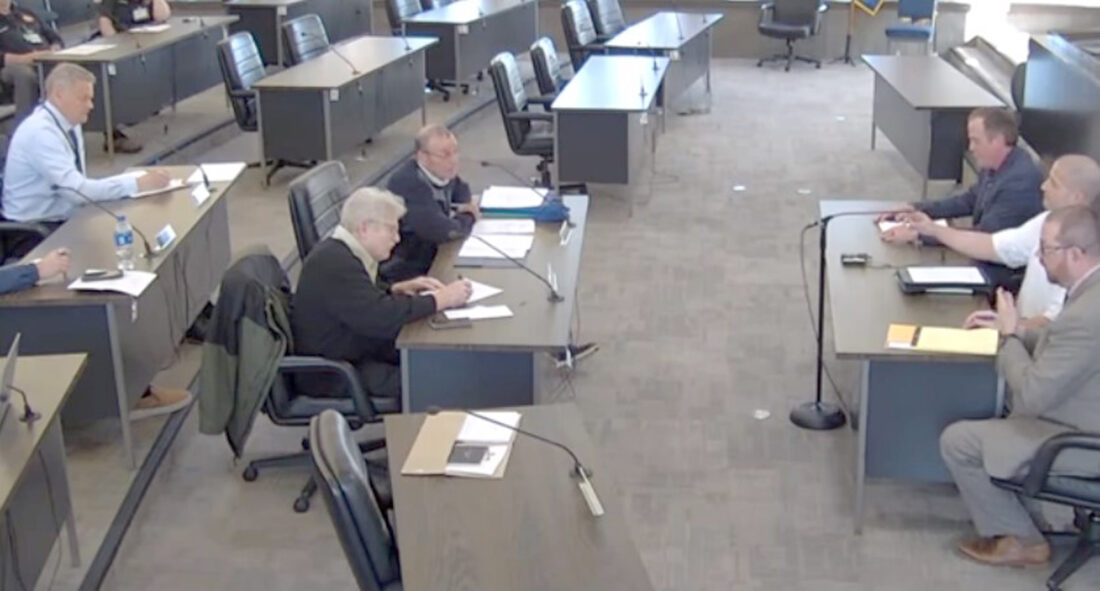
Interim Public Health Director Dr. Michael Faulk, Sheriff James Quattrone and county attorney Patrick Slagle, right, discuss operations at the county jail during the county legislature’s Public Safety Committee meeting.
In 2021, two Chautauqua County Jail inmates died. While county officials have yet to comment on the deaths, which were investigated by both the state Attorney General’s Office and the state Department Medical Review Board, they did officially acknowledge the two deaths during a discussion about jail operations.
During the county legislature’s Public Safety and Human Services Committee meetings, interim Public Health Director Dr. Michael Faulk, Sheriff James Quattrone and county attorney Patrick Slagle, discussed the jail’s operations.
Slagle began the conversation, noting The Post-Journal and OBSERVER reported in early April about the two deaths. One inmate died from a medical issue, while the other committed suicide.
He confirmed the state Medical Review Board made some recommendations, including having the county Legislature “review the findings and conduct an inquiry into the fitness of the designated provider.”
“The county Legislature does not actually appoint the provider directly. It approves the budget of the Department of Health and Human Services, which contracts for services,” Slagle said. “There will be a time when there’s an actual discussion on the facts of those cases, which were not agreed upon. The Attorney General did an investigation and also found no wrong doing. But I think at this point it’s essential that the (committee) members and even the general public understand what jail medical is.”
JAIL MEDICAL SERVICES
Faulk noted the county’s Health Department took over the jail’s medical services several years ago.
In October, Faulk began personally providing medical services as the physician for the jail, along with county physician Brian Walters.
He shared what medical services are provided at the jail. Those include: comprehensive access to routine medical management, acute and sub-acute illnesses and injuries, preventative health, chronic disease management, coordination of on-going and outside medical consults, and follow up with specialists’ care.
“All incarcerated individuals are screened at booking for acute medical or active and/or mental health conditions,” Faulk said. The screenings include drug or alcohol intoxication, or withdrawal symptoms. Medical personnel are either on site or available on call, 24 hours a day, seven days a week if questions arise.
Faulk said on weekdays during the day, there are at least four nursing staff members at the jail and at least two days a week either he or Walters are on site to do direct medical care.
In the evening and weekend hours, there’s at least one registered nurse. During those times, either Faulk or Walters are on call, 24 hours a day, seven days a week, 365 days a year.
According to Faulk, all incarcerated individuals receive comprehensive medical and mental health assessments within 14 days of entering the jail. If there are urgent matters, the assessment will take place much sooner, sometimes within days or even hours of being booked.
Most inmates only stay in the jail for days or weeks. Ones that stay longer are usually federal inmates. In those cases, they get regular preventative screenings, chronic disease management and dental care.
On average, there’s 170 incarcerated individuals in the jail. Right now 42 of them are federal inmates.
From January to March, Faulk said there was 1,935 visits, including scheduled nursing, acute, doctor, withdrawal, health assessments and Medical Assisted Treatments for drugs. “We’re averaging four to five emergency or 9-1-1 calls a month,” he added.
ACCREDITATION
Faulk noted that former Public Health Director Christine Schuyler and Quattrone sought to standardize the care at the jail.
“These leaders were committed and we will continue with that commitment to seeking and implementing a nationally accepted standard of care in health services delivery within the correctional setting,” he said.
To that end, Faulk said they’re working on getting an accreditation through the National Commission on Correctional Health Care.
Faulk said the NCCHC has done two inspections and interviews with the county, both of which were positive. He said they fully expect to get the accreditation later this year. “It’s a true testament to the dedication, passion and experience that both our medical and corrections leadership bring to the Chautauqua County facility,” he said.
Along with a potential accreditation, Faulk said there are now 54 new policies and procedures. They’ve also formed an Infection Control Team.
According to Quattrone, there may only be two other jails in the state that have this accreditation. “We will likely be the third. We have not had it awarded to us yet,” he said.
Legislator Terry Niebel, R-Sheridan, said Quattrone and the medical staff should be proud of their hard work and added that he’s looking forward to hearing about the accreditation, should it be awarded.