
Fredonia to evaluate upgrades of facilities
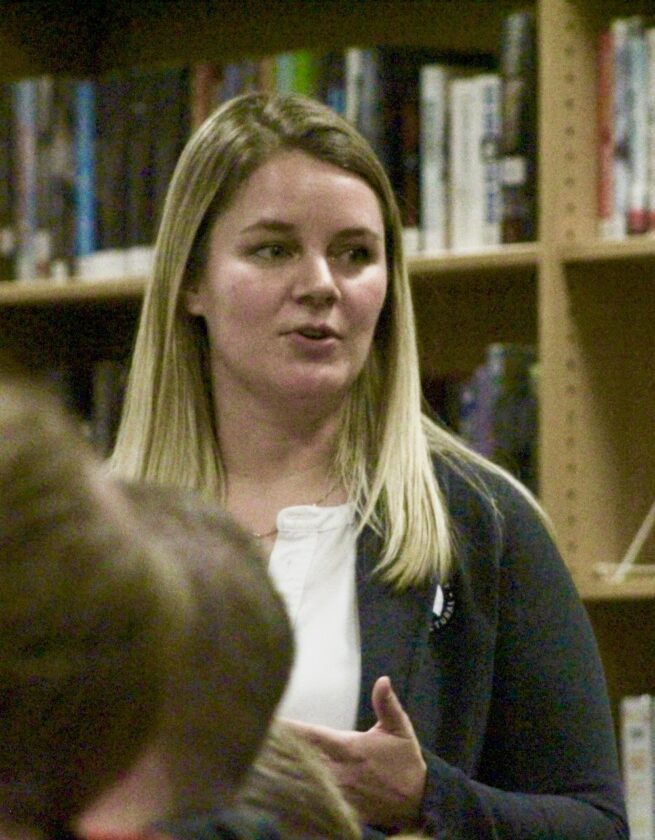
OBSERVER Photos by Braden Carmen Alyssa Catlin, Associate of Young and Wright, presented a plan for capital improvements to the Fredonia Board of Education at a recent meeting.
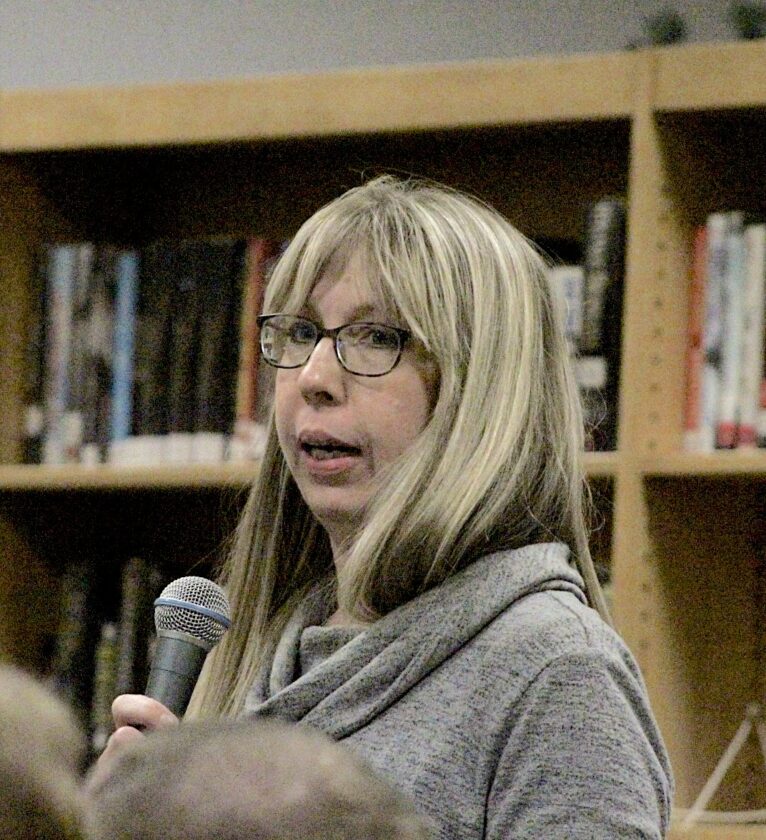
Kristi Leone, the mother of Elliana Leone, a first grader at Fredonia Elementary School, spoke about the district’s playground accessibility issues prior to the presentation regarding potential capital improvements at a recent meeting of the Board of Education.
OBSERVER Photos by Braden Carmen Alyssa Catlin, Associate of Young and Wright, presented a plan for capital improvements to the Fredonia Board of Education at a recent meeting.
Kristi Leone, the mother of Elliana Leone, a first grader at Fredonia Elementary School, spoke about the district’s playground accessibility issues prior to the presentation regarding potential capital improvements at a recent meeting of the Board of Education.
Trending
Regarding the district's facilities, the ball is now in the court of the Fredonia Central School District.
At a recent meeting, the Fredonia Board of Education finally received the information it was waiting for, as Young and Wright Architectural presented a report on the district's building conditions over the course of an hour at a recent meeting in front of an audience including nearly 30 guests in the High School Library.
Fredonia Superintendent Dr. Brad Zilliox called the presentation "a beginning of a conversation" about the district's priorities moving forward.
"It's nice to finally get to this stage," Board of Education Vice President Steven Johnston said.
Over the past year, Young and Wright sent multiple representatives from various different fields of expertise to visit Fredonia's facilities to evaluate the current state of the district.
In attendance to present the firm's findings for Young and Wright was a group that included Shawn Wright, Partner; Alyssa Catlin, Associate; and Christina Weber, Project Architect. Catlin took the lead in the presentation.
The district currently has a capital outlay project from 2022 still in progress, focused on a secure entrance to the Wheelock campus. That project, overseen by Young and Wright, will "wrap up in the next couple of months," according to Catlin. The 2023 capital outlay project is focused on pavement replacement at the Wheelock campus. Bids will be solicited in the spring of 2024, with construction to follow once a bid is approved.
"Those are the two capital projects that are kind of 'in the queue'," Catlin said.
When it comes to future work, however, the district has set its sights on much more substantial plans.
A major focus of the district has been its athletic fields, led by multiple speakers to bring the issue before the board at previous meetings. However, the only speaker from the public at the most recent meeting highlighted another issue the district has not addressed for years that involves "letting the kids play" in a completely different manner.
Kristi Leone – the mother of Elliana Leone, a first-grader at Fredonia Elementary School – spoke about the district's playground accessibility issues. Elliana Leone is handicapped and is unable to easily access the playground like her classmates are because of the district's unaddressed accessibility concerns. She was previously highlighted as a Special Olympian in the OBSERVER last school year when her classmates from Wheelock attended the Special Olympics at SUNY Fredonia to cheer her on.
"Just to remind everybody, accessibility does actually work for everybody, so it would be a really nice way to show that the district is really serving all of their students," Kristi Leone said.
In the report presented by Catlin, Young and Wright listed playground improvements in a list of "want to do's", along with improved student experiences, renovated spaces, and athletic improvements.
"The school playground is likely in need of being replaced anyways, so I'm hoping that, if that is part of the capital project, that it's replaced with an accessible playground," Kristi Leone said. "... If the district were willing to consider all of the playgrounds to be accessible within their district, I think that would show the public what a commitment there is to that."
While playgrounds and athletic fields were on the "want to do's" list, other areas of concern were named on a "should do's" list. Among those items at the main campus were $6 million in upgrades to the roofs; $5 million in window upgrades; electrical distribution upgrades of $3 million; and exterior door improvements of $100,000. At the Wheelock campus, roofing upgrades of $2 million were suggested, along with $5 million in mechanical improvements, $3 million in upgrading parking lots and sidewalks, and $600,000 in phone system improvements. The district's maintenance garage also needs approximately $1 million in upgrades.
"This data is driven by architects and engineers, and it's very factual and black and white in some ways, which doesn't necessarily translate to the real world all the time," Catlin said.
She then stated, for example, the roof upgrades targeted are based upon warranty dates and suggestions, not due to emergency needs. "There's some context that you have to put with the information to utilize it from a planning perspective," Catlin said.
Also included in the report Young and Wright shared was the district's financial capabilities over a five-year period at both the main campus and the Wheelock campus to address such needs and wants. The main campus has a maximum cost allowance of $63 million over five years, while the Wheelock campus has a maximum cost allowance of $16 million over the same timeframe.
The other factor in future planning besides what is allowable is how much money the district actually does have on hand compared to how much needs to be raised. The district currently has approximately $300,000 in capital reserve funds available, which means a project of $5 million would have no impact on taxpayers. For every additional $100,000 of funds raised, it would equate to a benefit of $425,000 of capital project work, according to Catlin. The state's building aid ratio accounts for 82.7% of state aid for every dollar spent by the Fredonia Central School District on aid-eligible work within the parameters of the maximum allowances over a five-year period.
Catlin also shared a table that showed a project size of $10 million of aid-eligible work would equate to an annual impact of $22 per $100,000 of assessed property value at an equalized rate.
The maximum cost allowance, which accounts for all state aid-able work, is broken down into two categories: Construction and Site Work/Incidentals. Construction, which includes work related to buildings already in use at the district, accounts for $51 million of the total $63 million of aid-able work at the main campus, along with $13 million of the $16 million available at Wheelock. Site Work/Incidentals accounts for the remaining $12 million at the main campus and $3 million at Wheelock.
The problem for the district is that a new athletic complex would come from the Site Work/Incidentals portion of the money. A new athletic complex for multi-sport use is estimated between $10-13 million, not including restrooms or concessions, which would not qualify as aid-able work.
Part of the requirement to receive aid on a project is equal work inside and outside of a district's building. Catlin stated that incidentals account for approximately 20% of any work done. She presented a hypothetical example of a $20 million project, where $8 million would go toward work inside the district's main campus building, $8 million would go to construction outside the building, and $4 million would cover the incidentals of the project. The outside construction and incidental costs would account for $12 million, which nearly exhausts the district's entire allowance over a five-year period.
Because of the associated cost, the athletic facilities work would need to be located at the main campus, where the district currently holds its baseball and softball games. Field conditions over the years have been so poor at the site that soccer games have been moved permanently to SUNY Fredonia in recent years, with drainage issues also leading a number of baseball and softball games to be moved to other locations. The district also conducted a study of the soil at the district site, which determined the soil is "notorious" for drainage issues, according to Zilliox.
"I can tell that this is a piece that we will work together with," Catlin said, referring to athletic facilities. "... I can tell already just from these questions."
Board of Education member Aaron Marshall also addressed the school's athletic facilities at the meeting when he asked, "If we decide that we can move forward with an athletic facility, what is a realistic timeline?"
Catlin responded that within 6-9 months, an operational long-term plan could be formulated. From there, a plan could go out to vote by the designated target of next December.
"Ultimately, it is about what you feel comfortable putting in front of your community and what you think your community wants," Wright said. "Essentially, it becomes a partnership between you and them."
The district will later invite members of the public to forums in the upcoming months, beginning in early 2024, along with surveys and workshop meetings to solicit and discuss further input moving forward. The district hopes to solidify a plan by a year from now, December 2024.
"There is a lot involved in the conversation, a lot of considerations, and we're going to take our time and try to make the best decisions we can based on the information we have in the moment," Zilliox said.