
LaBella explains water report to Fredonians
Trending
Fredonians got facts about the LaBella engineering firm's water system study straight from the source Monday night.
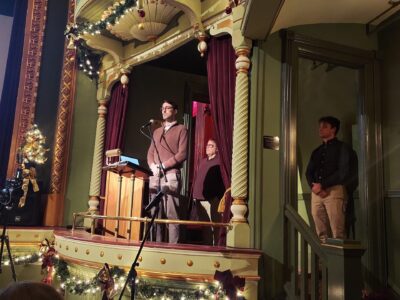
LaBella representatives answered a host of questions in a Fredonia Board of Trustees hearing held at the Fredonia Opera House. The questions were submitted and read.
LaBella's Matt Higgins first offered an abridged version of the firm's Nov. 13 presentation to the Board of Trustees. He said of the report: "It's not just LaBella's opinion, it's based on what regulatory documents require."
After the presentation, Mayor Douglas Essek commented that he would favor an option where the village keeps its water system and opens a new interconnection with the city of Dunkirk.
Higgins had just said the wells could go with any of LaBella's three preferred options. Well water usage was initially brought up in the option to decommission the treatment plant and draw down the reservoir. LaBella's other options would be to shut the reservoir and treatment plant, or to maintain and significantly renovate the current system.
LaBella's Don Lucas said the exact level of drawdown that would be needed, if the village chose that route, "was not calculated as part of this effort."
One question stated that the town of Pomfret is looking to expand its water customer base and asked if LaBella's options will provide new customers.
Higgins said, "We solely focused on existing customers" in the study.
Another question asked, "How does water loss play into this discussion?" Higgins said there is "a significant quantity of water that is unaccounted for...that is suspected to be a metering issue. 41% of the water is not being lost, but there are metering challenges." That includes unmetered customers.
Asked about water rates Fredonia might have to pay if it gets water from Dunkirk, Higgins replied, "We've been told by the city the rate is $3.87 per 1,000 gallons...as far as I know that rate is firm."
The redactions in the version of LaBella's report available to the public were questioned. Natalie Whiteman of the Chautauqua County Health Department rose from the audience to answer. She said sites of water facilities can't be shared because "we have to make sure the water system remains safe."
Higgins answered a query about the time frame for LaBella's options. He said there was no time frame. He did point out that splitting up water work into phases will lengthen the projects, but will also maximize grant opportunities.
It was asked if there would be any discussion about a proposed water line from Dunkirk to SUNY Fredonia if the village chooses to "go it alone" with the water system. "That is not something we evaluated," replied Higgins.
Soon after, Trustee Michelle Twichell asked about a possible Vineyard Drive tank next to the pump station shared by Dunkirk and Fredonia. Advocating it, she said the tank would provide water to both entities in emergencies.
Higgins said that regardless of alternatives, the village needs a new, additional finished water storage tank. "The question is where to put it," he said.
He added the Vineyard Drive site is "not designed for finished water storage. We did not consider the possible need for any storage tank at that location." Twichell said it should get considered.
Dunkirk Department of Public Works Director Randy Woodbury said the tank would have to be at least 150 feet tall to maintain proper water pressure.
As for water rates, "Our thought was the village would get the best price purchasing directly from the city" and not the North County Water District, Higgins said.
Trustee David Bird later questioned Woodbury if the city would help with the cost of any Fredonia infrastructure that would get built in Dunkirk, if the two communities shared water.
Woodbury said regional collaboration is "very green" for grants. "We don't have (funding) immediately available but we'd work with you to find it," he said.
Trustee James Lynden commented that LaBella's study is mainly concerned with the cost of changes and doesn't consider the long term view. Lynden said if Fredonia got its water from Dunkirk, it would incur long-term increased energy and maintenance costs to operate the infrastructure, including new pumping stations.
"What we currently have is gravity feed. Gravity feed never fails," he said.
After the written questions session, there were about 45 minutes' worth of comments from people who walked up to the podium. Their utterances will be summarized in an upcoming OBSERVER article.