
4-H connection made ‘dream’ possible
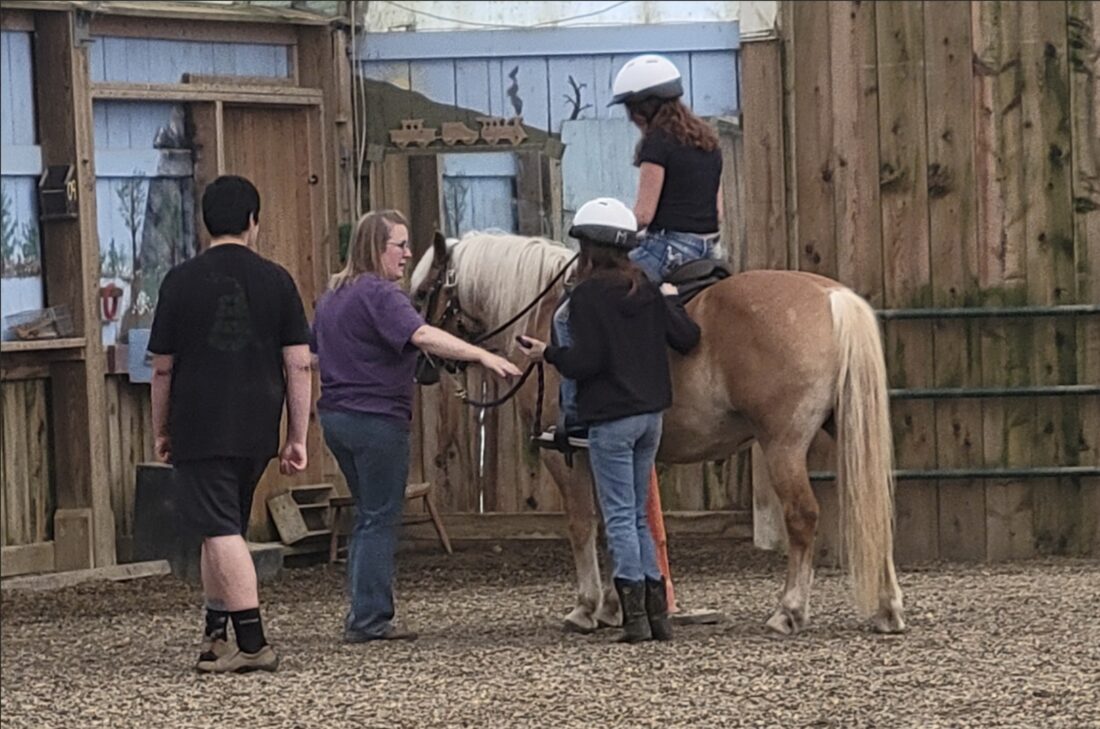
Instructor Savannah Chicora teaches teen volunteers how to lead and sidewalk while another volunteer gets to be the rider.
It is said that before something can become a reality, it first must be a thought or a dream, a term known as “ideation.” Edgar Allan Poe (from Elenora) said, “Those who dream by day are cognizant of many things which escape those who dream only by night.” The power of dreaming is more than we realize.
Some of my fondest memories come from the mid to late 1960s, a time when childhood happened almost entirely outdoors and neighborhoods functioned like extended families.
As summer wound down, the highlight of the year arrived: the Erie County Fair. As many neighborhood kids as could fit were loaded into my mom’s station wagon and dropped off for the day. We knew the fairgrounds like a map. The best and cheapest food was usually in the 4-H building, which, along with the Grange building, became my favorite places at the fair. I was in awe of the displays — quilts, sewing projects, baked goods, canned vegetables, and produce of every size and color. And then there were the animal barns and the horses. I loved watching the demonstrations and competitions and dreamed of joining 4-H myself.
But 4-H wasn’t available where I lived in the suburbs, and we didn’t have a farm. Our yard was small and pets weren’t allowed.
We played in the street, or in a five-acre lot at the end of our block, which had several trees among the overgrown brush, or at the beach a short walk away. We entertained ourselves.
Fast forward 25 years. My daughter was almost 8 and my son was 11 when I spotted a newspaper article announcing a newly forming 4-H horse club in Westfield. It even said you didn’t need to own a horse to join. Those childhood memories came rushing back. My kids were excited, and I was right there with them.
The 4-H was everything I had hoped for — except one detail. If you wanted to ride, you did need a horse. That requirement marked the beginning of our family’s unexpected journey with horses.
Horses are a little girl’s dream. As an adult, reality set in with the cost and the time-consuming unending chores. After three years of owning horses, I declared that we needed to sell them. They were pets, and my children were not happy. My husband had a different solution: starting a therapeutic riding center. I resisted. I had a strong feeling it would only increase the workload and the expense. I was right — but he was determined, and he usually won.
The challenges were overwhelming, but the idea became so purposeful that it was more like a life mission. I had a group of friends that joined in that mission
In 1990, New York state had very few therapeutic riding programs, and none in Chautauqua County. Pennsylvania, however, had so many that they had their own 4-H chapter for therapeutic horseback riding. Through networking, the president of that chapter reached out to Ken Balling, then Executive Director of Chautauqua County 4-H. Before long, we were operating out of our small barn and neighbor’s pasture with the county’s first integrated 4-H horse club for children with disabilities.
We started with seven members — three with disabilities and their siblings, including both of my children — and our five horses. The 4-H provided insurance and educational materials. My husband and I became certified 4-H leaders, and I learned more than I ever imagined.
Becoming a nonprofit took years, and even then, grants were denied repeatedly. Our mission centered on the physical benefits and emotional healing through horses and blended well with my new career as a physical therapist working mostly with children.
Adapting to changes and community needs, our outreach has expanded. Physical and mental health remain top priorities, but nothing exists in isolation. Healing, learning, responsibility, and connection are intertwined. We now include more education in our programming, teaching participants not only through riding but also through hands-on horse care, nature adventures and creative arts. It is an extension of everything I learned through 4H while blending the needs of people with disabilities, including integration and inclusion, and extending that opportunity to adults, even for people with cognitive and social challenges.
Statistics also show that in rural, especially farm communities, mental health concerns are escalating at a much higher rate than other geographic areas. Solutions and interventions are critical.
I still love the rural farm holistic and healthy living concept, but I am an adult. Children think differently. Convenience has replaced self-sufficiency and easy living or dependence has replaced hard work. Social media has taken its toll on the mindset of our children’s aspirations, channeled them into financially rewarding careers in technology, or worse, replaced them with absent-minded fillers and games.
At Centaur Stride, we teach what it means to be a volunteer — learning about the horses, their care, and the role each person plays in creating a safe, supportive environment.
4-H, an acronym which stands for “Head, Heart, Hands, and Health,” is central to the 4-H Pledge, which emphasizes clear thinking, loyalty, service, and better living for individuals and their communities. Each of these elements represents a commitment to personal development and community engagement.
Being a part of something beyond ourselves liberates us to complement each other rather than compete.
— — —
Our next volunteer orientation for adults will be held Saturday, Jan. 31, from noon to 2 p.m. at the barn, 8488 Jones Road, Sherman. Please call (716) 326-4318 to register..
We also invite the community to our Soup Supper Fundraiser, Saturday, Feb. 7, from 5 to 7 p.m. at the Westfield United Methodist Church, 101 E. Main Street. A $15 donation includes homemade soups, rolls, dessert, and a beverage. Tickets are available at Jack’s Barcelona Drive-In, or reservations by calling the barn, or at the door while supplies last. Guests may dine in or take out. Those dining in will have chances for door prizes and enjoy a short presentation about Centaur Stride. A basket raffle will also be held; winners need not be present.
Just like the neighborhoods and 4-H experiences that shaped me long ago, Centaur Stride still exists because community means looking out for one another.
Claudia Monroe is still President of Centaur Stride, which is in search of board members.
TOP STORIES
Nothing is ever as simple as 1+1
I am enjoying filling in for my good friend and former colleague Pete Howard as he takes a little break from ...
Intermediate students honored
Sales include exterminator company building, Institution homes over $1M
4-H connection made ‘dream’ possible
‘Santa Paws’ effort helps county’s humane societies
