
During harsh winter, birds add life to outdoors
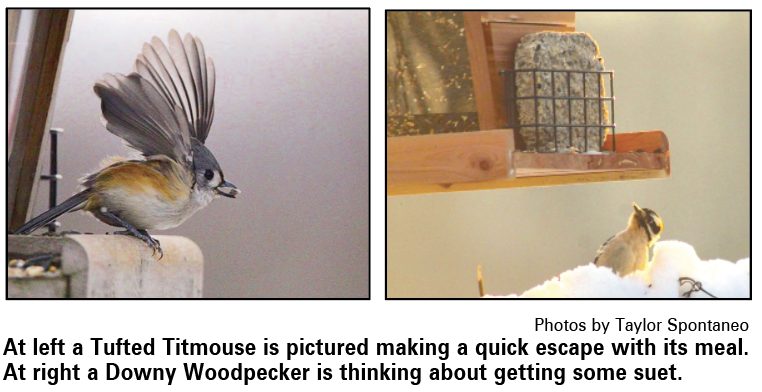
When winter winds are frigid and I crave a taste of the outdoors, I find myself glued to the window watching my birdfeeders. If the landscape is a bit snowy and I notice plenty of activity, I will sneak out my front door camouflaged by a white sheet, just barely exposing my camera lens beneath. With my back leaning on the frame of my house pretending to be a lump of snow, I can quietly spend hours happily capturing pictures of this feeding frenzy. The simple act of hanging up a birdfeeder does wonders at keeping birds local.
In a landscape filled with gray skies and white grounds, it’s hard to remember that western New York is still teeming with life. Seeing flitters of color flash as they pass my eyes reminds me that there can be movement in the stillness of winter. Sounds, colors, and energy are present at birdfeeders even when we think all life has gone to rest for the foreseeable future. The stark red of a male cardinal, a flash of blue from a Tufted Titmouse, and subtle yellows from goldfinches are all colors that can bring life back to the view outside your windows.
Birdfeeders help sustain a bird’s appetite when there is little availability food-wise. Every movement is critical to an animal’s survival during the winter. Flying burns energy and birds need to replenish theirs or risk perishing under these extreme elements. Certain types of bird seed can be a saving grace for these winged friends.
Just how us humans have preferred snacks, birds do as well. With each bird species having unique autonomy, beak shape, or foraging styles, different feeders are used to support assorted feeding behaviors.
The most common seed to purchase is black-oil sunflower seeds, which are densely packed with calories. These are a favorite for Black-capped Chickadees and cardinals. These bird species have thicker beaks to help them easily crack open seeds. Smaller birds like goldfinches and Pine Siskins prefer tiny black seeds called Nyjer, which are poured into elongated nets to evenly distribute seed. Another favorite among birds is cracked corn. When scattered on the ground, foraging species like Mourning Doves and Black-eyed Juncos swoop in and peck happily. Having flocks of 20 or more gather around my house reminds me that doves stick together to keep safe from potential predators like the Cooper’s Hawk. Some birdfeeders come equipped with feeding platforms that look like a trough, allowing birds to freely move in and out. Including peanuts in your mix allows larger birds like Blue Jays to indulge in their own deliciousness, too.
For woodpeckers and nuthatches, suet cakes, which are held together with beef fat and are set in a square cage, encourage foraging behavior. Woodpeckers and nuthatches have adapted beaks that are longer and pointed, which helps them reach into these cakes. Just as they would reach into the bark of a tree to get insects in the summer, suet cakes emulate this behavior and create wonderful enrichment. Suet cakes are filled with a variety of seeds that create boosts of energy for these very busy birds. Seeing a nuthatch hang upside down on a suet feeder always finds a way to make me laugh.
If you want to get creative and efficient, use scraps of fat from cuts of meat in suet feeders for woodpeckers to fill their bellies. I use cuts of fat in the colder months as to not run the risk of the fat melting and becoming a concern for residue on feathers. If you have a flowerbed near your feeders, leaving leftover plants in the ground helps birds gain access to the seeds that are dispersed during the fall. Many birds rely on these seeds to make it through winter. I purposely leave my shriveled-up vines from morning glories, knowing there are little pods of seeds still left over from autumn.
From watching my own birdfeeders throughout the years, I have noticed bird behavior more intently. Blue Jays have learned to use mimicry to scare other birds away. By using the call of a Red-tailed Hawk, a predator for most birds, Blue Jays effectively fool their competition (sometimes me, too!) and this gives them a few moments of eating all on their own.
Whether you want to stay cozy at home or visit Audubon, our Conewango birdseed blend is an excellent way to attract all sorts of visitors to your feeders. You can watch birdfeeders in action at Audubon, where we have floor-to-ceiling windows on the first floor, giving you an up close and personal look at birds in action. These feathered friends remind me that there is still laughter, curiosity, and colorful life in the quiet times of winter.
Audubon Community Nature Center builds and nurtures connections between people and nature. ACNC is located just east of Route 62 between Warren and Jamestown. The trails are open from dawn to dusk and birds of prey can be viewed anytime the trails are open. The Nature Center is open from 10 a.m. until 4:30 p.m. daily except Sunday when it opens at 1 p.m. More information can be found online at auduboncnc.org or by calling (716) 569-2345.
TOP STORIES
Healing with horses: The science behind feeling safe
During harsh winter, birds add life to outdoors

Property purchased by Wells among real estate sales

Reasons to soar: Westfield teen earns Eagle Scout distinction

School 7 celebrates achievement
Homicide victim identity unknown after 42 years
ELLERY – It’s been more than three years since cold case investigators released a new sketch of a woman ...