Officials Discuss Impacts Of Older Homes On Public Health

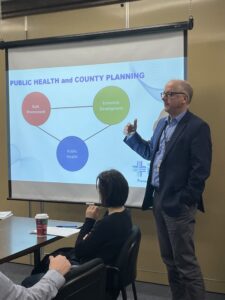
OBSERVER Photo by Gregory Bacon Steve Kilburn with the Chautauqua County Health Department discusses the connection of older housing stock and higher obesity rates.
When it comes to the health of the residents of a community and the physical structures where they live and work, it appears there is a connection.
During the recent Chautauqua County Planning Board meeting, some members of the county’s Health Department discussed how the two are related.
Jessica Wuerstle, the director of Environmental Services, and Steve Kilburn, grants project director, spoke at the board meeting and touched on a number of topics, including housing, public water, sewers, lead poisoning and more.
Wuerstle noted their motto is to “Prevent disease, promote wellness and safety, and protect the general health of our community.”
They are involved in doing inspections at restaurants and food trucks, water safety, infectious disease surveillance, maternal and child health immunizations, promoting vaccines, substance abuse response, and the county jail.
Kilburn noted the connection between the median income of residents in a given census track and the age of the housing. “It seems intuitive that the higher incomes have newer homes,” he said.
Also, studies have shown a higher obesity rate in communities with older homes, specifically homes built before 1940. “This is a relationship that exists in the county,” he said.
Kilburn noted that as the Baby Boomer generation continues to age, the older housing stock may not be a good place for people to stay at home. At the same time, there are fewer skilled nursing facilities in the county. “We’re going to see a disparity, I’m afraid, where some people have limited options,” he said.
Kilburn said he doesn’t have easy solutions but wanted to show the relationship of health and public planning. “We want to raise that awareness and work with other partners,” he said.
Wuerstle said the health of younger people is equally as important. “We want to have services for them and create the healthiest environment that we can to ensure that they stay here and stay healthy while they’re here,” she said.
Another issue that comes up with older housing stock is lead hazards, specifically lead paint. “Because these old homes are deteriorating, windows are chipping, people can’t necessarily afford maintenance, there are landlords who have other priorities than taking care of their properties, so that’s where we’re seeing lead poisoning, it’s from lead paint,” she said.
She said even the dust from paint gets into the air and affects children specifically.
In Chautauqua County, Wuerstle said if they’re notified about a child poisoned with lead, they test the water and test toys but “with very few exceptions, the problem has been lead paint.”
Wuerstle noted that lead can affect a child’s development, including brain and nervous system functions, hearing loss, kidney function, and bone health.
The county Department of Health works with families with both short- and long-term fixes, some which can be quite expensive. “Some of the remediation efforts to actually get rid of lead or contain lead such that it’s not creating the dust and imposing a hazard anymore — $40,000,” she said.
There are some grants available. Right now they’re mostly targeted for the Jamestown area.
The county is also in the process of creating a lead rental registry in Jamestown, which was created by the state. “A landlord will register their property as a rental property and then they are required to obtain a lead-safe certificate on a three-year cycle,” Wuerstle said.
TOP STORIES
Fredonia, Pomfret eye merger grant
Village of Fredonia and town of Pomfret officials continue investigating the possible consolidation of services ...

Third Walleye Festival returning to city in June

GOP puts forth ‘Save New York’ plan
Officials Discuss Impacts Of Older Homes On Public Health

Sparring agendas Hochul unveils plans in State of the State address