Spreading ‘liberty’: Chautauqua County women were a force in the Underground Railroad
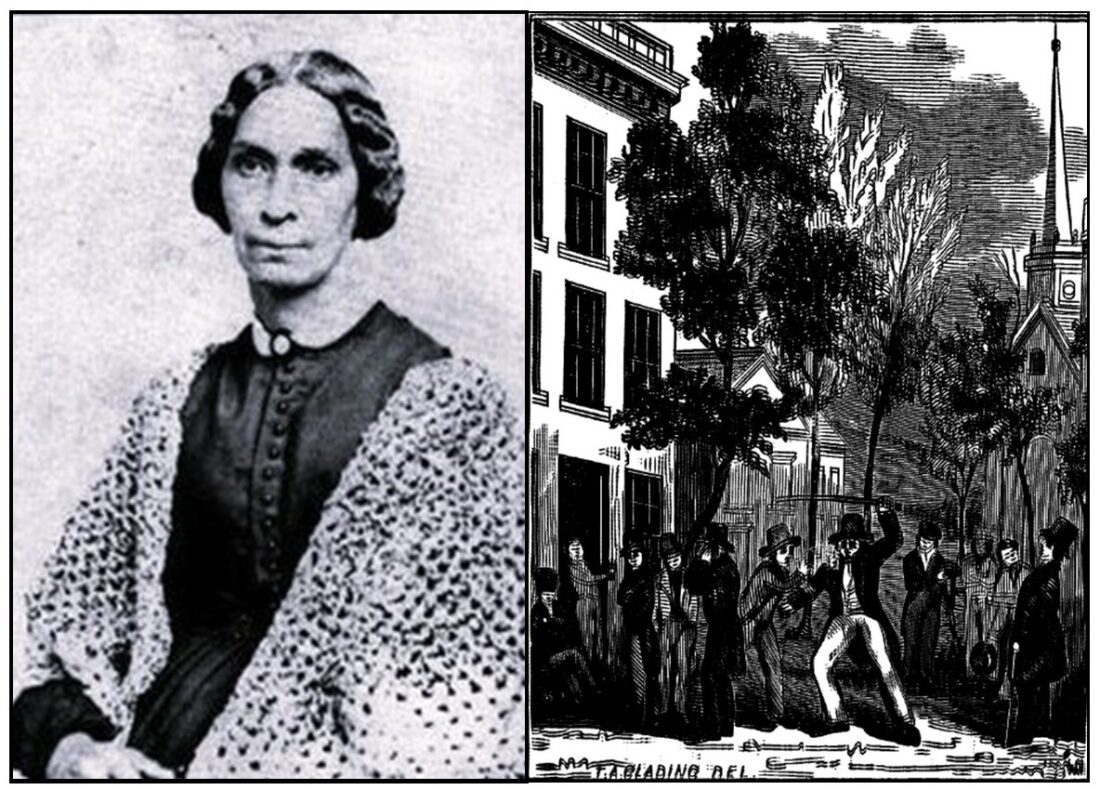
From left: Carloyn E. Storum Loguen about 1860; Mary Ann Brigham Brown’s husband Rev. Abel Brown under assault in Westfield NY about 1835.
Chautauqua County women Carolyn Loguen (1817-1867) and Mary Ann Brown (1814-1842) were active in New York state’s anti-slavery movement and in the Underground Railroad.
Working mostly in the shadows of their widely known husbands, the women themselves were locally famous for their own efforts in the cause of freedom.
Carolyn E. Storum Loguen of Busti married the formerly enslaved minister Jermain Wesley Loguen (1813-1872). The couple then operated an Underground Railroad station in Syracuse.
They had six children, and their daughter, Amelia, married the eldest son of the nationally known abolitionist Frederick Douglass (1818-1895), who also was formerly enslaved.
-

- From left: Carloyn E. Storum Loguen about 1860; Mary Ann Brigham Brown’s husband Rev. Abel Brown under assault in Westfield NY about 1835.
-
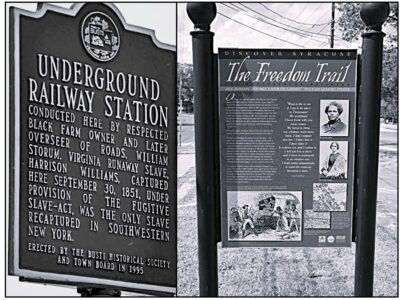
- From left: The Storum/Williams marker in Busti NY; the Jermaine and Carolyn Loguen marker in Syracuse NY.
In 1851, the Rev. Loguen assisted in the rescue of William Henry, a formerly enslaved cooper working in Syracuse. Henry had been arrested under America’s Fugitive Slave Law of 1850, but he was rescued by abolitionists and then sheltered in Canada.
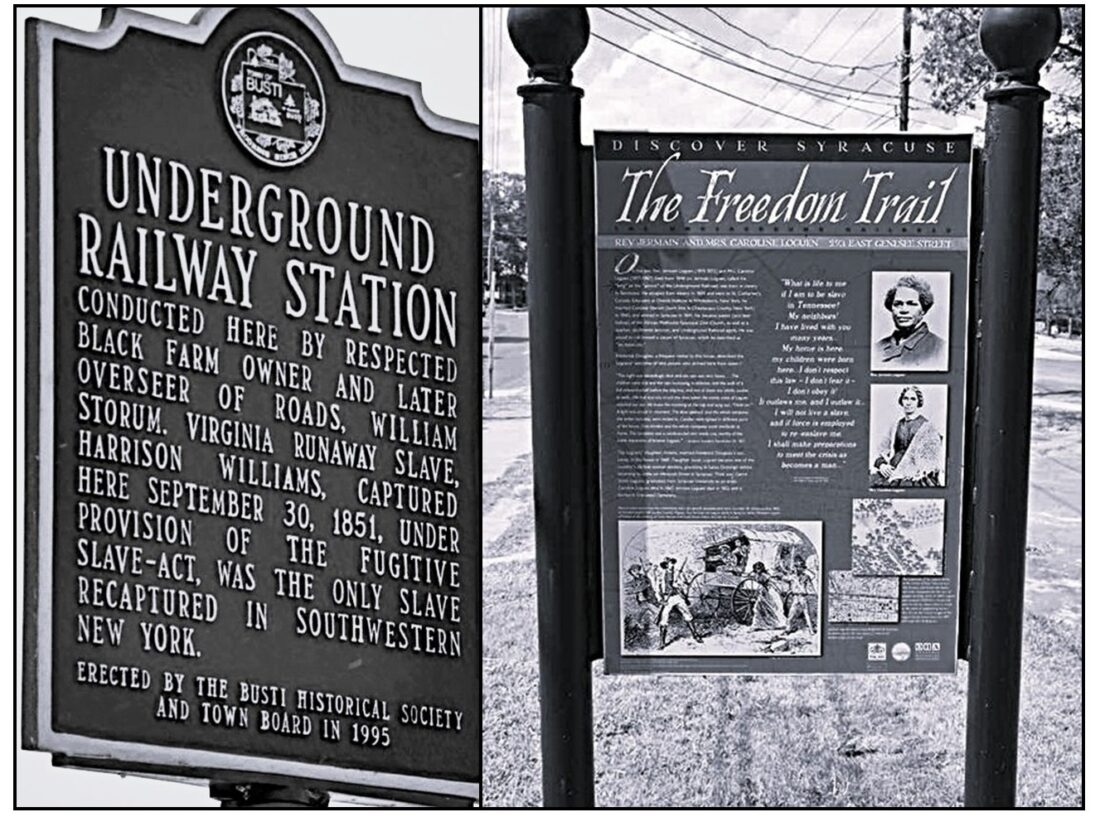
From left: The Storum/Williams marker in Busti NY; the Jermaine and Carolyn Loguen marker in Syracuse NY.
Also in 1851, Harrison Williams was arrested under the same law, on Carolyn’s childhood farm in Busti, where her parents operated an Underground Railroad Station. In spite of several attempts to rescue him, Harrison Williams was returned to slavery.
The historical marker paying tribute to Harrison Williams and the Storums stands today, on Sanbury Road near Northrup Road in Busti. Another historical marker, to both Caroline Loguen and her husband, stands today at NYS Route 92 and Pine Street in Syracuse.
In 1854, Carolyn’s parents coordinated the widely attended Anti-Slavery Convention in Sugar Grove Pa., near Busti. Both Rev. Loguen and Frederick Douglass were featured speakers at that major event.
However, Mary Ann Brigham Brown and her husband had been deceased long before the significant convention in Sugar Grove. Mary Ann was from nearby Fredonia, and she married another famous abolitionist, Rev. Abel Brown, Jr. (1810-1844) of nearby Forestville.
In the early 1830s, Mary Ann had met her future husband, while both attended the Fredonia Academy, which formerly stood on the site of today’s Opera House and Village Hall. The couple then traveled throughout the northeast, active in the Underground Railroad.
Scholars have speculated that when the Western New Yorker Eber M. Pettit mentioned in his 1879 anti-slavery memoir that there was a “President” of the Underground Railroad, he was referring to the martyr Rev. Brown.
Rev. Brown was so outspoken in his beliefs that he was often beaten by angry dissenters. His 1844 death in Canandaigua was said to have been from injuries sustained in just such a beating.
Another assault upon Brown had occurred in Chautauqua County a few years earlier, while he was preaching in Westfield. That was the period when New York State’s Anti-Slavery Society was being organized in central New York State, an endeavor also met with violent protests.
However, within a few years of Brown’s beating in Westfield, the collected voices of Chautauqua County’s other abolitionists attracted increasingly more of their neighbors into what became known as “the liberty cause,” and the Underground Railroad became more safely active here, until the 1850 law.
Although that law, signed by New York’s own Millard Filmore, generally made life dangerous for those involved in the Underground Railroad, the same law actually backfired in Chautauqua County, by drawing even more people into the anti-slavery movement.
Mary Ann died two years before her husband, shortly after the birth of their second child. Her children were then raised in Fredonia by her mother Mary (Polly) Dix Brigham Taylor (1790-1857), who also opened her home to a freedom seeker in 1844.
There is no historical marker to memorialize Mary Ann, her husband, her children, or her mother, but a Fredonia mansion stands today where Mary Ann’s children grew up. The former Taylor farm is located on U.S. Route 20, just west of Fredonia.
After the Civil War, Daniel Fairbanks greatly expanded and modernized the former Taylor home. For the 1881 Chautauqua County Atlas, the elegant, new house was illustrated in the name of Sayles Aldrich.
In the late 20th and early 21st centuries, Wilda B. and J. Carter Rowland operated a gift shop behind the mansion, at the approximate location of part of the former Taylor home.
(Mary Ann and Abel Brown died prior to the use of daguerreotype or other photographic imagery. The author is indebted to Doug Shepard, Peter Finn, Tom Calarco, Paul and Mary Liz Stewart, and Jennifer Thompson Burns for images and portions of this story.)
TOP STORIES
Sales include Dunkirk restaurant, former credit union building
Making it work, with fun, at Centaur Stride
Intermediate school students of month
Part of the team: United Way hosts Annual Girls in Sports event, serving 124 youth

Iranian state media say country’s supreme leader is dead