Discrimination ran rampant in early years here
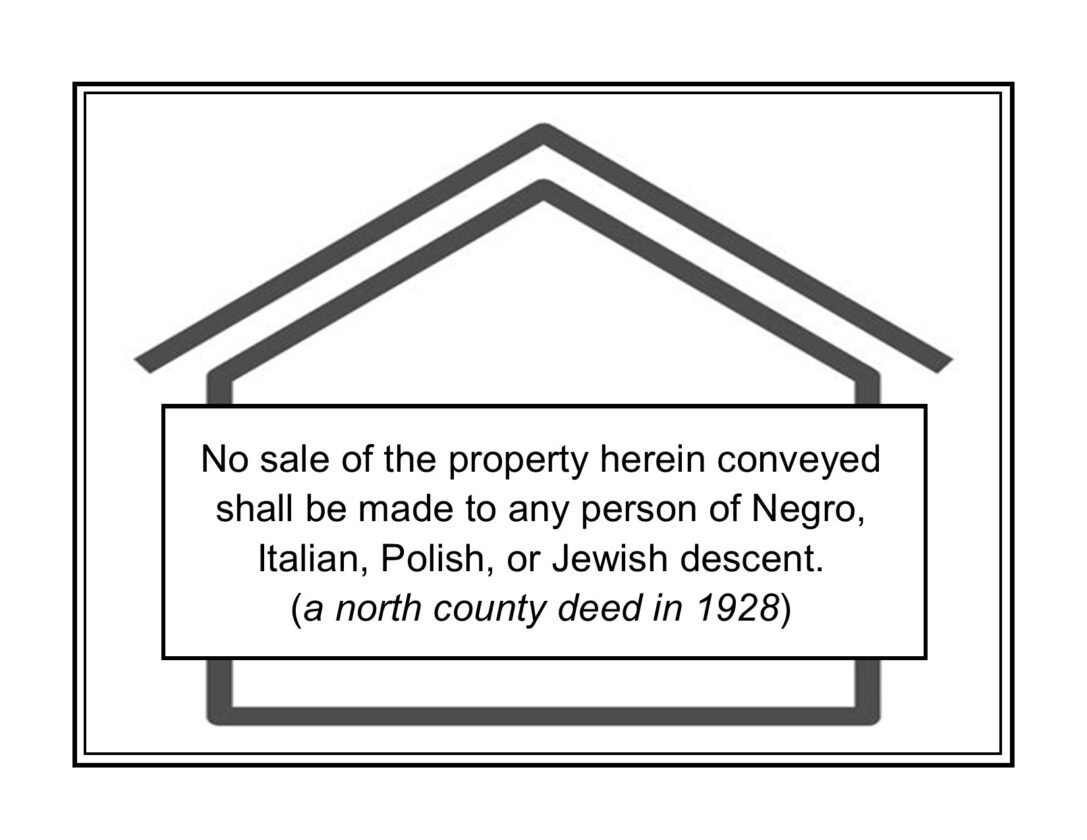
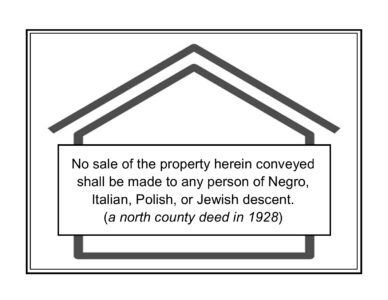
Sample deed stipulations that once applied here and across America.
We who live happily in the north county in 2026 may not realize that many of our ancestors were not welcome here.
As trains full of immigrants began arriving in Dunkirk in the early 1850s, a new Fredonia newspaper called The Advertiser published long, front-page stories, which protested the arrival of German and Irish residents, especially any who were Catholic.
Fredonia’s legislator F.S. Edwards (1817-1899) and his brother-in-law Devillo White (1816-1913) were supporters of that weekly periodical.
The newspaper was relatively short-lived, but its readers’ anti-immigrant ridicule continued throughout the 1800s, even after people from Germany and Ireland were finally accepted here. The following are examples of the resulting discrimination in our region’s housing.
By 1910, deeds for the Dunkirk subdivision between East Fourth and East Sixth stipulated that no lots were to be sold or used “by any Italian or person of Italian descent.”
Deeds at Van Buren Point in 1914 said that lots “shall not be sold or assigned to any person of Polish, Italian, Slavish, Hungarian, or Negro descent, or any other undesirable character.”
By 1925, deeds on Shorewood Drive stated that lots “shall not be sold or occupied by any person of the Negro, Italian, or Polish races, or who is not or could not qualify as a member of Shorewood Country Club.”
In 1928, deeds for the new Fredonia streets called Lowell and Holmes stated that the lots “shall not be leased or sold or used in any way by Negroes, or persons of Negro descent, or by Italians.”
Also in 1928, deeds at Greencrest stipulated that lots could not be conveyed “to any person of Negro, Italian, Polish, or Jewish descent.”
In 1933, deeds in Dunkirk’s Harrysbourg neighborhood said that lots could not be owned by “a person of the Negro Race or an unnaturalized Polish, Russian, or Italian” person.
Similar phrases also appeared in deeds within other communities across Chautauqua County. In 1939, New York State passed legislation to prevent housing discrimination based on race, religion, or national origin, but the law was sporadically enforced.
In 1942, deeds for the new Dunkirk subdivision along Bataan Avenue said, “No person other than the Caucasian race shall use or occupy” the lots.
In the early 1960s, developers of the new Fredonia streets of Birchwood and parts of Middlesex tried to get around New York’s ban on discrimination by stipulating in the deeds that houses built on those lots had to be constructed at a specific minimum cost, the equivalent of about $300,000 today.
Finally, in 1968, Congress passed the Fair Housing Act, outlawing ethnic and religious discrimination in housing throughout the United States.
During this Black History Month, it is worth recalling that Black Americans and most immigrants once faced extreme prejudice from people who felt entitled to land that had first belonged not even to themselves, but to the indigenous people who were already here.
Hatred based upon ethnic or national origin continues in today’s America. However, broadly paraphrasing philosopher George Santayana from his 1905 essay: we may avoid our past errors by remembering them.
Wendy Straight is an independent researcher and a retired land surveyor.