Fertility bill would cost insurers $20M
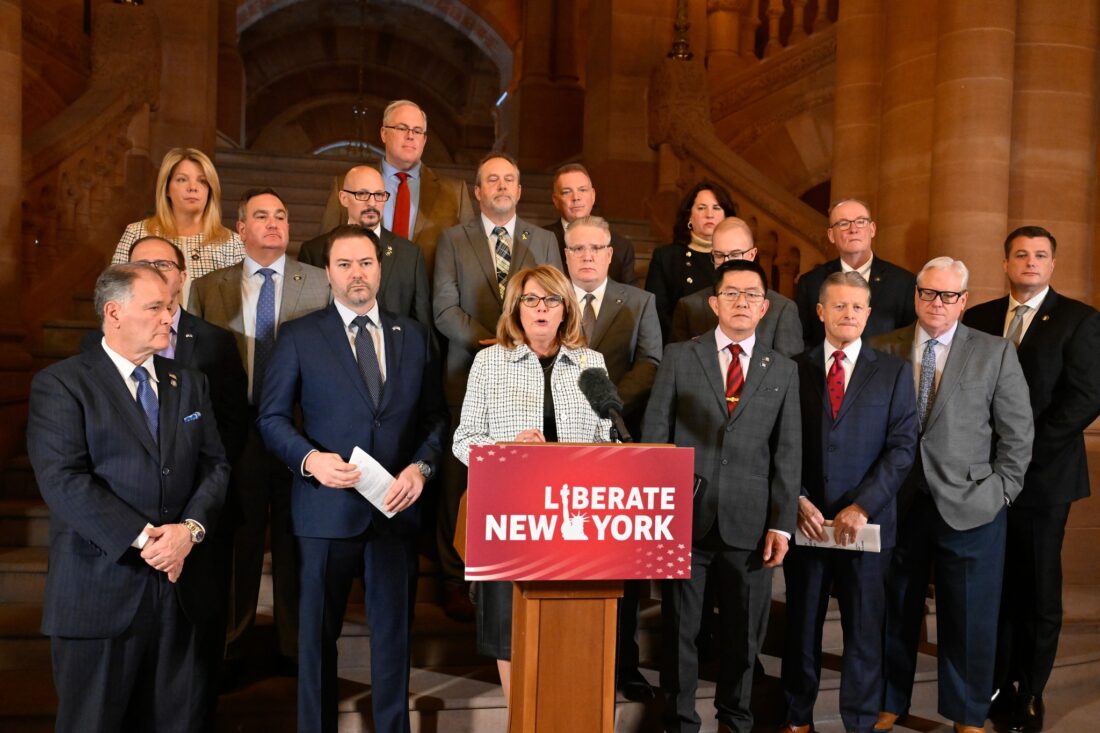
Sen. Pam Helming, R-Canandaigua, speaks during a news conference.
The state Senate has approved legislation requiring insurance coverage for some fertility preservation treatments.
S.4497, sponsored by Sen. Michelle Hinchey, D-Kingston, would remove an existing restriction that fertility preservation services be covered only in cases of iatrogenic infertility. The bill passed the Senate 47-11 with Sen. George Borrello, R-Sunset Bay, among those voting against the bill.
“For most New Yorkers, the cost of egg freezing remains unattainable, creating a significant and often overwhelming financial barrier,”
Hinchey wrote in her co-sponsorship memorandum. “This burden is especially acute during the prime reproductive years when egg freezing is most effective. Unless someone is independently wealthy or fortunate enough to work for one of the small percentage of employers that offer fertility preservation benefits, they are effectively excluded from using this advanced medical tool to plan their families and their futures.”
Republican opposition was based on what the change could do to insurance premiums. Sen. Pam Helming, R-Canandaigua, asked Sen. Jamaal Bailey, D-Bronx and chairman of the Senate Insurance Committee, what the cost would be. Bailey responded that the proposal is expected to cost commercial insurers $20 million and state taxpayers $3 million.
“Advancing real affordability requires at the very minimum understanding that the cost associated with mandates. like the one included in this bill,” Helming said. “This bill will absolutely have an impact on healthcare premiums. at a time when we have an issue with high cost of healthcare premiums. premiums in New York state are among the highest in the nation, roughly 13% higher than the national average.”
According to an October report from the Empire Center for New York State Policy, insurers said in summaries filed with state regulators that price increases for insurance are linked to rising costs – including state-specific factors, such as insurance taxes and coverage mandates, as well as broad national trends, such as surging hospital and drug claims.
New York was also No. 1 for employee-plus-one coverage, with an average cost of $19,431, and No. 5 for family coverage, at $27,188, according to a federal survey cited by the Empire Center. The Empire Center noted state-specific factors for increasing costs include coverage mandates that require insurers to pay for certain services regardless of whether plans consider them to be medically necessary – or to limit or eliminate cost-sharing for certain types of claims.
A 2003 study commissioned by the Employer Alliance for Affordable Health Care estimated that mandates in force at the time added 12.2 percent to the cost of insurance – and the state Legislature has enacted dozens more since then. In 2024 the legislature passed – and Governor Hochul signed – laws requiring insurers to pay for prenatal vitamins, to cover the cost of scalp cooling (to prevent hair loss during cancer treatment), and to cap copayments for EpiPens (an emergency treatment for allergic reactions). Additions passed in 2025 include bills that would require insurers to cover creative arts therapy services, to cover speech therapy for stuttering, and to provide a minimum number of inhalers for asthma patients without cost-sharing.
The bill’s memorandum did not specifically state there would be costs for insurers or the state, something Helming said must change as the legislature debates future requirements for health insurers. Helming is sponsoring legislation (S.8619) that would require legislation requiring new or expanded insurance coverage to have a fiscal note attached.
“My bill, Senate Bill 8619, would require that all legislation that mandates or imposes newer expanded insurance coverage, to have a fiscal note attached. What this bill doesn’t do is limit or discourage expanding benefits or services, it provides for fiscal clarity and transparency to help us to help lawmakers and to help the consumers and the people we represent anticipate and to prepare for the financial impacts.”
TOP STORIES
Fertility bill would cost insurers $20M
Stow business banned from selling tobacco for one year
A business in Stow has been temporarily suspended from selling lottery and tobacco items due to selling products to ...

One big wreck: Chief notes ‘someone should have died’ in I-90 pileup

Music teacher Kevin Way adds to Fredonia school retirees

Arkwright passes late night noise law