Healing with horses: Magical rides live forever in memories
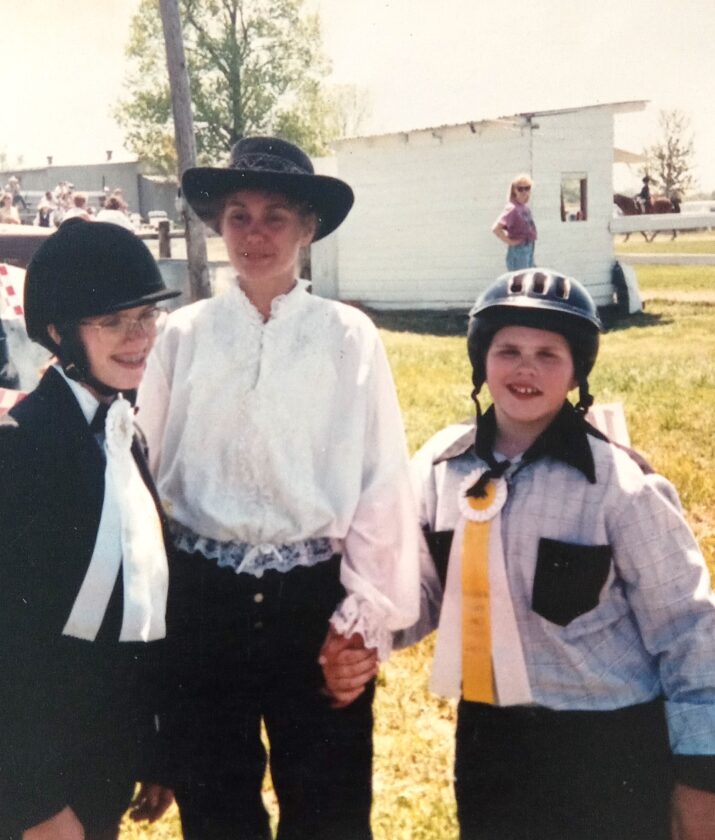
Krisie Auffhammer, Danise Johnson and Scottie Hilliker with their ribbons from their event.
Every day, I am reminded that living with a disability is not a single event — it is a daily negotiation. I often think of the kids I had worked with during my career as a physical therapist, with disabilities that do not improve over time, but may actually worsen as they get older and heavier, making walking even more difficult. Therapy is always needed, not just to improve function, but to maintain it.
A few weeks ago, after returning my grocery cart at Tops and painfully limping back to my car, I noticed a man hurrying — as much as he could hurry — across the parking lot with a cane and an awkward gait. He seemed to be coming directly toward me. I paused, squinting to see if I recognized him.
As if conjured up from my thoughts, it was Scottie.
“I saw you when I parked,” he said, slightly out of breath. “I hurried so I could catch you before you left. I think of you and Centaur Stride so often. I miss you. Can I give you a hug?”
It is difficult to hold back tears when the past walks toward you like that.
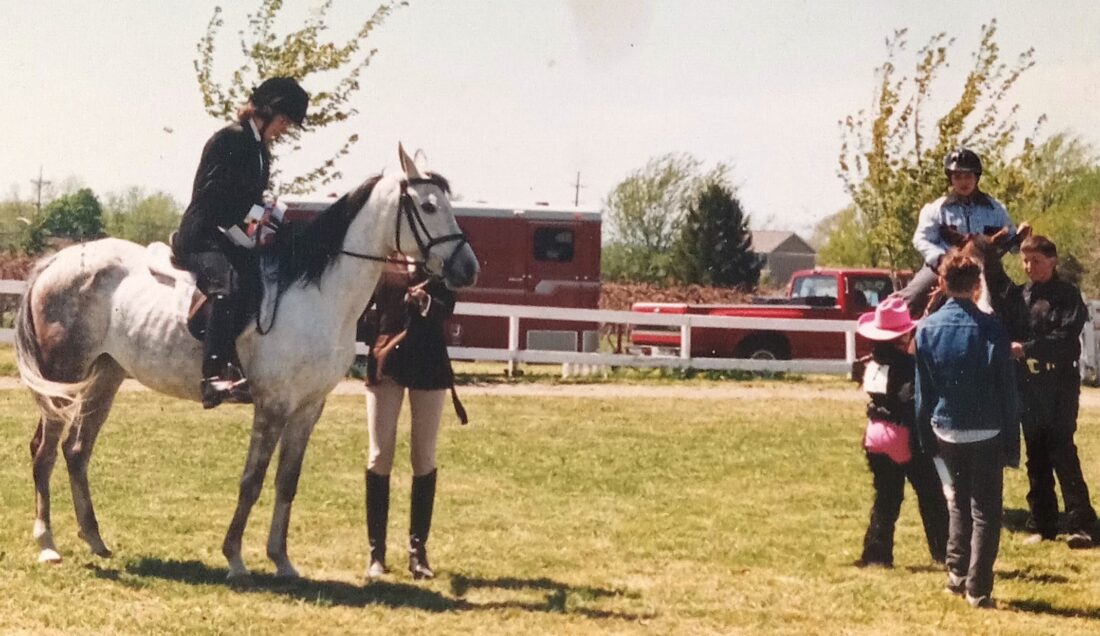
Krisie and Scottie on “borrowed show horses.”
Scott Hilliker began riding at Centaur Stride in 1994. He was 11 years old, born with diplegic cerebral palsy, which affects both legs. By then, he had already endured multiple surgeries — tendon releases and transfers common in growing children with CP — all in hopes of improving mobility. What Scott lacked in ability, he made up for in determination.
His favorite horse was Whiskey.
Before mounting, we stretched. On horseback, riders performed exercises that worked on strength, flexibility, balance, coordination, and core stability. Games often masked the exercises.
-
- Krisie Auffhammer, Danise Johnson and Scottie Hilliker with their ribbons from their event.
-
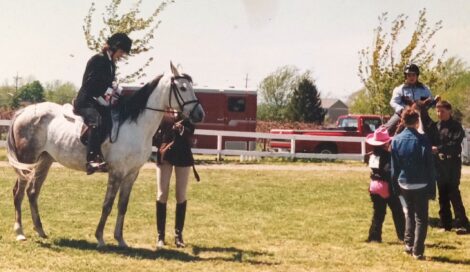
- Krisie and Scottie on “borrowed show horses.”
-
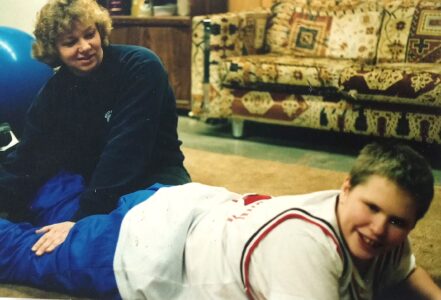
- Claudia Monroe helping Scottie to stretch his legs prior to riding.
But every movement had a purpose: greater independence, better control, improved function — in the saddle and in life.
In those early years, we dared to try competitions.
Claudia Monroe helping Scottie to stretch his legs prior to riding.
Mary Crandall, then president of the Chautauqua Saddle Club, and her club members, not only named Centaur Stride (annually) as beneficiary of one of their shows, but also modified that show for classes so some of our riders could participate. Leadline classes, typically limited to children under 8, were opened to riders with disabilities regardless of age. It was a generous gesture — but it didn’t solve every challenge.
Though some of our horses had show experience earlier in life, it had been years since they’d seen the bustle of a horse show. The sights. The sounds. The electric atmosphere. They were alert, animated, barely able to stand still. There was no safe way to place any of our riders on a horse that charged with that kind of excitement. Members of Mary’s club noticed the disappointment on our riders’ faces. Without hesitation, they offered their own seasoned show horses and volunteered to lead their horses with our riders in competition.
Scottie’s smile that day could have powered the entire arena. He won a yellow ribbon. Afterward he leaned toward me and whispered, “I want to ride that horse all the time!”
It was likely a $10,000 show horse. I smiled and said gently, “Wouldn’t that be nice.” (Whiskey, thankfully, was out of earshot.)
Horses, like people, are individuals shaped by experience. In my opinion, the best therapy horses are usually over 15 years old — past their spirited teenage years and settling into what I fondly call their “pre-retirement phase.” They have seen enough of life not to crave so much excitement but more to be grateful for a slower paced loving home.
Eventually, we tried competitions again — cautiously. We hauled horses to new places, exposed them to other off-sight horses, and practiced trail rides in different areas.
Then we took Dusty, a small, gentle pony once owned by a 4-H rider who had outgrown him, to a modified gymkhana event, some classes restricted to a walk for the safety of our riders. Independent “Walk” was next level for our riders once off leadline.
Dusty’s rider was a 13-year-old girl with hemiplegic cerebral palsy, affecting one side of her body. This rider was up to the level of trotting on a long line, so a walk should have been easy.
Then came the barrel race. When I say horses like fun, I mean it. Dusty was about 11 at the time. He decided that “walk-only” was merely a suggestion. He rounded the first barrel with enthusiasm that can only be described as competitive zeal. Our rider’s eyes doubled in size. She clung with every ounce of strength she possessed. Dusty didn’t need steering. He knew what to do, and did it well. I’m not sure either of us breathed the entire time. I didn’t even have time to pray more than “Dear God, please keep her safe”.
She did not fall. She might have even won — had Dusty not ignored the walking rule.
That day, we made another change. No more off-site competitions. From then on, our shows stayed at the barn — controlled, familiar, joyful. As it turned out, most of our riders were happier with that decision. Most did not want to compete, sure that they would lose. Games, fun and just the socialization of the event was enough.
Standing in that parking lot a few weeks ago, hugging Scottie, I was reminded of something simple and profound: sometimes the greatest victories are not measured in ribbons or trophies, but in the companionship, the act of just trying, in confidence built, in the greatest release of endorphins you may have ever experienced, or at least, a memory of a well-earned accomplishment that you will never forget! And sometimes, they are measured across time, in an embrace — two people moving imperfectly, but determined to be independent, with gratitude for so many special moments, and friendships that pass the tests of time.
— — —
— An ongoing fundraiser at Inner Lakes Federal Credit Unions, Hearts for Horses, $5 donation to help feed the horses.
— Next fundraiser is March 4 for take-out orders from Wanderlust. Centaur Stride receives 25%.
— April 12, Annual Walk-a-thon at Centaur Stride. Watch for details and follow us on Facebook or linktr.ee/centaurstride
Claudia Monroe is founder and president of Centaur Stride.
TOP STORIES
Healing with horses: Magical rides live forever in memories
Club names officers

Sales include former dollar store, $1.2M N. Harmony residence
Trustees turn down Fredonia DPW plow buy
Fredonia’s trustees turned down some equipment purchases for the village Department of Public Works this ...
County clerk finds no evidence of local fraud regarding plates