
At Panama forum, the why of proposed merger is discussed
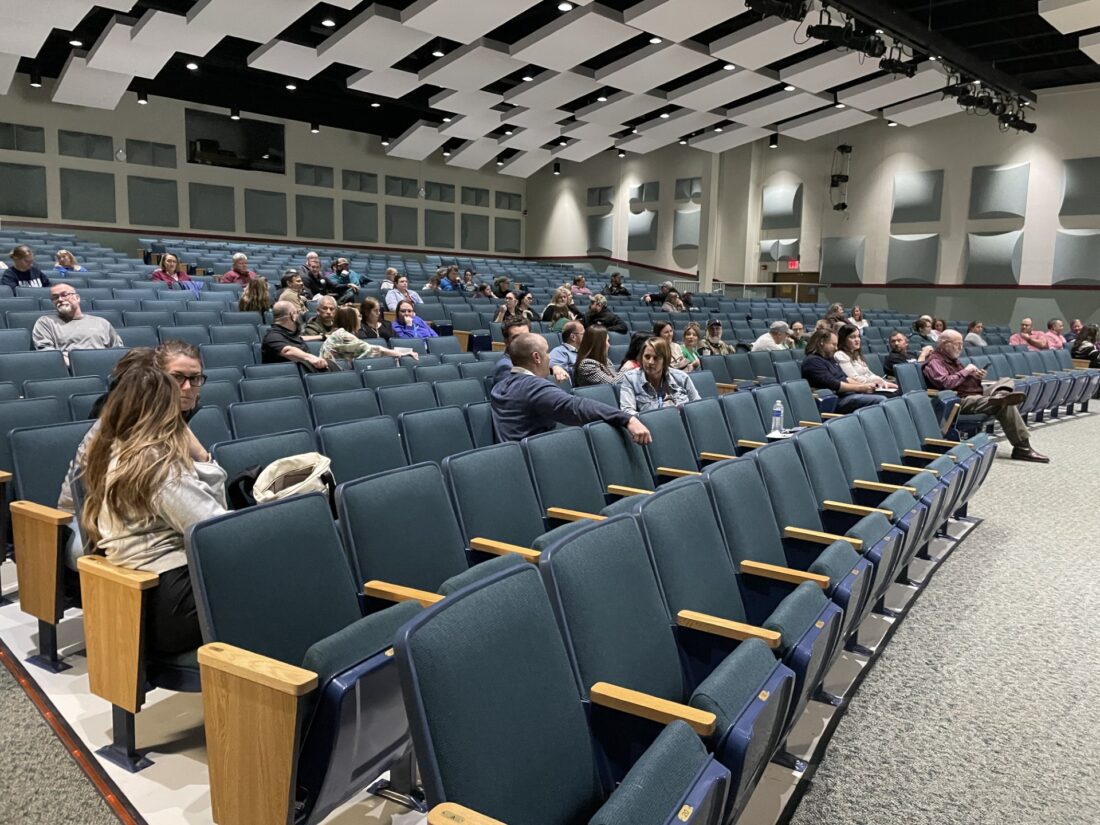
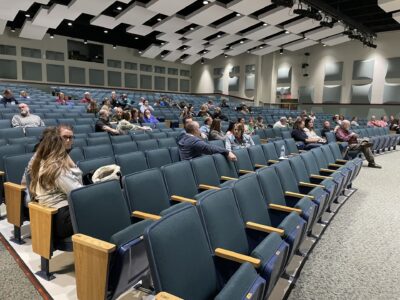
P-J photo by Sara Holthouse Panama community members gathered at the school on Wednesday night for the third community forum as a part of the CSP merger feasibility study process.
PANAMA — There are a few main reasons why Clymer, Sherman and Panama school districts are the three looking into a potential merger, compared to joining up with any other schools in the local area, and this was one of many topics addressed during the third community forum for the merger feasibility study held at Panama School on Wednesday.
The community forum began the same as the Clymer and Sherman ones, with Dan White and Lynda Quick from White and Partners doing a short presentation on items such as the purpose of the study and what all has been looked at so far before opening the room to questions. The first question that Quick addressed, as they had been seeing it before from a few different people, is why the specific CSP combination was the one chosen to be looked at for this study.
“We’ve had questions, why this combination?” Quick said. “We’ve heard why is Panama not looking at Southwestern? Why is Sherman not looking at Chautauqua Lake? We were not part of that original decision making, but it is important to know there’s a couple of factors going into this.”
The first factor is that there has to be merger partners, and both sides have to want to look into a merger study and process. In order to become a merger partner, the two districts also have to have similar demographics and similar tax rates.
“If you don’t have similar tax rates, it likely will not be terribly successful,” Quick said. “Let me give you an example; not from one of your districts, but Ellicottville and West Valley are immediately adjacent to each other. They share a lot of boundaries … Except, Ellicottville’s tax rate is low and West Valley’s is high, about 12 dollars more. The merger won’t work.”
To be able to merge either Ellicottville’s tax rate would have to increase, or West Valley’s would decrease, neither of which would make sense, Quick said. In order to merge, tax rates for school districts have to be very similar. Another factor that is involved is the district lines.
“Also a question, can’t we take some property from Chautauqua Lake and have those students come here from part of Chautauqua Lake?” Quick said. “It doesn’t work that way. You’d have to have a redistricting of the lines. You’d have to have a study, and they would have to be partners in that.”
Quick said they have also heard people say they would send their kids to another district if the merger goes through, which she said is an option for parents but they would have to go through the process of getting their students accepted as a non-resident student. There would also be an extra tuition charge if the other district accepted that student.
Other questions asked at the Panama forum were similar to the other two, including concerns about usage of facilities, the economic impact closing the school might have on Panama, and what else the buildings could be used for rather than sitting vacant if it was decided a new building would be built if the merger goes through. Quick said while nothing is decided as part of the study, facilities are a big part of what will be included, and recommendations will be made for the best use of a school building for the merger and options for the buildings if they were not used for school.
Additionally, she said it would be at least five years before a new building can happen if the merger were to go through and that was the option the newly formed board chose with community input and approval, but it would also be important to get at least the seventh through 12th grade students into one building as soon as possible. Quick said they were also aware that parents felt it was important to keep elementary students close to home.
“This is a scary time,” Quick said. “We know it’s an emotional decision. We know that the uncertainties of going forward merged is scary, but I’m going to pose a question; have you all thought about what are the possibilities of going forward unmerged?”
There are around 400 other districts in the state, Quick said, that are going through the same things and seeing their districts become smaller and smaller. There are some other districts she said, that do not have the ability to merge and have had to do other drastic things such as cut programs and only offer the core classes with teachers only teaching about four periods a day and then going home because they do not have any other electives and that is all they can afford. Others have had to contract their high school students out to other districts.
More building possibilities were discussed, including the possibility of keeping all students in one building, or splitting them into three separate ones. Other conversations included at the Panama forum reflected the same questions and concerns as the Clymer and Sherman forums; offering students more opportunities, preparing funds for 15 years once the potential merger incentive aid — between $68 to $71 million potential extra funding — is gone, what happens with staffing, and the potential for split or staggered start times. Quick noted that typically, merged districts do not see staff reductions at first and the only position that will need to be applied for is the Superintendent. Later on, teachers may start to retire or decide to leave on their own. Specifics will be up to the newly formed board and administration, but often teachers will have the ability to teach other classes that cannot currently be offered.
“There’s not as much crossover with teachers between the three districts as you might think,” White said.
White and Partners have also been talking with students throughout the process so far, and while some have expressed concerns about being the first graduating class of the merged district, or having to plan a senior trip with students that they do not know, it has also been expressed that students want more opportunities, and the ability to make more friends and have bigger social groups. Quick said while students do love their current schools and communities, they have also said a bigger class size would help them be more prepared for going off to college as well.
“I do point out that if you do come together to form a district, in five years that will be about 920 to 980 students, still not considered a big district,” Quick said. “Your cohort size is about 75 per class. If you graduated from here, this district 30 years ago was that size.”
Other questions about the study were able to be written down on the form handed out to attendees at the forum, or by emailing CSPstudy@e2ccb.org. The questions sent through the email go into a Frequently Asked Questions document, which is shared on the merger study website, CSPhub.org. The website can also be accessed through each district’s individual website.
Quick emphasized that no decisions are being made now, or will be made through the study, which is set to be finished with an official report shared with the public on June 15. Quick encouraged everyone to take a look at the study when it comes out. There will be more opportunities to ask questions after that, and following the study the boards will then choose whether or not to continue to move forward in the process. A straw vote to gauge community support is currently set for October, with an official binding vote in December. The first date an official merged district could begin to operate would be July 1, 2027.
TOP STORIES

Secondary school name changes
Prophetic energy warning beleaguers state
Arkwright to evaluate status of Highway Superintendent
Fredonia revisits board member term length discussion
At Panama forum, the why of proposed merger is discussed
Woman appeals ruling in county case
The state Division of Human Rights has ruled in favor of Chautauqua County and several of its employees in a ...