
Council approves street decisions
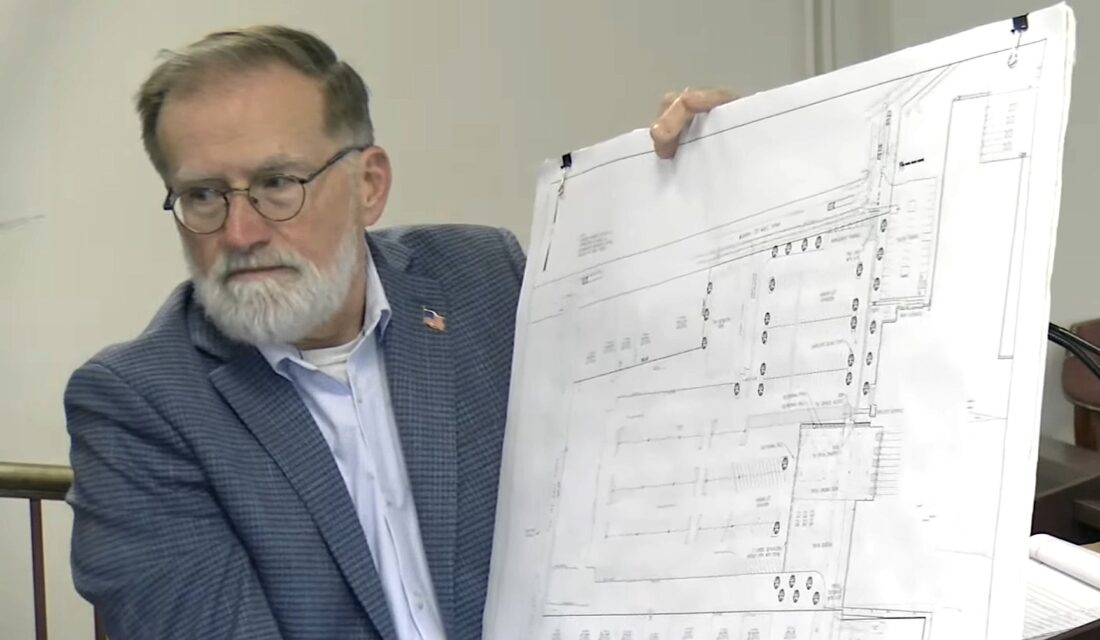
Michael Metzger, engineer for Wells’ Dunkirk project, is pictured.
The Dunkirk Common Council approved some significant changes to the city’s road network this week.
The council approved a closure of Main Street from Marsden to Newton streets. It also backed the extension of nearby Park Avenue between Marsden and Newton.
Finally, the council voted to extend a portion of West Seventh Street.
The Main Street closure is intended to make things safer for Wells Enterprises workers and delivery trucks. The opening of the Park Avenue extension on the south side of the railroad tracks, currently a grassy strip, is intended to alleviate traffic concerns caused by Main Street’s closure.
Meanwhile, the West Seventh Street extension is intended to provide access to a proposed electric storage battery farm.
The Park Avenue item was a last-minute “walk-in” resolution, unable to be viewed by the public before it was passed. However, the other two items were on the agenda and public hearings were held about them.
The Park Avenue extension was not a secret to Robert Welch and Robert Ryczko, who have lived on Newton Street for many years. They criticized the plan to open up Park Avenue during the Main Street hearing; the new street will be adjacent to their properties.
“I’m totally against it, it’s going to add too much traffic to Newton,” Welch said.
Vince DeJoy, Dunkirk’s planning and development director, spoke in support of the Wells project that is leading to the Main Street and Park Avenue changes.
“As we all know, Wells Enterprises is investing nearly $500 (million) in creating a new state of the art manufacturing platform for ice cream, and creating a campus in this area,” DeJoy said. “Wells has purchased numerous homes on Main Street around the footprint of this new plant to create the largest single investment in Dunkirk’s history. Wells has requested Dunkirk discontinue the section of Main Street to create a more secure and safe campus for the employees to park, and provide efficient means of staging and logistics for their deliveries going in and out of the facility. This will create a spectacular entrance to this fantastic new facility.”
DeJoy added, “The city feels that opening of Park Avenue will alleviate some of the congestion that could happen with additional cars needing to detour, to not go through Main Street.”
Welch asked how many homes Wells purchased and wondered if they were taken off tax rolls.
Michael Metzger, engineer for Wells’ Dunkirk project, spoke up. “This is a plan that we had not anticipated at the onset of the project — but as things are developing, it just really made a whole lot of sense, because of how the plant currently operates, with receiving bays that are immediately adjacent to the plant,” he said. Metzger said the current setup is unsafe.
“The fact that we had to build the plant while it was still operating brought on tremendous challenges,” Metzger said. He again cited maneuverability of trucks for closing Main Street, and added that Wells employees will no longer have to cross a street to get to the plant from their parking lot.
He finally said Wells purchased six homes on and near Main Street, all of which will be torn down. “By comparison with what we expect the value of the property after the expansion, it’s probably going to be well offset by the assessment of the properties,” he said.
The Seventh Street extension hearing featured criticism about the battery storage proposal from Reva Byczynski, who lives nearby on Brigham Road.
“There are homes on that West Seventh Street, all around that area. I’m within a block of that area and I’m sure my neighbors are a little concerned about the battery storage facility they want to put back there,” she said. “I’m really not happy about that. You can’t find any other land in the city besides putting it in someone’s backyard?”
Peter Pinkoski wondered who would build and maintain the road, and if utilities would be added. He also questioned why the city was building a street for a project that has not been completely green-lighted yet.
Brandon Bova spoke in favor of the battery project, stating that several have successfully and safely been completed in Buffalo.
DeJoy said, “The new road will be constructed to city DPW standards, with the entire cost being paid for by the developer of the proposed BESS project, GCI Lighthouse Energy. This project has received site plan approval at public meetings of the Dunkirk Planning Board and Chautauqua County Planning Board. They have reviewed the environmental documents that have been put forth. This project is currently being considered and reviewed by NYSERDA for funding in the long term contracts to purchase index storage credits.”
DeJoy added that when operational, the storage farm would pump $1 million of revenue annually into city coffers.
“The city doesn’t intend to construct a road there without a project. We’re not just going to be spending money on speculation of a project unless the project goes forward,” he said.
DeJoy went on that the battery farm will not be visible from Brigham Road and will meet or exceed current safety standards.
Daniel Brennan, a counsel for GCI, said the street extension is needed to access the project property, which currently has no road access.
TOP STORIES

Fish pen effort aims at future of steelhead at harbor
State announces expansion plans for city labeling facility
Empire State Development on Wednesday announced that Ultrapak, LLC is expanding its Chautauqua County operations, ...
IDA Director seeks Refresco answers
The director of the Chautauqua County Industrial Development Agency wants to have a conversation with a juice ...
Council approves street decisions

Fredonia officials discuss upcoming No Kings rally
Possible bus strike may impact students next week
A looming strike could possibly impact local school districts in the coming days. On Wednesday, Teamsters school ...