Merger forum touches on ‘misinformation’
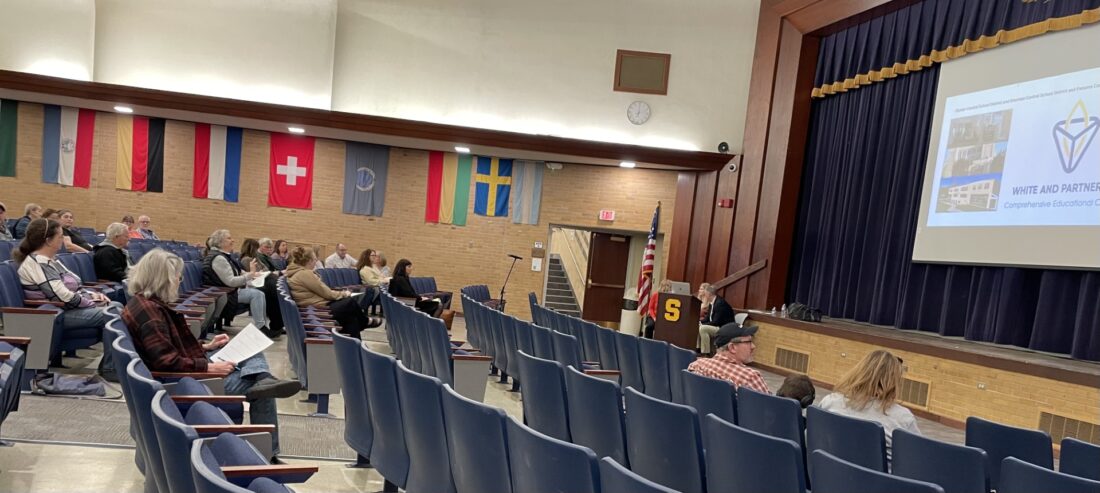
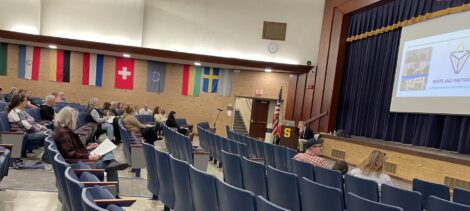
Photo by Sara Holthouse Members of the Sherman community came out Monday night for the second community forum for the CSP Merger Feasibility Study.
SHERMAN — A merged Clymer, Sherman and Panama school district should not affect non-resident students or the Amish.
What happens with tuition and non-resident students was among the questions asked by Sherman residents during a community forum Monday regarding a possible merged district. Tuition and non-resident students are included in the study’s numbers and the new board would decide on those students for sure, but if all three districts had non-resident students they would most likely be able to continue similar to now. Lynda Quick with study consulting firm White and Partners said they had received a similar question earlier about if non-resident students will still be able to attend BOCES and receive special education to the same degree, which they will.
“I think there was some misinformation out in the community that non-resident students don’t have the same right to attend with resident students for BOCES programming,” Quick said. “Not true, the rights are exactly the same. So, if a non-resident student were to enroll here and wants to go to a BOCES program, they would be able to participate just like any resident student of Sherman.”
Other questions arose about the guarantee of the merger money from the state if the state got themselves into financial trouble. Quick said merger money is probably more secure than any foundation aid and is a separate thing. Merger incentive aid allocates $68 to $71 million dollars from the state for a merged district over 14 years. White and Partners will also give suggestions in the study on how to allocate the extra money that will be coming in, and how to set some aside for the 15th year after the money stops coming in and the schools need to transition away from that. Quick added that this money will be enough to continue to easily pay the bills for the district, as it is about three times more than current individual budgets. They have also approached and talked with the Amish communities in the area that will be affected, and private schools will still receive the same services as well.
When talking with students, Quick said what they have heard the most is that students want more opportunities and to enhance the opportunities that they already have. Additionally, she said some expressed that they feel exposure to a slightly bigger class and more of these opportunities would be good for them, and while students express their love for their individual communities they also want more opportunities.
Many questions were raised about facilities and how the three current facilities may be used if they were not going to be used in the merger, and Quick said that will be included in recommendations to the boards from the study, but added that each building currently has its own unique things.
Questions on staffing and what will happen with the Board of Education were also brought up. Quick said some things may take longer to configure than September of next year, but for staffing only the superintendent is going to need to apply again and a new staff will not be hired, with existing staff becoming part of the new district. Seniority will also be kept for staff.
Returning to the building and facilities question, Quick said if the boards decide a new building is the direction they want to go in, it has to be approved by the community through a vote just like any other capital project. Any official decisions with what to do with the buildings will not be made until after the official merger vote, as Quick said no steps for that can be made until the merger is official, but again, recommendations for that will be included with the study. The boards will then be tasked with exploring the options and deciding the best place for kids to go.
For the new school board itself, she said it is required that a board of education has either five, seven or nine members, and there is no rule that each community will have the same amount of people on the new board, but there can be a gentleman’s agreement that makes that so. It is also likely that existing board members will make up the new board, as they have experience and will know the amount of work that will be involved.
Transportation options will also be included in the final study report, including how long bus rides may be. Another question was raised about how students will be able to be transported and get to the same place at the same time, as it was said that that would be almost impossible.
“Staggered start times are the way most merged districts have figured out how to manage busing better,” Quick said. “Some of it is double tripping, or adjusting the length of runs or starting your days at different times, which allows you to transport better.”
Dan White, also with White and Partners, emphasized that in regards to facilities they have heard comments and concerns multiple times and that each of the boards are very aware of these concerns. Part of the report will be advisory on what things will need to be addressed with the community, and facilities are a part of that.
Other questions and items discussed by the Sherman community in attendance included what happens to teachers. Quick said no teachers should expect to lose their jobs, and while the new district will not need three algebra teachers for example, there will then be the option of having those teachers teach other classes that they are not currently able to offer. This includes areas such as languages, and the ability to offer other levels of Spanish or different languages as well.
Electric buses will also be included in the study, though it was noted that there is currently a push back on the required timeline from the state on those.
The ability to offer certain programs such as BOCES options earlier for younger students instead of just juniors and seniors, and the ability for enrollment to increase and the way a new district may be able to attract students were also discussed by attendees, before the forum was wrapped up.
Other questions in regards to the merger can be emailed to CSPstudy@e2ccb.org. The third and final community forum will be held for the Panama community today, March 11, at Panama Central School at 7 p.m.
Quick and White opened the Sherman forum with an informational presentation before the forum was opened to questions. White noted a feasibility study is the first step that is required by New York state any time school districts are considering merging. He emphasized that no decisions are made during the study, and that White and Partners provide analysis and recommendations to each of the three boards of education.
Quick addressed the scope of their work for the study, which includes looking at seven elements; enrollment, instructional programs and opportunities including extracurriculars, facilities and food service, student transportation, staffing, financial and economic analysis of a merger and community and school culture.
Attendees were shown the merger study timeline, which extends from January to June 15, which is the day the final report from the study is set to be presented to the three school boards. Quick briefly discussed leadership and steering committee meetings, which are ongoing, and the reports that will be delivered at the end of the study. Four reports will be delivered in all; one to the public and three to the individual boards which will look at what the future of each school looks like if they continue unmerged.
Following the study timeline, Quick also shared the timeline for after, which will include information and public meetings between the June 15 report date and October straw vote.
“We hand over the feasibility study, which is a required part of the process, and then I say the real work begins, because the boards then begin to make some decisions and decide how they want to move forward for each of their communities,” Quick said.
The decision to continue to move forward with the merger will be made by the boards in June and July, and informational public meetings, along with a lot of pushing information out to the respective communities will follow that until the potential straw vote in October. The straw vote is to gauge the interest from the communities to merge; a required step in the process that is not binding.
“Only the commissioner of education in New York State can order a binding merger vote, and she will not order it unless the three communities are interested in that happening,” Quick said. “She does the straw vote to gauge interest and if it is a positive result in the three districts she will then order that the binding vote occur.”
The tentative binding vote could be held in December 2026, and if that passes then the districts are considered merged effective July 1, 2027. Quick also noted a few points along the way where some directions may change. In June and July if any of the three boards decide they do not want to continue forward with the merger, it can continue ahead with the other two at that point in time. If the straw vote ends up with only two districts in support, again it is possible to choose to move forward with only two districts at that time as well. Some implications and financial items would change with the feasibility study, but Quick said these two points in time are where the schools could potentially change direction.
Quick then showed attendees the results of February’s community survey, with the same results numbers that were shown at the Clymer forum; 798 responses overall from all three districts, 280 of the survey participants strongly agreed that a merger is a good idea today, 161 agreed, 178 did not know, 76 disagreed and 109 strongly disagreed. The total number of respondents from Clymer was 258, Sherman 224, and Panama 316.
“I did read the Facebook page from the Jamestown paper, why is the number at the top different?” Quick said. “This says 798 answered and eight skipped, so if you total that it’s 806. Not everybody had to answer every question, so the top will vary a little bit from six to eight, it’s just the way people answered the survey.”
More information on the merger study process can be found on each districts’ website or by visiting CSPhub.org.