Report touts economic power of SUNY for state, region

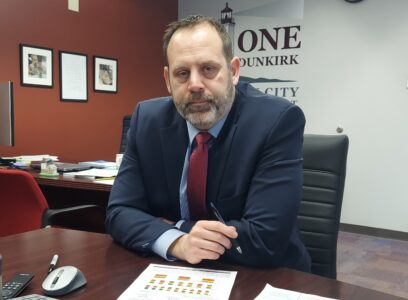
State University of New York Chancellor John B. King Jr. during a recent stop at SUNY Fredonia.
Higher education is a major economic engine for the state as well as the Western New York region, a Rockefeller Institute of Government report unveiled Monday notes.
Both State University of New York Chancellor John B. King Jr. and Rockefeller Institute of Government President Bob Megna announced that the findings show the SUNY system generates $35.5 billion in economic impact annually statewide. The report also outlines how SUNY supports nearly 160,000 direct and indirect jobs statewide, and that more than 70% of SUNY alumni are employed in New York five years after graduation, which are key indicators that the system is a major driver for New York’s workforce growth.
“A thriving and successful SUNY system helps ensure a strong and prosperous New York, and this report further demonstrates that fact,” King said. ”Thanks to the investment by Gov. (Kathy) Hochul and the State Legislature, SUNY has seen enrollment growth across every sector for the past three years in a row, and our campuses throughout New York state are able to provide an affordable, excellent public education, great jobs for New Yorkers, and serve as regional economic hubs. Investing in SUNY is investing in New York’s current and long-term economic prosperity. It is no wonder that every dollar of state investment generates more than $7 in returns to New York state.”
Chautauqua County is home to the State University of New York at Fredonia, which has an enrollment near 3,000 and SUNY Jamestown Community College, which has locations in the south county city as well as Cattaraugus County.
Data was used by the Rockefeller Institute of Government from the 2023-24 academic year and details how SUNY’s operations, research enterprise, hospital systems, and student spending ripple through hundreds of industries throughout New York. “While SUNY is known for its educational mission, its economic impact on the state is significant,” Megna said. “And you can’t really begin to understand how extensive it is until you pull apart the various ways SUNY schools and graduates participate in regional economies. This report, which builds on prior analyses of the SUNY system, aims to capture and distill this impact.”
In Western New York alone, 27,095 total jobs are supported by SUNY with 15,300 of those being employed through the system. All these employees, the report found, contribute $4.9 billion to the region’s economy.
In addition to the economic impact the SUNY system has for New York, the report also highlights that one in four New Yorkers with a postsecondary degree earned it at a SUNY school, that 70% of SUNY alumni work in New York five years after graduation, and that 77.5% of graduate degree holders are working in New York 10 years after graduation.
SUNY research also was seen as a catalyst for New York’s innovation economy. SUNY’s 2024 patent portfolio includes 249 invention disclosures, 284 patent applications, and 86 patents awarded.
Also, in the academic year 2023-24, SUNY colleges and universities conferred approximately 52.5% of all associate degrees, 29.5% of all bachelor’s degrees, 16.7% of all master’s degrees, and 17.9% of all doctoral degrees.
The State University of New York is the largest comprehensive system of higher education in the United States, and more than 95 percent of all New Yorkers live within 30 miles of any one of SUNY’s 64 colleges and universities.
The Nelson A. Rockefeller Institute of Government is a public policy think tank founded in 1981 that conducts cutting-edge research and analysis to inform lasting solutions to the problems facing New York State and the nation.
TOP STORIES

Report touts economic power of SUNY for state, region
Fredonia makes police, fire hires
The village of Fredonia hired two police officers and a firefighter at this week’s Board of Trustees ...
Swatland highlights attendance, test scores

Fredonia native serving with Navy earns award

Westfield man charged in shooting, chase