Ripley votes Wednesday on $10.2M project
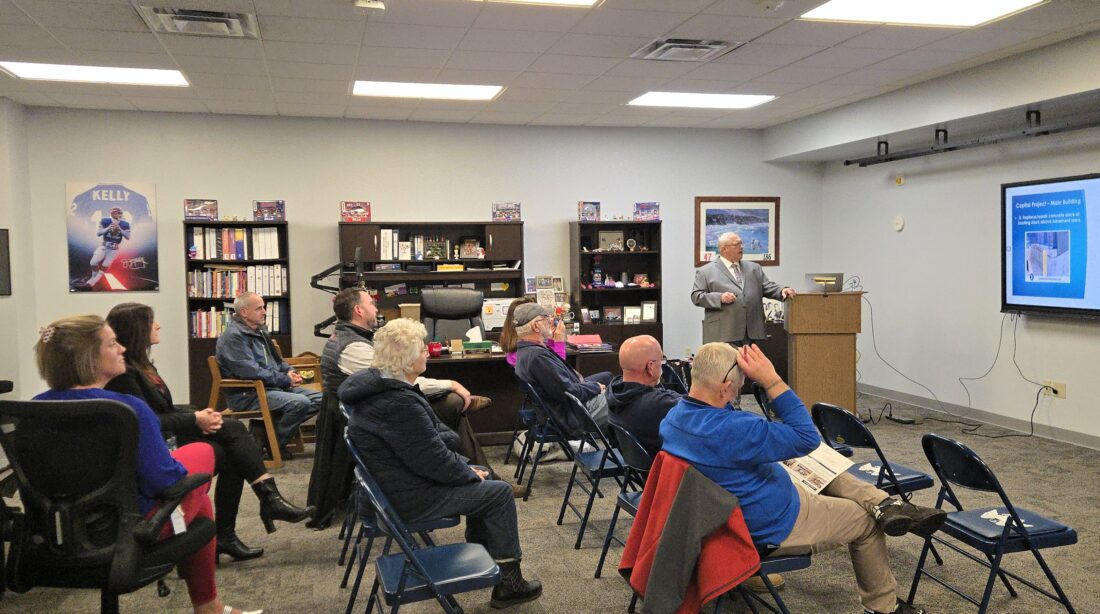
Photo by David Prenatt Ripley Central School Superintendent William Caldwell explains the details of a proposed Capital Improvement project to area residents at a public hearing.
RIPLEY — Following a community presentation last week, residents of the smallest school district in Chautauqua County will decide Wednesday on a proposed $10,196,736 capital project, which is a tax neutral project.
The vote is scheduled from 2 to 8 p.m. in the Ripley Central School District large gymnasium. Six members of the community attended the presentation, which provided “detailed information about the project, including project scope and funding details.” Community members were also given the opportunity to ask questions before the vote.
Total project cost is more than the annual cost to run the district when compared to previous school budgets.
District Superintendent William Caldwell explained the scope of the project.
“Through the State-mandated Building Condition Survey process, we have identified high-priority needs to address educational program spaces, health and safety requirements, asset preservation, and infrastructure improvements,” he said.
Caldwell described the areas that will be improved as part of the project. The project will include the renovation of eight classrooms in the Bentley (primary) Wing, renovation of the Health Office, reconstruction of the loading dock, as well as boiler, roofing and window replacements, he said.
Also slated are improvements to the bus garage. Most of these upgrades involve the infrastructure of the garage in order to prepare it for the probability of purchasing zero emission buses in the future.
Caldwell stressed that while the state has mandated all school districts to begin purchasing zero emission buses, there are no concrete plans yet to do so. “I want to emphasize that there is no purchase of electric buses planned as part of this project,” he said. “We want to be prepared for whatever is coming down the line.”
Because of the small size of the district, no new transformers are required to upgrade the bus garage. Some districts have to purchase new transformers, which involves considerable expense, he added.
Caldwell stressed this Capital Project is being proposed with no impact on taxpayers. “It was a priority of the Board and our leadership team to be mindful of the financial impact of a new capital project on our Ripley community,” he said. “As a result, through dutiful financial planning and optimization of State Building Aid and other available funding sources, we are able to propose the 2026 Capital Project with no additional increase to taxpayers.”
He explained the project will be funded by State Building Aid in the amount of $8,011,736, which will include EXCEL (Expanding Our Children’s Education and Learning) Aid from the New York State Education Department.
The remaining $2,185,000 will come from the Capital Improvements Reserve Fund ($621,241), the Transportation Reserve Fund ($400,00), and the General Reserve, which will cover $1,163,759, Caldwell said. “That results in a remaining local share of (no dollars),” he added. “We’re not going to ask you to support any part of this project with new taxes.”
Some of those who attended asked if tapping the general fund could put the district in a bad position in the future. District Business Manager Laura Napoli explained the general fund includes the transportation reserve and a capital reserve, and an unassigned reserve of $2.3 million. “We are basically using not quite half of that to do this project,” she said.
Caldwell noted the cumulative general fund balance, after the project, should be $3.2 million. “To answer your question, we should be in good shape after the project,” he said.
One resident asked if the project is voted down, will the district do the renovations piecemeal. Caldwell answered, “The items in the project are all necessary improvements, which would mean they would have to be completed eventually, but not all at once and without any state aid. We would have to prioritize based on necessity and cost, which will also deplete our reserves by an amount much greater than what we are proposing to fund in the proposed project.”