Window profile offers glimpse of 19th century high life
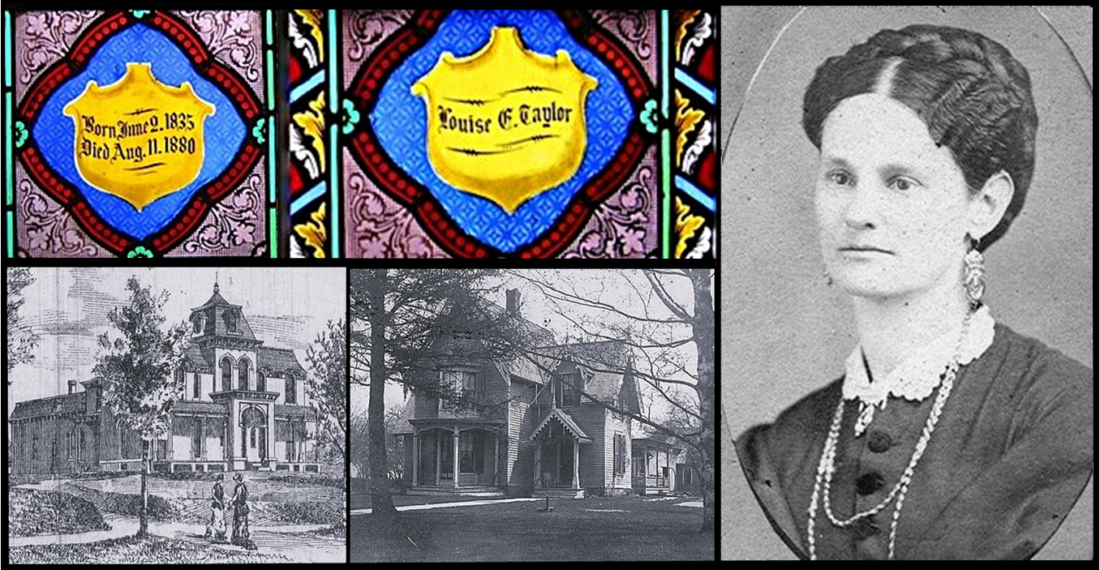
Clockwise from upper left: details from Louisa’s window, Louisa, one of her homes on Central, her home on East Main.
Editor’s note: This concludes a three-part series. Images are courtesy of Jack Woodbury, the Barker Museum, and the early Fredonia Baptist records. Many of those documents reside in the SUNY Fredonia Archives and Special Collections, and are transcribed and posted with Chautauqua GenWeb.
Like their predecessors in Parts 1 and 2 of this series, Louisa (Louise, Louesa, “Hattie”) E. Thomas Taylor (1834-1880) is honored in the exquisite stained-glass of the historic building which formerly housed the Fredonia Baptist Church.
Her lifespan, as with that of Euretta Pettit’s on the opposite wall, is slightly incorrect in the glass. Louisa’s window was donated by her husband, the industrialist and oil entrepreneur Hascal L. Taylor (1830-1894). The window was one of four such memorials announced on 6 July 1881 in the Fredonia Censor newspaper.
Louisa’s sisters in the other windows had been among the economically comfortable families of Fredonia, but Louisa’s financial situation was in a class above. Hascal’s carriage factory and its related enterprises filled an entire block at the intersection of Church Street and Center Street.
In addition to Hascal’s oil investments were his interests in banks and railways. Hascal would later commission Buffalo’s famous landmark, the Guaranty Building, widely known today for its stunning architecture.
In Fredonia, the Taylors built three homes. Two Gothic Revivals at 229 and 231 Central Ave. still exist, one of them having been converted by others into an Elizabethan style in the early 1900s. The third home, at today’s 145 E. Main St., most recently served as the rectory for St. Joseph’s Church.
Louisa’s husband Hascal is not listed as a member of the Baptist church. However, Louisa and her three children are listed, and their photographs appeared in the 1868 album of church members.
Of the 50 women and girls in that album, Louisa stands out for her abundance of jewelry. Two of Louisa’s elaborate silk dresses are now located in the Darwin R. Barker Museum in Fredonia, where visitors generally agree that Louisa’s dress size would be less than zero by today’s labeling system.
Unlike her sisters in the windows, Louisa does not seem to have suffered the loss of any children during her lifetime. However, in the early 1870s, she may have faced a scandal involving her teen son.
According to the local grapevine, as recorded in the diary of the Baptist’s church organist, Louisa’s popular son had fathered a child. The baby’s mother was said to be “Dutch,” regional shorthand for a person from Deutschland, and possibly a servant.
However, the county genealogical society has found no such infant in the county’s welfare record for “illegitimate” children, a document that was commonly called “the bastard list.”
Whether the birth was just a rumor or an actual event, the circumstances would have been an ordeal for Louisa. She died a few years later, only in her 40s. Her memorial was among a total of eight, 2-story, stained-glass windows for the 1852 structure, which replaced the 1822 wood-frame church.
TOP STORIES
Window profile offers glimpse of 19th century high life
Clerk of the year named
Top intermediate students listed
Bulk of city ARPA went to payroll
Officials address ‘set back’ for grape farmers
Earlier this week, Refresco announced through letters to grape farmers that they hold contracts with, that they are ...