State action sought on growing county homeless issue
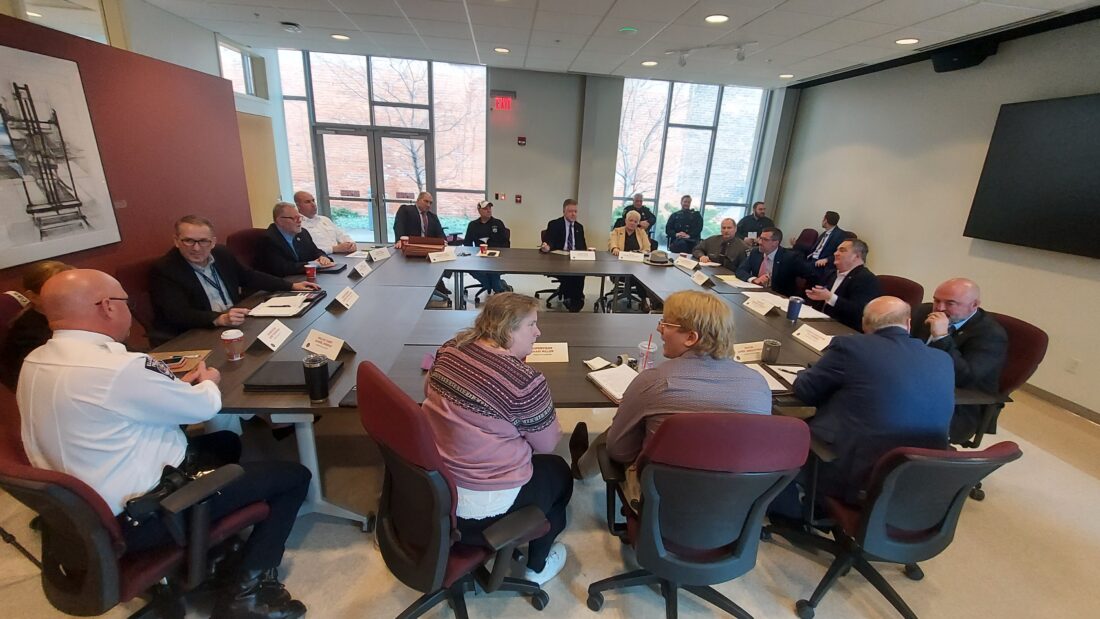
OBSERVER Photo by M.J. Stafford Local officials attend a panel Friday in Dunkirk concerning the housing of homeless people in hotels.
JAMESTOWN – State and area leaders are calling on New York state to act and assist in the growing homeless crisis in Chautauqua County.
On Thursday, state Sen. George Borrello and Assemblyman Andrew Molitor, joined by a bipartisan coalition of local and state officials across the county, have sent a letter to Gov. Kathy Hochul calling for a fundamental shift in how New York addresses emergency housing for homeless individuals, particularly in upstate communities that lack the shelter infrastructure found in larger cities.
The letter urges the state to repurpose closed or underutilized correctional facilities into structured emergency shelter and supportive housing, arguing that the growing reliance on hotels and motels is failing both vulnerable individuals and local communities.
At a recent roundtable of Chautauqua County state and local officials, leaders discussed the county’s growing homelessness crisis and the downstream impacts on communities. With homelessness more than doubling in the county in recent years and shelter capacity remaining limited, more individuals have been placed in hotels as a stopgap measure. Local officials said that approach has created serious public safety concerns, including hundreds of police and fire calls and incidents affecting nearby schools and neighborhoods.
Officials also noted that hotel placements lack the on-site services and structured support typically available in dedicated shelters, leaving vulnerable individuals without the resources they need to stabilize and move forward.
The problem goes beyond Chautauqua County. According to the State Comptroller, homelessness in New York more than doubled between January 2022 and January 2024. While much of that growth was concentrated in New York City, communities across the rest of the state have also experienced sharp increases, including double- and triple-digit growth in some regions.
“This is not just a big city issue; it is a statewide crisis that is hitting upstate communities especially hard,” said Borrello. “Unlike New York City, most upstate regions do not have a large, established shelter network, leaving local governments with few options beyond temporary placements that are not designed to meet long-term needs.”
Borrello noted that there are successful models in New York and other states that demonstrate a more effective approach.
“We do not have to reinvent the wheel,” he said. “There are proven models showing how former correctional facilities can be repurposed into structured housing with support services that help people regain stability and move toward independence.”
Building on that point, Molitor said New York already has the infrastructure to pursue a more effective solution.
“If we are serious about improving outcomes, we need to move away from temporary fixes and toward facilities that can provide supervision, stability, and access to services in one place,” Molitor said. “New York already has properties that are far better suited to that purpose, and the state should begin using them.”
Regionally, the legislators pointed to facilities such as the Lakeview Correctional annex, Gowanda Correctional Facility, and Collins Correctional Facility as potential sites for conversion into transitional housing with on-site services and oversight.
“This is a statewide problem that requires a statewide solution,” Borrello said. “Upstate communities cannot continue to manage and pay for this on their own. We need the state to step up and implement a system that is safer, more effective, and sustainable for the long term.”
A letter signed by Chautauqua County Executive PJ Wendel, Sheriff Jim Quattrone, area mayors, school superintendents, area police and town supervisors was forwarded to the governor’s office.