
Decree cites finances, population for St. Anthony’s closure
Trending
The bishop of Buffalo's Catholic diocese recently alleged that St. Anthony's Parish of Fredonia had overdrawn bank accounts totaling $5,050 when it merged with Holy Trinity Parish in February.
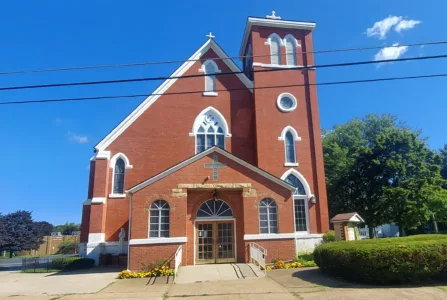
Bishop Michael Fisher made the statement as part of an Aug. 3 decree "reducing the church of St. Anthony, Fredonia and its associated property to profane but not sordid use." In other words, he closed the church, effective Aug. 31.
"Profane but not sordid use" is a concept of Roman Catholic Church canon law. It means a church building is closed for worship and returned to secular, everyday life (“profane”), but cannot be used for anything immoral, scandalous, or disrespectful ("sordid"). "Profane," a word that is rooted in the Latin for "outside the temple," refers in this case to any activity outside the scope of holy worship.
Fisher's four-page decree began with a brief history of the church, including its construction in 1906 and a devastating 1952 fire that necessitated a complete reconstruction.
Fisher noted that St. Anthony's was merged into Dunkirk's Holy Trinity in February. He wrote that the Buffalo diocese and the Rev. Robert Owczarczak, Holy Trinity's pastor, "have been tracking the cost associated with maintaining St. Anthony Church. The Dunkirk-Fredonia area is not known for being a center of wealth in the diocese and the number of churches which are currently operated by Holy Trinity Parish number four in total."
The bishop went on to cite canon law in arguing there is "grave cause" to close St. Anthony's. He mused about a "large migration" out of Dunkirk and Fredonia "which has left the population greatly reduced."
Fisher also pointed out that Holy Trinity is less than 4 kilometers from St. Anthony's and another church, St. Mary (formerly St. Elizabeth Ann Seton), is less than 7 kilometers away. (Fisher's use of kilometers is an inadvertent reminder that he is tied to an organization headquartered in Europe -- the Vatican.)
The bishop continued that St. Anthony's bank accounts were overdrawn upon the parish's merger with Holy Trinity. "Thus, the financial burden of operational costs for the church fell entirely on Holy Trinity parish with only liabilities and debts to transfer. It was not my intention to close this church immediately but, now that several months have elapsed, it is clear that the financial burden on Holy Trinity can no longer go unaddressed.”
Fisher said his "Vicar for Renewal" met with "a group of interested parishioners" at St. Anthony on June 9. The vicar told them contributions were not sufficient to cover the costs of operating the church. For example, according to Fisher, "The average weekly collection from St. Anthony church is $3,000 while it costs Holy Trinity parish $3,925 to operate this site on a weekly basis."
Fisher continued, "After a time, parish leadership spoke to the pastor and decided it was time to cease operations so as not to further stress the finances of the larger parish."