
Difficult starts can end with promising results
Trending
Don't give up. Parents of children on the Autistic Spectrum need an extra dose of perseverance. Truly, how many places are there where your child can just be themselves without judgment, where they can learn to regulate their behavior in a public setting?
We have many riders with autism. Programs are designed to target different needs, but all of them revolve around horses and nature.
Now in our fourth week of the E.A.S.E. program (a six-week program with parental respite at its core), one rider, an eight-year-old girl on the autistic spectrum experienced a change.
The first three weeks had been difficult. Each session had included periods of intense anxiety and screaming. (It is disheartening for a parent to watch a child struggle with things that should be fun and engaging).
Our horses, however, are accustomed to working around a wide range of human behaviors. They don’t judge, and if they don't feel threatened, they simply wait, listen and respond intuitively.
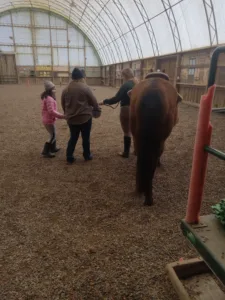
On week four, with the parent’s permission, Tyler, the instructor, carefully picked the girl up and placed her on the horse. The horse leader immediately gave the cue to walk on, while side-walkers positioned themselves on either side of the rider.
Too quick for increased anxiety to register, as the horse began to move, she became very quiet--not necessarily because the anxiety had magically disappeared, but because she was suddenly having to process an entirely new experience. There was movement underneath her. There were people beside her. There was the horse’s rhythm, the sounds of the barn and the sensation of moving forward. And then she smiled.
The lesson continued with starts and stops. She was introduced to the idea that she could help make the horse move by saying "walk-on" or touching the horse’s mane. Because she is mostly nonverbal, hand-over-hand guidance was needed initially, but voice commands were still taught. Sometimes first words are "walk-on".
With repeated stops, and delayed hand-over-hand assistance, she reached out and touched the horse’s mane herself.
That is often how progress begins--not with a dramatic breakthrough, but with one small moment of independence, while feeling safe.
For many autistic people, sensory experiences can be unusually intense, unpredictable or difficult to process. Some individuals may seek particular sensations, while avoiding others. And sometimes a person may appear to be seeking sensory input without being able to communicate or even know exactly what they want or need.
I first encountered the concept of what was then commonly called a "sensory diet" at a conference on autism in the early 1990s.
The term had nothing to do with food.
Instead, occupational therapists used it to describe individualized sensory activities designed to help a person regulate and participate in daily activities. These might include deep pressure, swinging, rocking, jumping, movement, changes in light, tactile experiences and many other forms of sensory input.
Some experiences were calming. Others were alerting or stimulating.
The challenge was -- and remains -- figuring out what works for the individual, when to provide it and how much is appropriate.
If you watch children carefully, you can sometimes see them attempting to solve that problem for themselves. They might rock, spin, jump, press against something, seek movement or repeat a particular activity. Their behavior communicates something, even when they can't put that need into words.
When I discovered therapeutic horseback riding, I began to see the horse as something more than a partner in an activity. The horse provides movement, and movement provides information to the body and is the foundation for learning.
A rider sitting on a walking horse is constantly adjusting to the horse’s changing position. The rider’s muscles and balance systems are responding to acceleration, deceleration, direction changes and the horse’s rhythmic movement. At the same time, the rider is receiving visual, auditory, tactile, proprioceptive and vestibular information simultaneously and in a way the brain can make sense of it all, process it, and begin to integrate it. The rest and relax nervous system finally has a chance to overtake the fight and flight nervous system.
There is also the interaction with another living being, an immediate cause and effect, action and reaction, instant gratification and learning experience.
In other words, a riding session is a remarkably rich collection of sensory and motor experiences provided in a manner that starts with passive processing and shifting into active regulation, organization, and purposeful motor output.
The girl in our program was beginning to focus on the present rather than the anxiety of the unknown. That distinction is enormous.
The goal is to help that child become more comfortable, more engaged and more able to participate in the world on her own terms.
For a parent who has watched weeks of anxiety, that small gesture of independently touching the horse's mane while riding the horse is real respite- working today with the hope for a better tomorrow.
To learn more about programs at Centaur Stride, visit our website at www.centaurstride.org.
Claudia Monroe is president and founder of Centaur Stride.