
Petition process begins, first merger town hall held
Trending
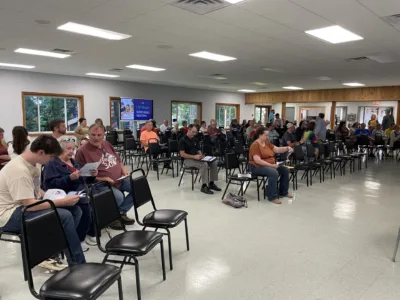
SHERMAN -- The first in a series of three town halls has been held for the potential merger between Clymer, Sherman and Panama Central Schools, and with that town hall also comes the official opening of the petition to gauge community support.
The town hall was held at the Sherman Fire Hall on Tuesday night, beginning with recognition of the board members from all three schools, and a reminder of what has happened in the process so far, dating back to May 2025 with the exit poll question that was included during the school budget votes, where all three communities voted in favor of the merger study process. More recently, the study was finished and presented to the boards and communities in June, with each board agreeing to move forward in July, taking the process to the town halls and petition. The next town hall will be in Panama at the school on Sept. 16 at 7 p.m., with a building tour beforehand at 6 p.m., and Clymer's town hall is set for Sept. 24 at 7 p.m.
PETITION PROCESS
The petition officially opened with Sherman's town hall Tuesday, and the petition period runs until October 1. If enough signatures are gathered in each community, the process continues onto the final, binding, statutory vote in early December. The petition is non-binding, and is the next step to gauge community support, and each district is required to get a different amount of signatures, based on the average of the last three years of voters at the school budget votes, plus one. Clymer needs to get 161 signatures, Sherman needs 301 signatures, and Panama needs 154 signatures. Each district also has several volunteers that will be going around the community to help gather signatures.
The town hall also began with a recap of some key points and recommendations of the merger feasibility study, including declining enrollment in all three districts, the ability to continue current courses and extracurriculars and offer more, Clymer and Sherman could keep their elementary students at their current facilities, with seven through 12th grade going to Panama, considering staggered start times and adding no more than 10 minutes to any current bus route, retaining all faculty and support staff while also considering a retirement incentive down the road, the reorganized district being eligible for incentive aid of $71,478,395 for 14 years, and maintaining each district's school culture and traditions.
During the question times, the first question raised was on the number of signatures for the petition for each district, which CSP Merger Study Project Coordinator Shelly O'Boyle explained, and noted that all of the districts are aware that the amount that Sherman needs to get is higher than the others, as Sherman had a good number of voters that came out to vote on the capital project.
"The other two districts were very aware of that when they decided which way to go, and they decided the petition would be the best way to be able to give the communities as much information as possible to make an educated decision to get to that statutory vote," O'Boyle said.
It was noted by an attendee that compared to the feasibility study done in 2017 when Clymer and Panama were considering merging, and a previous time before that, this current feasibility study was done much better.
Another question was raised as to what happens if one district does not get enough signatures, or votes if the statutory vote happens.
"If one of the three districts doesn't come up with the petitions and if all three petitions go forward and we make it to the statutory vote, what happens if one of the districts doesn't vote it forward," BOCES Superintendent, David O'Rourke said. "We've developed some timeline concepts with the department on how two districts could continue."
A revision of the study would be required, including a quick revision of the financials to change it to the two remaining districts, and the two districts would need to again show interest from the communities through a petition and then have another statutory vote. As each district tries to get the number of signatures needed, it was also cautioned that when considering two districts moving forward without the third that there would be difficulties and while the two would still try to help out the third, it might not work out that way. It was noted that that needs to be something considered going forward with the petition, that not having all three get the number of signatures would make things more difficult.
AID QUESTIONS
Many questions raised at the town hall focused on finances. This includes an explanation of hold harmless, which is a formula from the state for state aid that all three districts fall under. Dan White from White and Partners, the consultants who did the feasibility study, explained that each of the three districts are seeing the decline in enrollment and state aid converging. The amount of state aid that a school district qualifies technically decreases with enrollment, he said, but the state's hold harmless says state aid for each district will not decrease. Therefore, he said, each district is getting more state aid that the formula says they should. This also means a hold harmless school receives the minimum amount of state aid in the state budget each year, and is something that White said affects 60% of all districts in the state right now. It was also noted that the state is looking to claw back some of the current state aid as well.
Other financial questions and aspects noted throughout the meeting included that the districts' foundation aid will remain the same with the current formula, but the incentive aid is additional for the first 14 years, and it slowly tapers off as the years go by. It was also noted that during the 2017 merger process, incentive aid was $16 million. The incentive aid does have the possibility to change again in the future, and could be less if the districts do not merge now but decide to try again in the future.
WHAT HAPPENS IF THE MERGER FAILS
Another question that was asked is what will happen if the merger does not happen and the process does not continue.
"I think it's important to keep in mind that change is going to happen," Sherman School Board President Teresa Guzman said. "We know that. We're looking forward and trying to figure out ways to manage that change. We're not here to fearmonger and say 'we're going to fall off a cliff tomorrow', that's not going to happen. Everyone has been very careful working through their budgets. But, we are responsible to forecast and look into the future and try to figure out how to best manage that."
Guzman added the report shows about a $2 million gap in expenditures and revenues for all three districts in about five years. She said there is a choice right now to move into the future with strength or to allow themselves to become weakened by the situation. The merger allows the districts to become more financially stable with the $71 million incentive aid, offer students more opportunities, and to not have to reduce staff, she added, also noting the incentive aid calculation changed two years ago. Guzman said the state is working to incentivize merging and other options are not great as they look to do what is best for the community.
"It's because we're looking forward and seeing some of these things that could happen in the future that brought us together, it wasn't just so we could have about 50 more meetings a year," Guzman said. "It's because we think this is important for all of us and all of our communities in Sherman, Panama and Clymer."
OTHER QUESTIONS
Other questions expressed concerns about staffing, and it was emphasized that at the beginning of the merger all teachers and support staff will be retained and natural attrition is expected over time as teachers and staff retire. Some positions may also be repurposed into a different role, with an example given that a business official from one district could potentially move into something like an HR role. Teacher contracts and agreements would be renegotiated as well.
What would happen with current C/S/P athletics if the merger was not successful was also asked, with the answer being that is a question to be decided by Section 6 and something different and separate from the merger.
Why Panama was chosen as the place recommended to be the high school was also asked and it was explained that it has the greatest capacity to hold a larger number of students, though other options such as renovations or building a new building may be considered down the road. This would be something decided through the district's new school board, made up of five, seven or nine people. Merging into one pre- kindergarten through 12th grade school is also a potential option down the road, and though it would be a board decision nothing would ever be done without community input.
Other questions and areas of concern brought up were the ability to recruit new bus drivers -- which was said that a larger district would have more of an advantage in that area, being bigger. Another question focused on class sizes in a combined district.
It is estimated that a combined district would have just over 1,000 students overall, kindergarten through 12th grade. Individual class sizes would vary, but have about 75 to 90 students per class. It was noted that those numbers are not much bigger than class sizes were around the 1980s.
Areas such as the free meals program that all three schools offer would continue as well, as long as it remains supported by the state and federal government.
When questions from attendees wrapped up, O'Boyle thanked everyone for their patience and for being respectful at this meeting, reminding them the next town hall is September 16 at Panama.
"The leadership committee has spent countless hours trying to put the best interest of their districts, their taxpayers, their students, keeping that in mind," O'Boyle said. "We know that a merger is something that is probably going to be inevitable for many of the districts throughout New York State, and we know that it is emotional. But, we do feel that together we can be stronger."
More information on the CSP merger including the study and who the petition circulators are for each district can be found at CSPhub.org. Questions can continue to be sent to CSPstudy@e2ccb.org as well as asked during the next town hall meetings.