
Trending
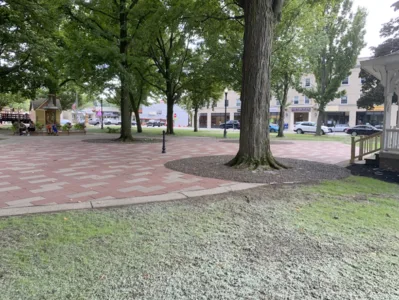
I have decided to offer a short history of Barker Commons.
ORIGINAL GRANT
Originally the land in the center of the village, known as Barker Commons, was owned by Hezekiah Barker and his wife, Sarah Barker.
On April 18, 1825, the Barkers deeded the land that is now Barker Commons to Zattu Cushing, Leverett Barker, William Barker, Mosley W. Abel and Oliver Barnes. The land consisted of an undivided single 5¾ acre parcel of land (no street was running through the center of the Park at that time).
The 1825 deed from the Barkers to the individuals above mentioned recited that the land was deeded to the Town of Pomfret on condition that the land was to be held by them in trust for the inhabitants of the said Town of Pomfret as a Public Square or Common.
By resolution adopted on Feb. 18, 1879, the Town of Pomfret placed custody of Barker Common in the Mayor and Board of Trustees of the Village of Fredonia. Since that time the Village has maintained Barker Commons.
LAWSUIT TO CLOSE THE DIVIDING STREET
There was a very contentious lawsuit over Barker Common in 1901. The law suit was commenced by Dwight Dutton, William B Archibold, John Miller and Samuel C. Coddington against Mayor of the Village, John A. Warren (then called President), and the Board of Trustees of the Village. The purpose of the lawsuit against the Village was to obtain an injunction against the Village from closing the driveway (now Temple Street) dividing the twin parks. The Village Mayor and Board of Trustees wanted to close the dividing street and return the Park to its original condition as a single 5 & 3/4 acre lot with no street dividing the park.
Originally, Barker Commons was one single 5 3/4-acre parcel of land. There was no driveway or street dividing the Common.
The affidavit by the Village opposing the citizens law suit against the Village to close the driveway or street which divided the Commons asserted that the Village's decision was "not made in secret."
The Village also asserted in its opposing affidavit that the Village's decision to close the street was taken at a "regular board meetings publicly held" and that "the public was not denied the right of admission to said meetings."
The affidavit by the Village opposing the citizens demand that street remain also alleged that "at all times where the matter was under discussion or consideration anyone or every one could have the privilege of addressing the Board upon such subject."
The defense by the Village also alleged, under oath, that the action of the Village Board of Trustees to close the street was not done in secret and that the "resolutions and actions of the Board have been published in the official newspaper of the Village of Fredonia, that the name of said paper was the "Fredonia Censor."
The outcome of the lawsuit was a dismissal of the citizens demand to keep the street dividing the two parks. The Village had won the law suit to return the Park to one parcel as it was originally and to not have a street running thru the Common. The Village then removed the center road and planted flowers where the road was located. This was completed in June of 1901.
However, that was not the end of the matter. An election was upcoming and the Village citizens by exercising their right to vote, elected a Mayor and Board of Trustees who favored keeping the street dividing the Common as it is presently. In the election in March of 1902 there was an overwhelming vote for the Mayor and Trustees who favored keeping the street (Temple Street) dividing the Common as now exists. The street remains.
COMMON OR COMMONS?
The question of how to refer to the park. Should it be referred to as Barker Common or Barker Commons. I believe this question is answered as follows: When the park was one parcel it was called Barker Common. When it was divided by the street into two parks it was then referred to, as it is now, as Barker Commons.
Source of Information in this letter was from the affidavits submitted by the Village in defending against the Fredonia citizens' legal proceedings seeking an injunction to prohibit the removal of the street, the 1825 deed from Hezekiah and Sarah Barker conveying Barker Commons to the individuals named in the deed with the trust provision for them to hold the land as a public park for the Town of Pomfret, the 1879 resolution of the Town of Pomfret Board giving custody of the Park to the Village of Fredonia and a history written by Elizabeth Crocker, lifelong Village resident, who was also Chautauqua County and Village historian.
Sam Drayo Jr. previously served as Fredonia village attorney.