
Before saddling up, there’s work to be done
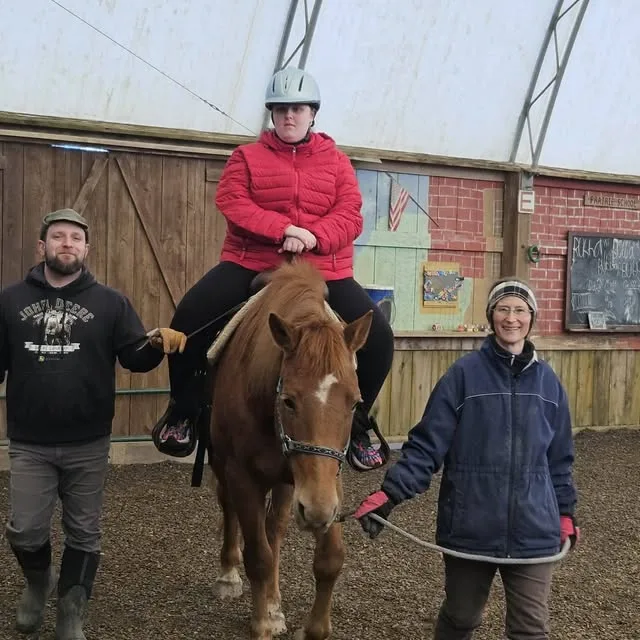
Jean Lozier leading a horse when not enough volunteers.
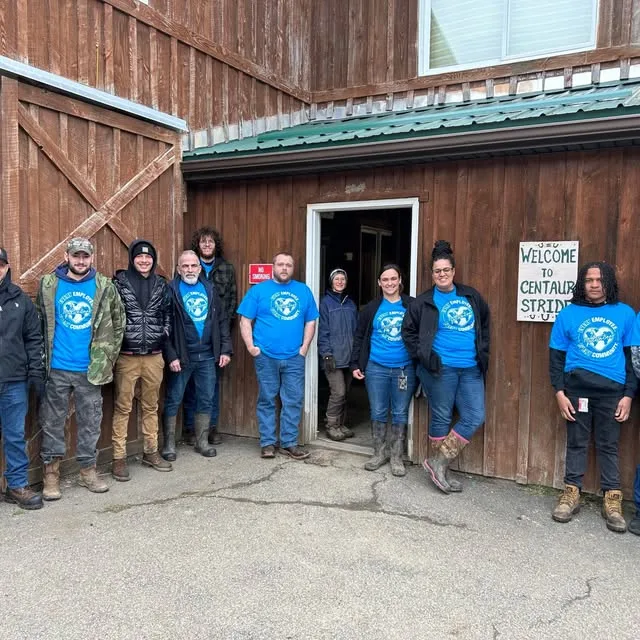
Jean Lozier, at center of doorway, organizing a volunteer work day for employees from Cummins Engine in Jamestown
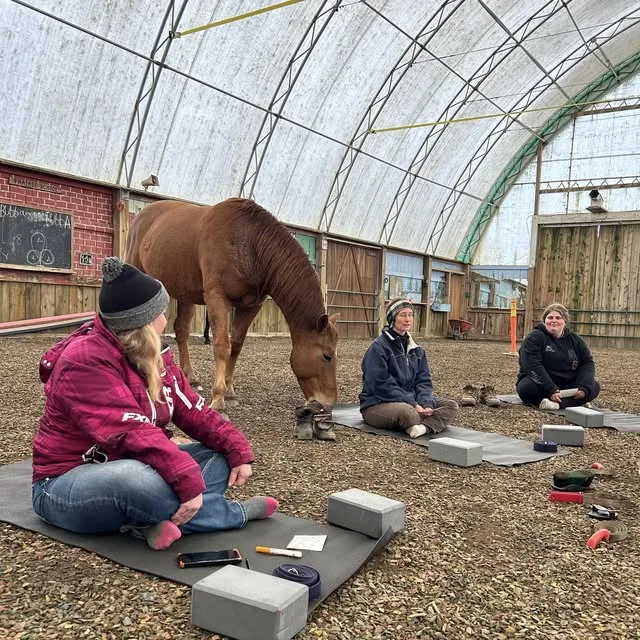
Who do the horses migrate to first when free to do so? They know Jean Lozier and wonder why she is sitting down?
Jean Lozier leading a horse when not enough volunteers.
Jean Lozier, at center of doorway, organizing a volunteer work day for employees from Cummins Engine in Jamestown
Who do the horses migrate to first when free to do so? They know Jean Lozier and wonder why she is sitting down?
Trending
By the time a rider climbs into the saddle at Centaur Stride, dozens of people, countless hours of work, and a whole lot of hay have already made that moment possible.
Have you ever thought about getting a horse? Maybe you’ve even dreamed about starting a therapeutic riding center. It is easy to understand why. Horses have an extraordinary ability to connect with people, and the benefits of being around them can be profound.
But what isn’t always visible from the saddle is everything that happens behind the scenes.
At Centaur Stride, a therapeutic riding center in Westfield, the foundation of everything we do is the safety, health and well-being of both horses and riders. Making that happen requires knowledge, planning, time, money, dedication--and a remarkable team of people.
For more than 20 years, Jean Lozier has been at the heart of that effort as our barn manager. Her job encompasses the daily care of the horses, training, barn chores and countless responsibilities that don’t necessarily make it onto a lesson schedule. It is demanding work, seven days a week, in every season.
And feeding the horses is only the beginning.
A Horse’s Day Doesn’t Take a Day Off
Horses need more than food and water. They need movement, companionship and the opportunity to simply be horses.
Turnout is an important part of their health and wellness. Horses are herd animals, and being able to interact physically with one another--touching, playing and socializing--is vital to their well-being. At Centaur Stride, our eight pastures allow us to rotate horses and separate groups when necessary.
But pastures require work, too. Fences must be inspected regularly to make sure horses remain safely where they belong. We were fortunate to receive a grant from Electrobraid Fence Company years ago that helped provide our fencing system. Even the best fence, however, occasionally needs repair.
Then comes winter.
Snow may make a beautiful landscape, but it can create another set of challenges for a working barn. Horses still need turnout, even when snow makes getting them safely outside more difficult. Sometimes that means shoveling paths and entrances. We have a snowblower for the driveway and parking area, but the horses still need to be cared for twice every day--whether lessons are happening or not.
And Then There Is Hay
There is a running joke in the horse world: If you don’t have enough hay, you have a problem.
Hay is one of the biggest necessities--and expenses--of maintaining a herd. Every year, we calculate how much will be needed, arrange for delivery and find a dry place to store it. And somehow, the hay always seems to arrive on the hottest days of summer.
For those who do the work, hay day can be exhausting and, admittedly, one of the least anticipated days of the year. But it is essential. Without a reliable supply of hay, there is no therapeutic riding program.
A few years ago, a grant from the Chautauqua Region Community Foundation allowed us to expand our hayloft to hold another 600 bales. That investment not only gave us much-needed storage space--it helped make it possible to increase the size of our herd.
And a larger herd matters.
Every Horse Has a Job
There is no single “perfect” therapeutic riding horse.
Our riders have different physical, emotional and developmental needs, and horses must be carefully matched to the people who ride them. That means having a variety of horses with different personalities, sizes, gaits and abilities.
Before a horse can become part of the program, there is also training to prepare them for therapeutic riding. That process alone could fill another article.
Then there is the routine healthcare that keeps them ready to do their jobs: farrier visits for hoof care, dental care, veterinary examinations, vaccinations, emergency care and ongoing monitoring of their health.
Grooming is another daily responsibility, unless riders or volunteers are helping with it. Baths happen occasionally, although the horses often seem to have their own ideas about staying clean.
Some appear especially fond of rolling in mud immediately after a rainstorm. Perhaps they know that the muddier they become, the more certain they are of receiving a long, satisfying grooming session afterward.
The Work Beyond the Horses
Keeping Centaur Stride running involves much more than caring for the herd.
There are arenas to maintain, tack and equipment to clean and repair, trails to care for, buildings to maintain and supplies to manage. Riders and volunteers must be scheduled. Lessons and group activities must be planned. There is paperwork, communication and coordination.
Behind all of that is the administration: staff management, program development, financial management, fundraising, advertising, social media and the constant effort to make sure the organization is meeting its goals.
Every one of those responsibilities could be its own story.
And then there are the volunteers.
The People Who Make It Possible
Volunteers are essential to Centaur Stride. Their willingness to give their time helps keep our costs manageable and our programs affordable to more people.
Not every volunteer assignment is glamorous.
Some involve grooming a horse. Some involve helping a rider. Some involve organizing an event. And, yes, some involve cleaning stalls.
It can be surprisingly difficult to recruit someone who is enthusiastic about spending part of their day shoveling manure.
To those who do it anyway: thank you. Wear old shoes.
Every task matters.
Every volunteer matters.
Every donation matters.
The Real Reward
The rewards of this work aren’t measured in dollars.
They are measured in smiles.
They are found in the moment a rider discovers a new ability, gains confidence, relaxes into the rhythm of a horse or simply experiences joy. They are in the burdens that seem a little lighter after time spent at the barn.
There are also the natural benefits of simply being around horses. Research into equine-assisted activities and therapies has shown that interaction with horses can influence human physiological responses, including breathing, heart rate and blood pressure. The relationship between horse and human can create a sense of connection and calm that is difficult to replicate elsewhere.
That is why what happens at Centaur Stride matters.
What may look like a riding lesson from the outside is actually the final piece of a much larger picture--one involving horses, riders, instructors, barn staff, volunteers, donors and an entire community working together.
So, yes, there should be a horse barn on every corner, just like the old neighborhood corner stores.
If you can’t own a horse, perhaps you can spend a little time with one. Volunteer. Donate. Attend a fundraiser. Support a therapeutic riding program. Or simply learn more about what these organizations provide to their communities.
At Centaur Stride, none of this happens alone.
To Jean Lozier, our dedicated barn manager of more than two decades; to our staff and instructors; to the volunteers who show up and do whatever needs to be done; to the donors and community organizations that have invested in our future; and to every rider and family who has trusted us--we are deeply grateful.
You are the reason the work continues. And we couldn’t do it without you.
Learn more about Centaur Stride at www.centaurstride.org.
Donations may be sent to: Centaur Stride, Inc., P.O. Box 174, Westfield, NY 14787.
Claudia Monroe is founder and president of Centaur Stride.