
District Attorney grilled on Fredonia Flock cameras
Trending
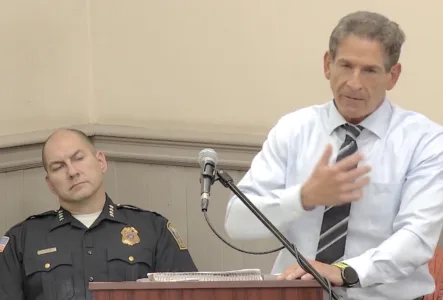
Chautauqua County District Attorney Jason Schmidt vigorously defended his office's use of Flock Safety cameras in Fredonia. The village residents who jammed the Fredonia Board of Trustees room to hear him speak Monday were not impressed.
Schmidt said the cameras help catch criminals and their data is safely, securely stored. Fredonians retorted that the data might not be as secure as he thinks.
Schmidt started his presentation, held at the beginning of a lengthy village Board of Trustees meeting, by noting he is a Fredonia resident. He compared it to Mayberry in the "Andy Griffith Show" when he moved there in 2003.
He called it "a place where you could keep cars unlocked. Each citizen looked out for the other." However, he said that in 2026, "ask any Fredonia residents, are you still leaving your doors unlocked and the keys in your cars? The unfortunate truth is, times have changed in the 23 ½ years that I've lived here now."
Statistics publicly available on the state website data.ny.gov, in an index of crimes reported by New York's police agencies since 1990, offer room to question Schmidt's assertion that "times have changed."
They show that in 2003, there were 293 crimes reported in the village, not counting the SUNY Fredonia campus which has its own police department. "Crimes," in this data set, include murder, rape, robbery, aggravated assault, burglary, larceny and motor vehicle theft.
Fredonia has seen its reported crimes top 293 just four years since then, according to the state's data set. There were 381 crimes reported in 2009, 327 crimes in 2010, 320 in 2012 and 314 in 2020.
For the latest year available, 2024, there were 163 crimes reported. In 2023, the number was 218. For 2022, it's 189.
'HOW DO WE GET FURTHER'
Schmidt went on to go over some of his work career, noting that he was elected district attorney in 2021 but has also worked as a defense attorney, Schmidt said he enjoyed being David to the government's Goliath when he was a defense attorney.
However, "I was in for a shock when I became district attorney. The pendulum had swung, where all of the money now is invested, at least from the N.Y. state standpoint, in the defense bar and our public defenders' office."
Schmidt said, "The number one problem we have is... we don't have enough money to finance proper law enforcement. One of the problems we try to resolve is, how do we get further with less money?"
He mentioned that a 2024 fatal shooting in Dunkirk is not necessarily unsolved, but remains uncharged because residents are afraid to turn over doorbell camera footage for fear of retribution.
In response to such issues with private cameras, "About a year ago, I started looking into all sorts of programs for cameras to watch public places," he said.
Schmidt initially looked at a Ring camera program, which provides them to local businesses.
"We can't get enough cameras here to solve some of these crimes, so we were looking into camera systems. That's when we became aware of Flock Safety," Schmidt said.
Using grant money, his office "determined that we were going to create a pilot program of 10 units."
"We have the ability to see, if they flee police in Fredonia -- wherever they go, if we have cameras and license plate readers deployed in the right areas, we could possibly catch them with minimal expenses to everybody," Schmidt said.
Schmidt spoke of a deterrent effect, stating criminals "don't want to be caught on film."
LIMITED ACCESS TO DATA
He said only four people have access to the Fredonia Flock data: himself, two investigators, and an IT person. Police agencies must request the data from his office.
"It's not as if you can go just willy-nilly into the system and you're cost free from it. There's oversight, at least here in our community, because there's only four of us who have access to it," Schmidt said.
Someone asked how Flock guaranteed that no one else could see the camera data. Another audience member asked what prevents Flock from selling the data, to car insurance companies for example.
"This is mass surveillance on a massive scale," he said. "None of our elected officials were told about it when this was put in. That's scary. You're not telling us the full thing."
Schmidt responded: "I started off by saying to you that there is going to be a balancing of interest here. You can shake your head -- and I guarantee if you were the victim of a crime, you would want to see that crime solved, and more than that, you would want some type of deterrent so it doesn't happen to someone else."
“Not at the cost of liberty," the man replied.
Schmidt stated that courts have ruled people have no right to privacy from cameras in public places. There was some grumbling in the meeting room.
Trustee Tim Mulholland directly asked Schmidt about the security of the camera data.
"We're relying on their policy and it's built into our contracts as well," Schmidt said. "Flock's contract with us says it can only be used for crime solving purposes, for law enforcement purposes. Are there opportunities for an abuse of power in any situation? Sure."
The district attorney went on, "I wanna push back on this idea that we are somehow impinging on rights."
He noted that Flock just shortened its video retention period from 30 to seven days.
LOCAL NETWORK VS. FLOCK
Mayor Michael Ferguson continued to downplay the use of the Flock cameras in Fredonia, reiterating that the village has its own cameras on Village Hall.
Former Trustee James Lynden spoke up that those cameras were out there in specific response to mischief in Barker Common.
"We would not have done that if the public said no. This is not that. ... Why was it done in a quiet kind of way?"
Lynden later said, "We are not all criminals. I realize you're looking out for the best of us, looking out for someone who committed a crime. But there's got to be a better way. ... We don't want to be in a police state. Yes, we highly respect the job police officers do. But this is not the kind of community we want to live in."
Schmidt said he “apologized that (the village Flock program) came out in this fashion" to the trustees. On the other hand he said it was "Difficult for me to listen to these blanket statements that this is surveillance. It's targeted." He repeated that courts have ruled there is no right to privacy on the streets.
After 70 minutes of chatter, Mayor Michael Ferguson limited the discussion to two final speakers.
Pomfret Town Board member Mike Lee said he supports law enforcement "and my concern is not for local abuses specifically... my concern is about other jurisdictions outside Western New York having access to these systems and tracking folks without our knowledge and consent."
Lee said use of a local, closed-circuit camera system would be a guarantee against abuse from afar. The town councilman backs those -- but stated that the Flock contract with Chautauqua County has no guarantee about control of local data, or that it can't be shared.
"We can look across the entire United States and audit who is looking at our footage," Schmidt replied. "We do have the ability to correct abuses of this technology. We live in a community with very limited resources. The crime has increased substantially and we are dealing with a lot of criminal incidents."
A person wondered if he can submit a Freedom of Information request about whether a Flock camera has picked up his plate. Schmidt said he didn't know if he could even access the data at all if the man is not accused of a crime, but would consult the county Law Department.
"The cameras are observing, but we haven't pulled the information from Flock Safety until an incident has occurred," Schmidt said.
Ferguson concluded the discussion. Lynden called out to village trustees that they should pass a resolution demanding that Schmidt's office turn off the cameras.